
Hispania
Hispania is Andreas Steding’s Britannia-clone. Hispania was issued by Azure Wish in 1994. I’m not sure whether Azure Wish is still in business. The website is is defunct. Hispania is long out of print, but I was able to secure my copy at Spirit Games. Alas, it had the rules in an improvable English translation which wasn’t always unambiguous. So we took careful preparations: Each of us, Loredana, Hans, Markus and I myself had their own copy of the rules booklet, we all read them beforehand and discussed issues by e-mail before we finally met to play the extended version.
And extended it was. When Hans and Markus arrived, the board was already completely set up and we started at once at 10 am. We finally finished with Loredana winning at 10 pm. There were no longer interruptions, no rule discussions, only one short pizza break. We all felt rather exhausted but happy. I do no longer have the scorings for the game (perhaps Moritz or Aaron kept note) but they were all between 7 to 10 points.
Interestingly enough, Markus and I, inveterate Britannia players as we are, scored lower than Hans and Loredana. This is basically my main point in this review. Hispania is good, yes very good indeed, but Britannia (excuse the pun) rules.
I won’t try to explain the basic mechanics of Britannia-style games. I did this elsewhere (link), and by the way, every one of us skips paragraphs which try to explain abstract gaming concepts, don’t we?
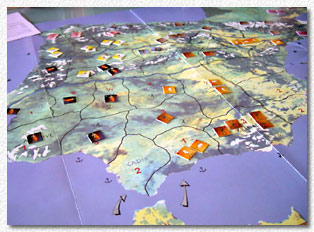
The counters of Hispania are really beautiful, being reproductions of Osprey Man-at-Arms books. Alas, players in Hispania don’t use color like in Britannia but symbols instead. Colors are in fact much superior. You can distinguish a red marker from a blue marker with one glimpse. Distinguishing a tiny symbol in the upper left is much 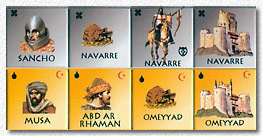 harder. Then, there are those useful words blue, red, green, purple to denote the four players in Britannia. In Hispania, there’s the teardrop player, the player with the four rhombs that form a rhomb, the player with that gizmo that somewhat resembles that cross on Portuguese Euro coins and finally the player with the 3D globe. Why couldn’t they chose colors, or at least cross, triangle, square, teardrop? Even worse: the counters of Omeyyad, most powerful people of the teardrop player, have erroneously the Portuguese-cross-like thingy printed on it. This adds more misunderstanding to an already confusing system. But since we all stayed alert, this whole symbol chaos never turned into a real problem.
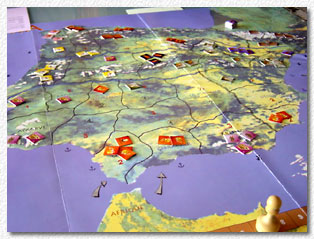 The rest of the gaming material is rather cheap, but it perfectly does the job. One of the innovations of Hispania is the use of 10 sided dice. They are needed because there are much more battle modifiers than in Britannia so 1-6 would be too short a scale. I did not like this additional complexity because it lengthens the game („Did you account for knight modifier?“ „Err, knight as attacker or defender?“). I prefer the Britannia approach which totally focuses on the objectives of each player without too much distraction by too many extra rules.
Hispania has in fact more special rules to consider. It is at the same time fun and burden to explore them. Like with any Britannia-style game, you always keep thinking „Next time, I’ll do it totally different“.
I really cannot give a fair estimate whether or not Hispania is fair for all players. As with every Britannia-style game, players think that the color (err, symbol) that won in their particular game has certain advantages (in ours, it was Loredana’s teardrops). Thanks to a long Britannia experience I wouldn’t subscribe to that. Only lots of replays can show the truth. I am only certain that there is neither a clear favor nor a handicap for any one color (err, symbol).
There is one thing I really did not like about Hispania. This is that one can exterminate peoples that are bound to transform into other, mightier peoples, thereby hamstringing a poor player considerably. Markus and I did this to Hans, and consequently he finished last.
Final verdict: Well, I repeat myself: Hispania is a very good game. If you don’t know Britannia yet, you better start with that classic because it is easier to play and slightly better. If you are already a seasoned Britannia veteran, you absolutely should try to get hold of one of the few Hispania copies still available. You’ll enjoy the game. And if you don’t insist on playing the extended version like us, you should get away with perhaps 7 hours gameplay.
Additional clarifications:
- The rules do not state the dice modifiers clearly. They offer merely dice tables. Using them seems rather cumbersome, and so Hans wrote a playing aid with the battle modifiers extracted from the tables.
- By doing this, Hans noticed two errors in the official tables. We asked Andreas Steding, and he confirmed Hans‘ finding. They are:
- – defending Knight vs. Cavalry in mountain: should be +2; in the tables it’s zero
- – defending Elite vs. Knight in mountain: should be -1; in the tables it’s -2.
We had several other questions to Andreas Steding. Some of them might be clear for someone with the German or French rules, but for other victims of the English translation let me repeat them all:
- If you have a +4 counter, you can save — even if you cannot build castles yet, or anymore. So, p. 7, „A nation with Knight or Castle units can save up to 8 points of income“ should be corrected to „A nation with a +4 counter can save…“
- When the Vandals rush through Spain, enemy „armies“ get a free attack. We wondered whether „army“ includes Roman forts — and yes, it does. Forts can cast their die.
- There is a +1 stacking bonus during invasions (so +2 counters over limit in one area). It applies as well to the first as to the second movement of an invasion, not only to the first movement.
- Byzantium has naval supremacy in turn 9 (rule book). The Byzantium card says 9 and 10, but the 10 is a typo.
- The Omayyad card says for turn 12 „For each own castle the income value of the area as points“. This is hardly understandably. Andreas gave us the German text so it’s clear now. Omayyads count victory points at the end of turn (not their turn). In every area with castle they get the income value of that area as victory points. They do not count victory points for areas with castles of subjected people.
- When Toledo is sacked, castle areas without infantry surrender. We wondered whether this applies only to the very moment of the fall of Toledo or is applies to all later combats. Correct is the latter, i.e. the condition is not only checked in the very moment of the fall of Toledo, but from then on always when Omayyads are attacking Visigothic castles. Andreas also told us that at least one Omayyad unit has to survive to enter the castle. So if Visigothic infantry and Omayyad attackers die at the same time, the castle doesn’t surrender.
- Al Cid disappears in turn 19, in the turn of Valence