(This article was originally published in “Games
International”, issue #2 and is reproduced here with the permission of Brian Walker,
the former GI editor)
KREMLIN
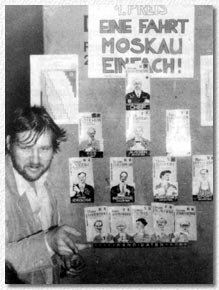 The object of Kremlin (reviewed last issue), is to
manipulate mythical politicians in the Soviet Politburo with the aim of becoming Party
Chief and waving at the October Parade in Red Square. In its first life Kremlin was
designed by Urs Hostettler (pictured above) and published by his company Fata
Morgana, in Berne, Switzerland. In this short feature, Urs describes how he got the idea
for the game, and his opinion of the newly released Avalon Hill version.
How does one go about designing a game like Kremlin? It’s a question I’ve been
asked on more then one occasion.
Well, it all started one night in March 1985, as I was watching TV at home in Berne.
Tschernenko had just waved the long goodbye a few days earlier, and already the silver
screen was awash with speculating specialists attempting to predict his successor.
Old man Gromyko was Foreign Minister at the time, and as such, was able to nominate
the new Party Chief. The hot money was on Marshal Ustinov who was just approaching the
peak of his career at 80. In the background were two young turks, Gorbachev from Moscow,
and Romanov from Leningrad. Both were in their late fifties and thus had a lot to lose
should their bid for power fail (you don’t get a second chance).
As I was listening I played around with some cards and decided to create my own
Politburo, and work out a mechanism that would respect the principles of gerontocracy
(the rule of the old), but allow a hidden strategy whereby younger members also stood a
chance of gaining power.
I worked on the game system for Kremlin for about one year. Both Sigma
File (Gibson’s), and Down With the King (Avalon Hill) were strong
influences in terms of game mechanics. At one point we thought of changing the setting to
the Vatican, with the Pope taking the place of Party Chief, and visiting foreign
countries instead of waving. But then the situation in Moscow changed so dramatically
that we wondered if some evil Russian game developer had stolen our ideas; Ustinov died,
Romanov was demoted to candidate status, and Gromyko got the heave from the foreign
ministry. Thus, Kremlin was born.
One of our objectives when designing Kremlin was to produce a simulation of
Soviet political culture, which is why we place so much emphasis on controlling
characters in secret. Thus a player who has been playing very aggressively and dominating
the game, can find himself rudely upstaged at the climax when he discovers that the
character he thought he was controlling and who has been waving like a Queen, was really
controlled by somebody else!
So in this sense it can be seen that our version is much more of a psychological game
than the Avalon Hill one; a player can win by simply doing nothing the entire game.
This is not a criticism of the AH version which I know went through a lot of rigorous
playtesting. My main qualms were about re-situating the game in the eighties. Originally
the game was set in the fifties – the grey era of Soviet politics. My intention was to
satirize this period. I don’t really think many aspects of the game apply to what
Gorby is currently trying to achieve, though this is something of a political point and
does not affect play in any way.
As to the game itself, I am inclined to think that their version is more suitable for
the American market with its emphasis on action. It can be quite boring to sit around for
two hours doing nothing, except revealing victory at the conclusion. But being perverse
by nature, how I like to win this way!
But what of the American version? Better? Worse? or merely different? Our editor,
who was partially responsible for AH’s decision to take the game, describes the
Kremlin campaign.
My brief from Avalon Hill was simply to write the character cards for their version.
However, their head of development Don Greenwood knew I’d played the game several
times in its original form, so sought my advice on some of his proposed rule changes.
When I read the first draft for these changes my heart sank. My American colleague Alan R
Moon had already seen the changes and had inevitably chimed in with his
two-penn’orth. Even so, I wasn’t prepared for the changes that Don had wrought.
Rightly or wrongly, Avalon Hill had acquired a reputation for making games more complex,
merely for the sake of it. At first glance, Don’s changes seemed to confirm this
view. How wrong can a comrade be? My initial reaction was along the lines of ‘why
change a winning team?’ After all, the game had sold very well in Europe, even with
minimal production standards and limited distribution. Some of the changes seemed petty,
like changing the ‘Kremlin Wall’ (under which Soviet heroes are buried) to the
‘Graveyard’. To his credit Don later admitted that this was ‘dumb’ and
reinstated the unique Soviet structure.
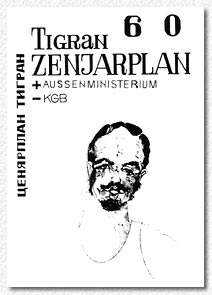 Like many who had played the original game I was
disappointed to see Anatol Fuckoff and Andrei Pissin purged, but this was expected so no
resistance was offered. Don also asked me to come up with some alternative names for the
characters as it was felt that the Teutonic humour of the originals would be lost on the
English speaking market. I demurred; apart from having a sentimental attachment to Tigran
Zenjarplan et al, I felt that they added atmosphere to what was already a
‘foreign’ game. Attempting to change the names into jokey English ones seemed
unnecessary, though I did agree to come up with two to replace Anatol and Andrei. As I
didn’t hear from Don again on this point I assumed that the originals were to be
retained. It wasn’t until I saw the finished product that I was aware the names had
been changed. My own afterthought contributions had missed the deadline anyway, but who
knows, perhaps Betty Boobsky might turn up in a future edition?
As to the rule changes, my main concern was the removing of the hidden influence
points and being able to win with three different wavers. I felt the effect of
this would be to produce a more muddled game, lacking the clarity and the psychological
elements of the original. The crux of the argument was that I felt Kremlin was
essentially a fun game, while Don seemed to be trying to turn it into an altogether more
strategic affair via increased rules.
Then there were the political problems inherent in re-situating the game in the
eighties and sticking Gorbachev on the cover. Urs and I were adamant that the game was
meant to reflect the Cold War period under Stalin, and was in no way representative of
Gorby and perestroika. Don countered this by stating that having a recognisable
and topical figure on the box would help increase the game’s ‘saleability’:
an assertion with which I could never agree.
By now letters were flying backwards and forward across the Atlantic on a daily basis.
Superficially it was almost a Hollywood scenario; the creative artists seeing their
masterpiece disfigured by a monolithic corporation. But that’s a rather pretentious
notion; in truth we both knew that Don was working very hard to produce the best possible
result for all parties.
Eventually though, our persistence paid off; Don agreed to reinstate the original
rules, albeit in a shaded area in the rulebook, a move that had the faint whiff of
tokenism, a feeling compounded by the somewhat less than complete rules in this section.
In addition there were also to be basic and advanced rulebooks which mollified us
somewhat. By this time though, my guns were firmly trained on the cover. I felt more
strongly about it than Urs, who was more philosophical, remarking that the ‘Americans
probably understand then-market better than us’. Be that as it may, the Gorby cover
has now been ditched in favour of a colourful collection of Soviet iconography, making
the game appear less serious. Little wonder Don was to remark later: ‘This was the
toughest game I’ve ever worked on’.
But to return to the original question; is Kremlin now a better game?
After all the static I gave Don he’ll probably kill me when I say, yes, I believe it
is. In retrospect, I think I probably suffered a knee-jerk reaction to the changes per
se, rather than the effect of these changes, in my mistaken desire to retain the
‘purity’ of the original. Ugh! these words taste awful.
The Kremlin Reshuffle
Declared Influence
The main change from the original is the removal of secret influence; in the original
a player could win if he had as much or more undeclared influence points in the
Party Chief as the player controlling him openly. It is still possible to have the
best of both worlds here by adopting the rule that a player can still claim a wave for
his faction by declaring influence points equal to, or in excess of the player
controlling that politician, immediately prior to phase 8 (Waving at the October Parade).
Of course it is also possible to play the game as per the original rules, but bear in
mind that in this version declared influence points are not lost if the politician is
dispatched to Siberia, something the American rulebook fails to point out.
Three Time Wavers
The second major change is the ability to win if your faction has waved three
times, irrespective of who did the waving. In the original, the same politician
had to wave three times for victory to be claimed. The effect of this is to make the game
more fluid. In the Swiss version it became very difficult to become a three time waver,
especially in a five or six player game.
Siberia I Declare
Losing declared influence points on politicians dispatched to the icy wastes is, at
first glance, a fairly radical change. The effect of this should make players more
circumspect in their bidding. But in reality players become power crazed and go the whole
hog anyway, thus rendering this change rather less radical than it appears initially.
Tie Breaker
This has to be one of the best changes Don came up with. Ties are now broken by the
player with the third highest declared influence points on a particular politician,
rather than simply by the player who declared first, though this method is still used in
the event of ties unresolved by the first method.
The effect of this is to involve more players in decision making which is always a
good thing in any game, but especially this one.
The Options
Optional rule should there be no Party Chief at the end of phase 5 in year
eleven: Although this situation does not often occur it can be a problem when it
does, as it means that a player controlling the Foreign Minister decides who will win the
game by announcing the next Party Chief. Clearly not a satisfactory solution. To resolve
this, we suggest that the winner is the faction with the most recorded waves. In the
event of a tie then the player controlling the highest ranked politician wins the
game.
Jobs For The Boys
The plus and minus signs on the politician cards refer to their suitability for
certain offices. We seldom used this in the original but that was more due to the
fiddliness of constantly changing ages, but more relevantly it was so difficult to get
anyone to wave three times, let alone make sure that your men had the jobs. Now both
these factors have been eliminated this option seems a good one since it makes the
promotion phase considerably more strategic.
Adding Influencing Points
Should be considered mandatory rather than optional.
The Intrigue Cards
Difficult to decide about the usefulness of these. Certainly they add uncertainty and
make for a more fluctuating game, but rather at the expense of planning. The blackmail
cards are not my cup of vodka at all, though this is more to do with my distaste for
games where you have to strike bargains with players.
Historical Revolutionary Variant
This is the new expansion kit released by Avalon Hill featuring historical
politicians. So a big hello to Josef Stalin. The concept of having real politicians who
are replaced by mythical politicians when they die is indeed a wonderful one.
Unfortunately it simply doesn’t work. The main problem is one of age. Uncle Joe
checks in at 44, so no matter how much purging he does you can be sure it will be a long
time before he checks out.
Likewise Leon Trotsky (45), and Nikita Krushchev (30). The suggestion I would make is
that you add 30 to the ages of the ‘real’ politicians.
Let’s hope I don’t end up eating these words as well.