(This article was originally published in “Games
International”, issue #13 and is reproduced here with the permission of Brian
Walker, the former GI editor)
DESIGNER’S NOTES
Birth of a dynasty
Derek Carver explains the design of his game of competing
dynasties, published by Games Workshop as Blood Royale.
Ideas for new games present themselves in a variety of ways. Sometimes, though rarely,
as complete games, sometimes as a system devised, perhaps, with playing cards or
counters, around which a theme is subsequently developed, and sometimes as a scenario
which has the potential of being made the subject of a good game.
If Blood Royal (in common with many people, I prefer to drop that final
mysterious ‘E’) came into any of the categories it was the third one.
In my earlier game – Warrior Knights -I was enthusiastic about the idea of
games during the course of which the players ‘assembled’ and used their skills to
vote on issues which would greatly affect subsequent play. Although such an idea had
great appeal for me it wasn’t sufficient for a game in itself and a much wider game
had to be developed around this core concept. Much the same thing happened in Blood
Royal.
Unlike many gamers, I would not call myself a history buff, but I do enjoy reading
history, and I had also been an avid watcher of the TV series The Plantagenets,
having visited many of the locations as a result of my fascination with this period. The
history of the Middle Ages illustrates that not everything was achieved purely by
conquest (although military might was a great bargaining factor in one’s favour).
Prolonged campaigning was not easy. There was considerable diplomacy, often sealed by a
marriage contract. Here, I felt, was the substance for a game. I wanted to make a game
where each player was a monarch who would produce children, marry them off to the
family’s advantage, secure trade routes and wage war. Each player was Henry II, if
you like.
SURVIVAL CHANCES
From the start I decided the only realistic way forward would be to include an element
of role-playing in the game. I therefore gave each ‘character’ a character sheet
in the true role-playing tradition. The die-rolls recorded on this sheet determined 1)
how healthy the character was, 2) how strong in battle or diplomatic cunning, and 3) how
attractive to the populace. The first was an indication of survival chances – especially
important to the women who, it was hoped, would produce a number of children, hopefully
some strong males. The second is self explanatory, women being able to confer their
qualities on their husbands. The third quality reflected the character’s general
popularity. A popular king could roam Europe with less fear of rebellion breaking out at
home and an attractive princess was always to be hope for.
This all meant that the characters in the game also had to die from time to time so
instead of being only Henry n, the English player, for example, would have to represent
the more abstract concept of the entire dynasty, and this gave the game its original name
– Dynasties. Thus, the game differed from normal role-playing in that instead of players
being their character they would in this game control many characters, all
different.
Each player starts the game with a king, a queen, and two children, all of specified
age. Dice rolls are made to determine the sex of each child and rolls are also made to
determine the three characteristics of each member of the family. Each is given a
character sheet recording year of birth and so on, and the players also have to choose
their dynastic name and names for each of the characters. This meant that from the start
the game was peopled by seemingly real and quite different characters
(‘different’ because of their individual qualities). The only unreal thing about
it is that at the start each player controls families all of the same age, but this
situation doesn’t last for long.
FEWER CHILDREN
Play is in five year segments, starting with 1300. A survival die roll has to be made
for each character every five years. Their survival chances vary, of course, according to
age, childbirth, and fitness (the original die roll 1) mentioned above).
One of the many changes that took place during the early days was the reduction in the
number of small children that were around. Originally more children were born, but quite
a few died before they reached the age of 15, which is the age they are of any interest
to us in terms of the game. So in order not to make die rolls and fill out character
sheets for children that didn’t survive to 15 the system was adjusted. Fewer children
were born, but those that were born were guaranteed to survive to 15. We ended up with
the same number of young adults but saved a lot of time and paper in the process.
So this was the core idea. The early problem was what to do with the idea. We
couldn’t sit around the entire evening manipulating these royal families; we had to
do something with them.
The first problem was that history did not have a four to six player game in mind,
each with more or less equal chances. While England hasn’t changed much
geographically speaking, the rest of Europe has, and there was no Germany and no Italy as
such. Unlike Warrior Knights where I felt the correct answer was to create a
fictitious country, with Blood Royal I knew I could only maintain the historical
‘feel’ I was aiming for if I set my game firmly in medieval Europe, so I had to
create Kingdoms of Germany and Italy, and also give each country in the game the same
number of provinces. This doesn’t seem to have bothered people as much as I thought
it would (although I don’t know what German and Italian players think about it!). But
even with my cavalier attitude to history and geography there was no way in which I could
easily bring in a sixth power, so I restricted the game to a maximum of five.
So – I had already departed from history, but the general feeling in the game was all
right.
THRASH AND BASH
What next? I didn’t want it to be a thrash and bash wargame. I decided I wanted it
to be centred on the securing of trade and trade routes plus income from taxes. The
latter was pretty simple – I allowed players to collect taxes from each province they
owned with the option of double taxing. The latter increased the chances of the highly
taxed provinces going into rebellion – a calculated risk, in other words, which is a
concept that always appeals to me and about which more anon.
For the trading I hit upon an idea which I must confess to being rather pleased with
and which could, in itself, have been the core idea for another game. Wanting it kept
simple, I devised a system of three basic commodities (what they are called is
unimportant – let’s call them A B and C). Each country had to acquire these
commodities and transport them to their capital to be ‘cashed in’. But they could
cash them in only in sets of three (ABC). In the full five player game there are only
three of each type around the board, which means there are not enough for each player to
have a set each time. Also no single country produces one of each (they might produce two
As and a C, for example). This means that in order to secure the missing item(s) players
had either to trade, secure them by contract (about which more later), or capture the
province in which a desired ‘missing’ item is produced.
Additionally there are around the board two somewhat more luxurious commodities – two
Ds and one E. If, instead of trading in a set of just ABC, you can acquire ABC and
D you get much more for them, and if to this you add the true luxury item E you get
considerably more. On their own the Ds and the E are worth nothing; they have to
supplement the basic set. These commodities are placed on the board in their producing
province at the beginning of each five year period unless there is a specific occurrence
that prevents this.
ROYAL FAMILY
This trading aspect of the game hasn’t changed since the early days. It worked
well and provided the framework I needed. We now had a royal family that had to ensure
its own continuation and it needed to obtain commodities. It also needed income. If it
had some strong royal males plus a strong army it could go out and capture the producing
provinces by force. In the same way it could wage combat in order to secure its trade
routes. If necessary a country could build a string of castles. A castle means it
doesn’t matter what happens to the province in which it is located: goods can still
be transported through that otherwise enemy province, the castle ensuring safe passage
for troops and trade goods. But warfare was an uncertain business. Kings especially could
not normally safely leave their capital to indulge in prolonged foreign wars. If they
were generally popular and were doing well it was easier but if they were not too high in
the popularity stakes and also weren’t being too successful in their campaigning
there was always the possibility of domestic unrest looming over them. And if they
don’t at once rush back to quell it rebellion had a nasty habit of spreading.
So securing what they want by other means became important and here another major
aspect of the game comes into play – the royal marriage. For each player it is essential
to ensure the continuation of his dynasty. If he doesn’t do so control could go to
another player who can trace his monarch’s ancestry back.
Also an unmarried king cannot produce princes to lead his armies. So wives are in
demand – especially beautiful and healthy ones. (Even so, there are a lot of desperate
marriages between pretty nasty boys and somewhat sickly girls, I might add!) Most
marriages also seal a ‘Marriage Contract’ and if, for example, you are seeking a
girl to marry the King’s eldest son you can put your demands pretty high, because the
player controlling the potential future queen’s family stands to gain quite a bit
financially when she ascends the throne. These all-important contracts can concern
non-aggression, military support, money, trade rights, trade routes, land, or a mixture
of the lot. They have to be carefully worded because their terms become binding for as
long as both parties to the marriage survive. Players are not allowed to break the terms
of a marriage contract: they would have to arrange the death of one of the parties
first.
QUILL TO PARCHMENT
So crucial is the clever negotiation of these contracts that they presented one of the
early problems in the game. A new player could be totally at the mercy of an old hand who
easily tied him up into a contract that he subsequently came to realise he could well
have done without. (France is always best played by such a persuasive player.) This is
why a change was made so that at the start of the game the children are too young to be
married at once. This at least gives an inexperienced player time to see what it’s
all about before he puts quill to parchment.
One of the features of the game is that during each five year turn each player has to
announce to the rest of the players what has happened to his dynasty – who has died, who
has been born and the description of a child, and so on. The death of a king or queen is,
of course, a major event and the records are searched to establish the next in line in
those rare cases where it is not immediately obvious. It is even possible for a
player’s kingdom to pass to another player who has the only direct heir, but this is
rare. Legitimate claimants to the throne can be passed over, but from then on they
provide a nuisance factor in the game that other players can exploit.
There were a few other aspects that were slowly modified during the early days (or
years) but that was the game in essence.
As it stood it presented one important problem as I saw it, although it wasn’t one
that seemed to worry many of the groups that came to know it and made copies. To obtain
the full feeling of this continuing and developing dynasty it was essentially an ongoing
game. During the course of a three hour game the most one could expect is that the king
or queen (or both) might die and the next in line ascend the throne but it wouldn’t
go much farther than that. The true essence of the game, though, was the continuation of
the family and its ramifications as it married into other dynasties and produced
children. This meant that it either had to be played for a long time or it was best
played as an ongoing game by the same group (the winner each session being the player who
had best improved on his starting position). This is the way it was often played.
Chronicles were kept and huge family trees maintained. It has been turned into a play by
mail game in Austria and there they publish the appropriate dynastic announcements with
proper obituaries on the death of an important Royal Personage. This is what the whole
thing is about.
HISTORICAL EVENTS
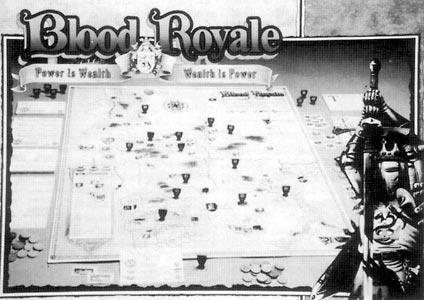
So this was how the game stood when Games Workshop came on the scene. They had
recently done an excellent job with my Warrior Knights and I was happy to let them
have Dynasties as it was then called. They knew the game and were attracted to the idea
of incorporating role-playing features into a traditional boardgame.
The first thing they decided to change was the name. They were rather frightened to
use Dynasties because of the popular TV series. At the first meeting I tossed in Blood
Royal as an alternative title, which was finally adopted but with an additional
‘E’. I have noticed that continental players, obviously disliking the mixture of
languages, refuse to acknowledge this final E.
Unfortunately we then started to run into a bit of trouble and our good relations took
a temporary downturn. Warrior Knights had been published precisely as I invented
it. Well, that is not 100% correct – a few changes were made to assist production but not
only were they all made by me or with my approval, but I also felt they were
improvements. The GW developer for Warrior Knights was Albie Fiore, who had also
worked on my Dr Who (one of GW’s first boardgames) and he subsequently worked
on my Whirlwind (FASA). By this time he had left Games Workshop and the in house
developer of Blood Royal was somebody different, and he wanted to expand the game
and introduce more historical events. Although my contract allowed me to veto any changes
to the original I had respect for the enthusiasm and undoubted abilities of the
developer, even though I feared the additions would lengthen an already long game. But
the big problem was that in the main the proposed additions (and they were all
‘additions’ as opposed to changes) were not the sort of rules I would have
invented. Not that they were bad in themselves, they simply reflected the sort of game
the developer would have invented and not the sort of game I like.
Let me give an example to illustrate the different approaches. Games Workshop wanted
to introduce a series of historical events in the form of chance cards. These were to be
events that often affected (usually adversely) one player. Of course, they were not as
crude as ‘Go to Jail’, but you know what I mean. They also mirrored historical
events. While I was not totally against the idea of these events I wanted them to have
considerably more interest and add to the fun of the game. I also wanted them to be
different from the sort of thing people are used to. My feelings are that historical
events happen because a certain regime either takes a certain action (one out of a number
of possibilities) at a certain time, or decides to take no action at all. If at a
particular moment a contrary decision had been made the course of history would have been
changed in some way. What we see as history, therefore, is the result of one decision out
of a number of possible decisions taken at the time and in my game we were living in
the time.
INTELLIGENCE REPORT
So, to get back to the game, I suggested that firstly, we should try to restrict
events so that they affect all players, and secondly, that the event should be in
the form of an intelligence report listing what could happen in, say, two to three turns:
i) if no action was taken, ii) the chances of averting this occurrence if more money was
directed into the area (money that might be in short supply), iii) the chances of
suppressing the event by stationing troops in the area, and so on. The ‘chances’
would be expressed in terms of die roll odds. After all, these are the sort of questions
a ruler would have to ask at the time and he would decide on the action to take in the
light of the replies, the odds of success, and the effect on his exchequer, stability,
and so on. So in game terms it would mean that the player would do what he thought most
expedient and possible and he would have to await the outcome. At the same time other
players who have no love for him (and no contract preventing intervention) could,
possibly, lessen his chances of success by taking certain actions themselves.
The developer saw my point but sadly our minds didn’t run along the same lines.
Certain modifications were made, but generally speaking I thought the event cards at the
end of the day didn’t really reflect the original thinking I was aiming for. I
preferred to offer the game as I invented it and leave it to enthusiasts to extend it as
they wished as a result of play and the preferences of their own group.
As it was clear that we were thinking quite differently and time was being consumed it
was finally agreed to publish the game in my basic form with the new rules being included
as ‘Optionals’ to be used or discarded by the purchaser as he or she wished. In
this way I was able to give Game Workshop carte blanche with these additions,
without further reference back to me. It is pertinent to add at this stage that it is
rare for publishers to agree to allow an inventor to veto any changes. He normally has no
control whatsoever over the product that finally arrives on the shelves, which might be
quite unlike his original. An amazing situation when you come to think about it.
FOREIGN PRINCES
The solution reached was quite satisfactory. As far as the production was concerned
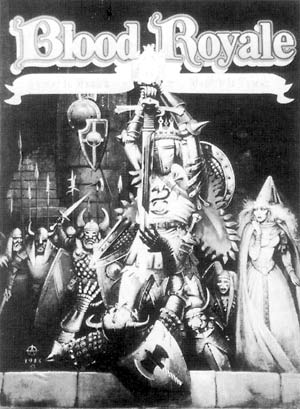
they made a truly superb job of it. I must admit that I took exception to the box cover,
which didn’t reflect the feel of the game at all, and it was rather sad that GW
scored an own goal by deciding to suggest names for foreign princes and princesses –
presumably for the benefit of players whose knowledge was limited in this regard- and
getting them wrong! But these are peripherals. No inventor could be anything but
delighted with the quality of the product offered, right down to such often overlooked
details as the magnificent presentation of the rules, which excellently carried through
the historical feel of the game. These are the qualities that show Games Workshop at
their best, and they deserve every compliment.
In its basic form Blood Royal presents a system that is ideal for building on
and I know a number of groups have developed additional rules bringing in the power of
the Church, rules that have qualities that appeal to their particular group and have
stood the test of playing over a period, being slowly refined in the process. This is
excellent and what I hoped would happen.
While one must be pleased in one respect, it is also a pity that Blood Royal
appeared just before GW made the decision to turn exclusively to the fantasy games with
which they are normally associated and which (as a result of their White Dwarf
readership) had been far more profitable for them than their ventures into non-fantasy
and comic strip themes. Having made this decision it reflects greatly to their credit
that they pushed ahead with Blood Royal in the quality that they did, it being no
small investment.