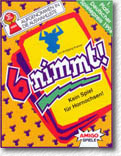
This supposedly light game has more strategy than most people think. Here are some tested tips to lower your average score (scoring is negative for the player in “6 nimmt” – just for those of you who don’t know)
1. Play the card with the least risk of taking a row
This is so obvious that I feel embarassed pointing it out, but some players actually DO forget this and rather play “from the gut”. Look at your cards, and if there is a card that is the most safe to play, choose it, as easy as it is. Of course this is not always obvious, but sometimes it is very obvious that playing a certain card will most definitely have you take a row. Avoid this card. Understood? Very good, than we can move on to more subtle strategy…
2. Get rid of extreme cards as quickly as possible
It is clear to the experienced player that the very high and very low cards are your greatest danger. Usually players are more scared of the low cards, as they are more difficult to play without taking a row, but that can be deceiving. In fact a high card can become much more dangerous – a “100” is a bigger risk keeping than a “1”, for example.
The low cards are also not attractive, BUT… even a “1”card can come handy late in the game, when you rather take a small row with one or 2 cards than risking more with a medium or high card. You might even have your closest competitor take a high-value row because you mess up the cards with taking an unexpected row – one of the few events in the game when you can actively play against someone! Some players insist that it is good to keep at least one pretty low card until the last 3 rounds or so.
Most of the time players will play their low cards in the first round – do the opposite and play your highest cards, when it’s still safe (at least with 4 players), and THEN play your low cards, when the other players have established nice and safe low rows for your perusal…
3. Don’t always try to “set up a series”, especially when playing high cards
Very often it is tempting to play the first card of a series of cards in your hand (for example playing the 95 when you have 95, 96 and 98), hoping that you can then deliver the other cards pretty safely.
But most of the time what will happen is that a 5-card row gets blocked, with your card being the last card of 5. Now you sit on your 96 or 98, and at some point you will be forced to take the row, if you want it or not.
If you have high cards you want to get rid of try to do this in the first rounds, when it’s still safe. Begin with your highest cards. Immediately play a “104” for example, if you have one, even if you have the “103” as well. If all your other cards are lower, you’ll never have to take this card, and blocking one row will raise the chances of other people taking rows. If there are more than 2 players chances are better that it is NOT you who will suffer from this, although you might, of course. But “no risk no fun”….
4. The art of playing the “lowest highest card”
In every game there will come a situation when no card you have is safe, and all rows are pumped up with 4 or 5 cards. Somebody WILL have to take a row. What to do now?
If there is a low-scoring row you might consider taking it deliberately with a low card, better than ending up with lots of “oxens” otherwise. But if there is no such row, play the “highest lowest” card, as we call it at the “Westpark Gamers”. You don’t want to play too high, as you might be too close for comfort to one of the “sitting duck” rows. You don’t want to play too low, as you might end up with a forced-on-you row as well.
What should you do? Check the “margins”: 1) what is the lowest card that will definitely take a row? 2) What is the highest card in this low row? The best card for you would then be the card which is as close as possible to the HIGHEST card of the LOWEST row. If that card is not available for you, the truth lies in the exact middle – it might look as if this card is a sure “taker” as well, but chances are that another player is playing a lower card, starting a new row where you suddenly can play the card safely.
This is why keeping your “medium value” cards is so important, as very often the ideal card in this situation will be something around 40-60 or so. There is no sure-fire tactic here, you might STILL end up with a row, but playing the “lowest highest” card is the best – and only – hope to avoid this.
5. Wait a little before you play your card and watch the other players
You might learn some interesting things. Let’s say you have 56, and there is a row with only a 5th possible card left that ends with 54. Everybody knows that there is a certain risk involved in playing a 56 – if somebody else plays the 55, you’re busted! But of course the 55 is not necessarily in the game (or has already been played, but in “6 nimmt” it is more difficult than usual to remember played cards, because everything happens so quickly).
If one of the other players VERY QUICKLY plays a card, s/he most probably will have played a “no-brainer” card, meaning that it is a “series” card which is absolutely safe to play. If you’re in the above situation and nobody is playing quickly you might be safe with the 56, who knows. Of course the other players might have read these strategy tips :-)
But most players I know, including myself, will play “6 nimmt” very quick, so sometimes you’ll forget to “hold back”. If you remember watching the others sometimes it will increase your chances, believe me!
Moritz Eggert, 19.4.2003