
reviewed by Aaron Haag
If you have ever been to Munich or any other part of southern Bavaria during summer, you have probably been to a beer garden. These are, sometimes rather large, outside areas with tables and benches where people can drink and eat. Beer gardens in the past where often owned by breweries in order to make use of the area atop their cellars which for the purpose of keeping the cellars cool during the summer had been planted with densely leafed chestnut trees. Until today, many beer gardens are owned by breweries with tight bands between leaseholders and the breweries (sometimes with dramatic consequences as in the case of the „Hundertjähriges Haus“ in Munich).
Franz-Benno Delonge adopted the beer garden and brewery relation for his latest game „Goldbräu“. Players aim to control beer gardens and breweries in order to earn the most money through selling beer to guests in the beer gardens.
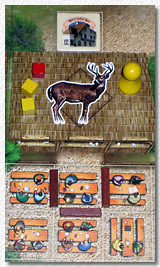
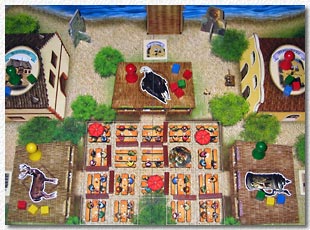
The board shows a total of four breweries and six beer gardens. The beer gardens are tiny when the game starts but can be extended by its manager later in the game, similar to the mechanism used in „Löwenherz“. The size of the beer garden is the prime factor for calculating its income.
During the game setup, each player is dealt six shares, four of which are revealed immediately and influence tokens placed on the respective brewery and beer garden while two remain secret in the players‘ hand. The concept of hidden influence reminds one of „Kremlin“. In addition, each player in sequence places two manager pieces on any not yet occupied brewery or beer garden.
Control of managers is vital in the game as only they give control about the actions performed by beer gardens and breweries. They can only be placed on the board if no other player holds a majority of shared in that brewery or beer garden. While it is important to have sufficient own managers on the board it is equally necessary to have sufficient influence (shares) in order to prevent other players to take over a manager’s position. Players secretly and simultaneously select their action for a turn having a choice of
-
- expanding a beer garden controlled by one of their managers,
- nominate one of thier managers as the new manager for a beer garden,
- sign a beer delivery contract between a brewery and a beer garden, both of which must be controlled by their managers,
- buy shares.
However, „Goldbräu“ is a game of shortages. In any one turn players can only perform one of these actions. Therefore, correct timing and balance is an issue in this game; it is too easy to lose control of a beer garden only because one spent too many actions on expansion rather than taking care of maintaining influence (i.e. by buying shares). There’s one more element of timing in the game, which is interesting and new: a player has a benefit, if he is the only one selecting a particular action. Now he is allowed to perform the action twice or pays a lower price for shares. This concept favours anti-cyclical gameplay on the one hand, but to be honest, it introduces also a large element of luck as it is hardly possible to sufficiently plan ahead to make use of it.
 This is further amplified by the fact that brewery/beer garden shares are not freely available for purchase. Two shares per turn are revealed and only one of these or a hidden share drawn from the share pile can be bought by the players. Since there are only six shares of a kind, it is common that players have to wait several turn for the right share to become available. Again, it is a matter of timing here combined with making the best out of the current position. As a consequence the ownerships on the board can be rather static.
Aword about the „pretty waitress“ and the „drunkard“: they are giving a bonus/malus to the beer garden in question and their main effect is adding chaos to the game. While their position is known at the beginning of the game, the ability to change their position is completely determined by luck (i.e. decided by cards in the share pile), rendering any advanced planning obsolete.
The subtitle of the game reads „The most clever landlord wins“. Well, does he? Walter mentioned after our first game, that if the shares were freely available and not drawn from a pile „Goldbräu“ would come close to „1830“. This statement indicates a potential problem with „Goldbräu“: it is very dependent on the luck of the cards drawn and may not appeal to die-hard gamers and it is too complex to be a good all-purpose family game. All in all, it is a fast-paced business game and given the right group of people it will provide 60 minutes of fun.
Westpark Gamers ranking: 6.5