“1860” – Railways on the Isle of Wight
reviewed by Aaron Haag
It was Queen Victoria’s love for the island south of the United Kingdom, just 30
km long and 20 km wide, which triggered the building of railways on the Isle of Wight. It
all started in “1860” when two British railway companies, the LSWR and the
LBSC, bitter rivals at the time, connected Cowes in the north with Newport in the centre
of the island and Ryde with Ventor down the east coast and Freshwater in the west.
Life was not easy for the presidents of the railway companies. Terrain was difficult,
especially in the southwest and the majority of the building materials had to be imported
from the mainland using one of the three ferry lines of the time. Traffic was a problem,
too, as most of the population lived either at the east coast or in the central city of
Newport, and the revenue generated was barely enough for the companies to survive.
Therefore, bankruptcy was not unusual and some companies even went bankrupt more than
once but still managed to survive.
This is the setting for the latest addition to the “18xx” series of games,
which are all based on the original design of Francis Tresham’s “1829”. The
object of all of these games is to invest cleverly in railway companies that build
railway networks to generate profit for their shareholders. Since its first release more
than forty years ago, “1829” has seen more than twenty successors using the
same basic game mechanics. All follow a common naming convention: the year of the first
railway operation in the respective area.
Quite a few of the “18xx” games have been released as game kits by hobby
game designers and especially in recent years there has been no release of an
“18xx” game by larger publishers. While game kits often come with high quality
components and a well tested game system (e.g. see our preview
on “1895”) they need several hours of assembly time because most of the
components need to be cut out, mounted or laminated.
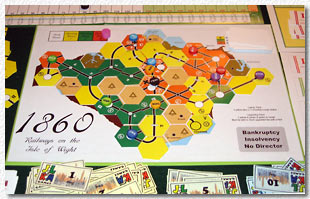
In contrast, “1860” is produced by the small UK based games publisher JKLM
who until today has produced ten games; this is their first one of the “18xx”
series. As one would expect from a professional publication the game is – besides
punching out some tokens and tiles – ready to play. Most components seem to have been
produced using a colour laser printer, the material either being cardboard or plain
paper. The map is mounted on sturdy cardboard and all components rest perfectly flat on
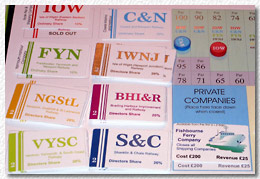
the table. Credit is given to Chris Lawson for inspiring playing aids like the revenue
chart and the calculation tables on the company charters, which help speeding up game
play. It is also a nice idea to provide two different types of currency, one for the
companies, and another one for player money. Unintentional mixing of the two can no
longer happen and buying trains in the later phases of the game has no effect on the
length of the game.
The rules are well written and provide enough information also for “18xx”
novices. There is only a small glitch when they state, that the game comes with £500
notes, when in fact there are £200 notes provided. According to the publisher the latter
is correct. There is also a small omission in the description of the initial auction
round. This round also ends if no player wants to buy or can buy any of the remaining
stock of that round.
Let us look at the main features, which differentiate “1860” from the other
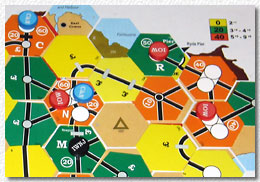
games of the series. The first thing experienced “18xx” players will notice is
the small size of the map in terms of track hexes. There is space for 42 track tiles
only, less than in “1849 – Sicily” but still twice as many as in “1876 –
Trinidad”, both also island based games. Even more significant is the huge number of
37 cities, villages, and halts on the map. This leaves only 9 tile spaces without a stop.
Combine this with the total of eight railway companies and it is obvious that the
resulting railway network will be rather complex and the calculation of revenues will be
difficult. Hence, it is wise to make use of the revenue chart provided with the game
(note: by mistake the column for revenues ending on 80 has been omitted in the
chart).
Trains come in 8 different sizes and can travel between 2+1 to 9+5 (large + small)
stations. As 9+5 trains are available in an unlimited quantity railway companies are able
to travel across most of the map in the end game – station markers permitting – and will
rake in large revenues per operation round. This is also supported by the rule that a
company may pass through one, but only one, “tokened out” station per operation
round.
A combination of three stock market and company related features derived from the
historical background of “1860” makes the game unique. First, there is the
possibility that a player sells the Director’s certificate to the bank, thereby being
able to get rid of all stock of a company even if no other player holds more than 10% of
that company’s stock at the time. The railway company goes into receivership and
while in this state retains the complete income generated in operation rounds.
Eventually, the company will be attractive enough to find a player willing to buy the
Director’s certificate. This feature was already present in the original
“1829” game but has not been adopted by many “18xx” games since.
Secondly, if a company has lost all its trains and has insufficient funds to pay for a
new one it becomes insolvent, a new feature to the “18xx” series. Insolvent
companies use (“lease”) the smallest available train from the bank without
actually acquiring it but in return receive only half of the income generated in an
operation round. Insolvent companies do not pay dividends. There is no longer the need
for a director to finance the buying of a train out of his own pocket making the game
much less cutthroat than for example “1830”. However, if shares of a company
with no trains are sold during a stock round, the selling player receives only half of
the current stock price. Deciding on whether to keep or sell the shares of an insolvent
company is one of the tougher choices players are faced with during the course of the
game.
Finally, companies may go bankrupt. This concept is new to the “18xx”
series, too. In other “18xx” games players will go bankrupt if they have to buy
a train for one of their companies and have insufficient funds, thereby ending the game.
In “1860” company bankruptcy arises if the share price of a company reaches
zero either because the director has chosen not to pay any dividends for several
operation rounds or because dividends may not be paid due to the company being either in
receivership or insolvent. When a company goes bankrupt, all of its shares are returned
to the bank’s IPO and become available again for sale and re-floatation. Former
shareholders receive no compensation for lost shares in any way. Interestingly, bankrupt
companies keep all their assets (money and trains on the company’s charter and any
station tokens already placed on the map) making them very attractive for re-floating. A
formerly bankrupt company most of the time is a tremendously good deal as it not only has
a route with stations but also lots of money and possibly even a train or two.
Looking at these three features and their effect on game play one may think that much
of the thrill and suspense in the correct timing of share transactions and train
acquisition has been eliminated. But during play one quickly realises that taking
advantage of these new features requires just as much good timing skills and proper
planning and strategy as in other “18xx” games.
The concept of “feeder lines” comes to mind here, which are used to provide
money and/or trains to other companies of the same player but which do not pay any
dividends to other players. Players deliberately shift money from one company to another
by buying nearly obsolete trains from a company for large amounts of money, giving that
company the opportunity to buy a better train while still paying dividends. In
“1860” the other company will eventually become insolvent and if timed
correctly, the player will be able to sell all stock of the company before this happens
and re-float it after it has gone bankrupt. None of this is as simple as it sounds and
requires a constant look at the stock market, the priority deal and of the availability
of trains, but if timed correctly it is a real moneymaker. Bankruptcy will eventually hit
one or the other company so it is wise to make the best out of it.
Three conditions signal the end of the game. Like in most “18xx” games it
ends if the bank runs out of money. However, the game also ends if a railway
company’s stock price reaches the top score of £340 making it an attractive
possibility to accelerate the game’s end. The third condition is unique to
“1860” and simulates the nationalisation of the railway companies on the Isle
of Wight. Nationalisation begins as soon as the first 9+5 train has been bought and all
companies own at least one train. From then on, no more stock rounds are played and at
the end of each operation round the two companies with the least revenue cease to
operate, maintaining their current stock price. As soon as all but two companies have
been nationalised this way the game ends. In our games this was the common type of ending
and it is wise to plan ahead for it by creating attractive routes for one’s companies
in order to prevent their early nationalisation.
“1860” offers a well-balanced combination of ideas which at the same time
makes it challenging for “18xx” die-hards and not too cutthroat for beginners.
The game components are of high quality and support the game play very well. For those
who are “18xx” aficionados this is a must-buy as it provides plenty of room for
new strategies; for those who want to get into the “18xx” series I can
recommend it as a good introduction into the game system.