Australia
reviewed by Aaron Haag
It’s the 1920’s and Australia’s economy is still booming. The government
vigorously pursues industrial development and at the same time encourages the development
of national parks to support the environment. This is the setting for Wolgang
Kramer’s and Michael Kiesling’s latest game.
The map shows the six mainland territories of Australia split into 24 land and water
regions. It is the players task to complete industrialization and conservation projects
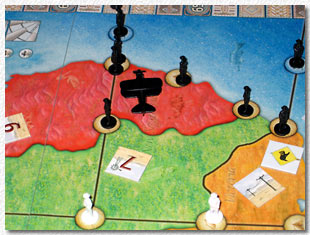
in these regions and to place rangers into camps or on ships located on the regions’
borders. The number of rangers a player has depends on the number of players in the game,
ranging from ten in a five-player game to 20 with only two players. Small plastic
double-decker airplanes fly the rangers into the region and pick them up again when their
task is finished.
During a turn, a player performs two actions out of a possible three. One possible
action is to fly his plane to any of the regions in preparation for unloading or
withdrawal of rangers. Another action is to unload up to four own rangers into one of the
camps or onto a ship of this region. In order to do so the player must play a region card
from his hand. Each card shows the colour of the region it can be played for, the number
of rangers one may place (one to four) and the money one earns (three to zero dollars)
for doing so. The hand card limit is two, which may sound rather limiting, but in fact
each camp is adjacent to at least two and many are bordering three or more regions so
that there is only a slight reduction of choices by unlucky card draws. If all fails and
you do not have the right colour in your hand you may even change the colour of a card by
paying money. The third type of action is to remove up to four own rangers from any of
the camps bordering the region where your plane resides.
Players may spend money during their turn to either change the colour of a card they
play (3 dollars), or to move one of their rangers from any camp or ship to any other
valid location (4 dollars), in addition to the other two actions performed. According to
the German rules, the latter option is allowed just once per turn, while the English
rules’ wording suggests that it may be performed repeatedly in a turn. Wolfgang
Kramer is said to support the English version while Ravensburger is quoted to support the
German one. We followed the English rule version because it leaves you slightly more
options in case of a required major reshuffling of rangers due to early bad planning.
At the end of a turn, players draw new region cards to fill up their hand to two with
players having a choice from which of the four stacks they draw, the back of the cards
showing the distribution of money vs. rangers.
The completion of industrialization and conservation projects triggers the
distribution of victory points. Whenever a plane arrives in an area for the first time,
the industrialization marker of the region is turned over, showing how many rangers must
be present in camps located around that region to complete the project. As soon as this
condition is fulfilled the active player scores three points for completing the project
and all players score one point for each of their rangers in camps bordering the region
or two points for rangers on ships. Conservation projects on the other hand are completed
once all camps and ships of a region are occupied. Scoring is the same as for
industrialization projects.
Although Australia comes along with only a small set of rules and is explained
quickly, playing the game well is a completely different matter. Placement of airplanes
and rangers is tactical and there is not much point in trying to develop regions all by
yourself, because you will quickly run out of rangers to deploy. It’s better to
predict where projects may complete soon and to try and participate in the scoring.
The number of actions you are allowed to perform is always less than you would like,
so planning ahead is essential; the placement of the airplane being of particular
importance in order to not having to move it in every turn. Hence, playing the game in a
group of brooders and optimizers can result in long downtimes. My experience is that this
doesn’t really matter because there is a lot of suspense even when it’s not your
turn as you constantly try to determine the other players’ plans while at the same
time hoping that they won’t recognize yours.
During the first few rounds players set up what is deemed to be good strategic
positions. Completed projects in this phase can result in some players running away on
the score track. However, it is almost impossible for the early leader to maintain his
position, not because there is ample possibility to gang up on the leader – in fact there
is none – but because an early lead often results from a concentration of a player’s
rangers in just a few regions. Consequently, that player needs too many actions later in
the game to transfer his rangers to other, still scoring locations.
Once the board gets filled up with rangers there is a steady increase of suspense when
many regions will be close to completing their projects and placing just a single ranger
may trigger multiple scorings. Now special attention is required not to overlook scoring
regions because other players are not required to point out any missed ones. They may
even score the region in their own turn collecting the three bonus points for completing
the project! This sounds obvious but I have yet to see a game of “Australia”
without at least one such missed scoring.
| Variant (simple game) | |
|---|---|
|
In our very first game of Australia we made a small mistake, when we accidentally Overall, the game was felt to have a faster pace in the beginning and the gameplay |
|
The game comes with two rule variants: the familiarization game as explained above and
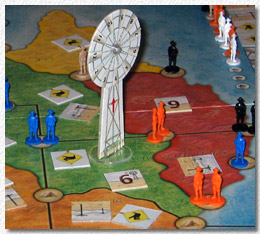
the full game. The full game adds a little windmill, which is put in an arbitrary region
at the beginning of the game. It provides an option to place rangers on a ranger track in
addition to the camps and ships if the player’s airplane is in or adjacent to the
region where the windmill stands. Whenever a project is completed its associated marker
is placed on a windmill track. If an industrialization project marker shows a windmill
upon discovery, the windmill is immediately moved to that region and the point value of
the windmill is increased. Each time the last position of the windmill track is filled
with a marker the windmill scores by giving points to the three players with the most
rangers on the ranger track. Then the markers on the windmill track are removed and the
top half of the rangers on the track are returned to their players. The windmill feels
like a rather pasted on theme and game mechanism. It does provide additional food for
thought, though and it is certainly suitable for more mature gamers, but it also bears
the risk of increased downtime between turns. We had mixed feeling about the windmill
versions for some other reasons. It provides an additional option for placing rangers,
which comes in handy if you do not want to place all rangers in a camp because you want
to complete a project there while the card allows you to place more rangers than you want
to. The chances you can do so are rather limited though, as you have to be close to the
windmill in the first place and secondly you must have sufficient rangers to place.
Especially later in the game the latter will be a problem. On the other hand, the
windmill scoring is very hard to predict in advance and we found planning ahead for this
to be near impossible.
Australia plays equally well with two, three or more players; three being in my
opinion the best number of players. With five players, I would recommend not to use the
windmill variant, as there is not enough possibility to plan ahead for it to make much
sense while increasing the downtime considerably.
It has been a while that I have played a Ravensburger game that provides fun for the
casual player as well as sufficient challenges for experienced gaming groups. If you like
abstract games with only a lightly pasted on theme and if you don’t mind if there is
little interaction between players Australia is the right game for you.
(An earlier version of this article has been published in “Games International“, issue
#21)