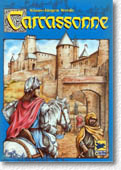
Carcassonne
Publisher: Hans im Glück
Author: Klaus-Jürgen Wrede
Tester: Aaron Haag
Game Type: tactical tile-laying game
The Game: Carcassonne is a nice city in the south-western part of France – not
too far away from Toulouse. It’s quite famous for its historical fortress from the
ancient times of Romans and knights. Two to five players recreate Carcassonne with its
town areas, roads, farmland and monasteries with the objective to score as many victory
points as possible. On his turn a player takes a tile from the face-down stack of area
tiles and places it orthogonal next to the tiles already placed by other players (or the
specially marked start-tile on the very first turn). A tile placed must fit in terms of
roads, farmland and city walls to the already placed tiles it connects to. Immediately
after placing the tile the player may place one of his 7 pawns on the just played tile –
either on a road, a farmland, the monastery or the city itself. This pawn marks the
corresponding area as “under control”. During the turn of the game these areas
extend due to other tiles played (roads get longer, cities and farmland cover a larger
area, monasteries are surrounded by other tiles). Once a road is completed by connecting
cities, villages or monasteries the “owner” of this road scores points
according to the length of the road (2 points per tile). Similarly, once cities are
completed by closing the city walls they also score. Monasteries score points at the
moment all surrounding tiles (i.e. 8) have been placed. Farmland though only score at the
end of the game. In each case the pawn that scored the points is handed back to the
player and is again available for placement.
Playing Time: The game can easily be explained and played in 30 to 45
minutes.
Similar Games: El Caballero (Hans im Glück)
Westpark Gamer’s Opinion: This game is a perfect starter for an evening of
gaming. It plays quite fast (unless you are playing with gamers that just cannot decide
on the perfect spot for laying their tile) but still has a lot of depth. The players are
permanently struggling between short-time tactics and long-term strategy for placing
tiles and pawns. This is certainly an upside of Carcassonne. Players have to watch out
for those extending farmlands which score big points at the end of the game and at the
same time do some housekeeping with their pawns. The decision between quickly scoring a
few points for completing a road and getting back a pawn compared to extending a
structure and scoring later is tough. There is also quite a bit of player interaction
involved when the other players lend their advice for “perfect” tile placement
to the one whose turn it is. On the downside there is definite element of luck introduced
by taking tiles from a face-down stack. If you do not draw monastery tiles or never get
that one matching city tile there is not much you can do to win besides preventing other
players to score – certainly not an empire builder’s game. And destroying the other
player’s plans again requires some luck in tile drawing. There have been suggestions
to place a number of tiles face up (e.g. corresponding to the number of players) as in El
Caballero. We still have to play this variant to judge on it.
Aaron’s Rating: 7 (out of 10)
Westpark Gamers’ Rating: 6.8
| Links to further information: | Board Game Geek Caracassonne Review |
| Caracassonne homepage by Hans im Glueck (German) |
|
| Funagain page with player reviews of Caracassonne | |
| Luding link for Caracassonne |