Dividends
reviewed by Moritz Eggert
During my visit to Singapore last year I had the pleasure to meet Nikki Lim and Evelyn
Brunner, a game designing couple then on the verge of starting their own company. While
there I had the chance to test their prototype of Giza, a tile laying game, with promises
of “more games to come”. Now their first published game, “Dividends”,
has arrived by post, and I had the opportunity to try it out several times during the
last weeks.
“Dividends” is a pure-breed stock market games, probably closest to games
like “Long Short” or the German “Boersenspiel”. Unusually it can be
played by up to 12 players, although playing with 12 might produce a lot of downtime (but
I haven’t tried it yet). But it is certainly nice to have a game that can also be
played with 7 players, a situation that often arises…
The production quality of the game is nothing short of amazing. Although the board
(which is basically a turn track only) is rather small, there is a plastic rack holding
the stocks, playing money, metal (!) pegs to indicate dividends, a lot of cards and
counters. All the playing material comes fully “punched”, even to the point
that the counters have already been put into Ziploc bags. The game can literally be
played “out of the box”, simply read the rules and start. Singapore is close to
China, and of course this is where the game has been produced, but Evelyn (the graphic
designer) has told me that it’s not really cheaper for Singaporeans to produce there.
Still, this is certainly an amazingly high quality effort rare for a starting game
company (and their other game, “Giza”, also looks amazing).
Game play is deceivingly simple: Each player gets a certain amount of money (depending
on the number of players) and tries to multiply it through trades at the stock
exchange.
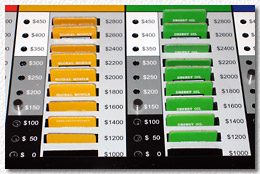
There are 5 generic “companies” in 5 colours, with an equal number of shares
(10). At the beginning of the game (and also later) the dividends are randomly determined
through the roll of dice. The system is simple: the dividends can either be in the high
(white), medium (grey) or low (black) range. If they are high they can only fall by 1-3
slots, if they are low they can only rise by 1-3 slots, if they are medium they can rise
or fall (50% chance). If only the real stock market was that simple :-)
The price of the stocks is determined by the number of sold certificates. The first
one always costs 1000$, the next one 1200$, then 1400$ etc. Players start buying the
certificates from the bottom up, and if they sell them they are put in the next free slot
from the top. This means that what happened with the company in between sells/buys
determines your net gain – If many certificates have been sold after you bought your own
you might win a hefty gain when selling it back now, but you might also lose a lot if
after your turn other players have sold their certificates. The problem is that sometimes
you are even forced to sell under such conditions, but more about that later.
This is of course why turn order in the game is all important, and not very
surprisingly the order of play is auctioned in free auctioning system at the beginning of
each round After that each player has the possibility (in turn order) to buy/sell stock
(optional), play influence cards and discard unused influence cards. Influence cards are
gained if you hold the majority in a company only – they come in all colours (there are
also jokers) and shift the dividends (payout) of the company they are played on by 1 (up
or down is indicated on the card). It is possibly to play several cards on the same
company in one go, but you can also decline to play cards by simply discarding them
(usually the ones bad for the stock you own).
After all players have completed their action phase there is a payout phase, where
dividends as they are now are paid. The dividends go up in 50$ steps, from zero to 450$,
usually you will always have the feeling you don’t get enough! This is why
selling/buying stock wisely will win the game for you, because there the profit can be
much higher…
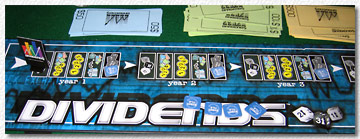
Then influence cards are distributed, one for each share of a company in which you
have the majority.
After that one of four events is drawn:
- “Force Sell” forces each player to sell his most expensive share at the
moment for the current price, in turn order. - “Buy in” enables players to buy the cheapest currently available share, in
turn order. - “Placement Offer” – players check which company (or companies) have
currently the fewest sold shares. Each player can now buy one share of those at half
price (in turn order). - “Technical Correction” is the opposite of “Placement Offer”,
players check which company has the most sold shares, and owners must sell one of them
for half the price, again in turn order.
This procedure is repeated 5 times (equalling “years”), then there is a last
chance to play influence cards, then a final payout, then each player sells one share
back to the market, in turn order until all of his/her shares are sold. The player with
the most money is now the winner.
Of course this makes the turn order in the last round extra important, and one should
be willing to pay more than usual for it…
The game sounds simplistic and luck-driven and at first glance majorities seem
all-important because they enable you to gain influence cards. This is why the first game
I played went relatively slow. Each player basically stuck to the first majority stock
that s/he bought, with only little change and variation through the events. The game
winner actually only went from owning 3 shares to owning 5 shares!
I didn’t go into the second game with high expectations, but I thought it
important to try it with hardened 18xx players who play the stock market more
aggressively by nature (at our Westpark Gamers). This time around the game was totally
different, as we started buying/selling stock very aggressively. Shares changed their
owner more quickly than one could say “Dividends” and all in all game play was
dynamic and very much fun. The winner (me, hehe) actually reached nearly 15.000$, which
was very different from the 8000$ in the first game. The following games have
strengthened the second impression – the more risks the players take and the more
aggressively they play the stock market the more fun this game will be. Still there is
the element of luck – one can make mistakes and avoid them, but in close play very often
the change of dividends or the appearance events will make all the difference.
| Characteristics | |
|---|---|
| Explaining the rules: | 5-10 minutes |
| Setting up the game: | 0 minutes (true!) |
| Fun: | yes, if you like abstract stock market games with clear-cut mechanics |
| Brain: | not a brain-teaser, but you certainly need to watch what’s happening closely to stand a chance |
| Excitement factor: | high, if you get into it |
| Atmosphere: | manages quite succesfully to simulate a certain hectic stock exchange atmosphere, although fiddly players can easily produce a lot of unwanted downtime |
If you like this game will very much depend on your gaming preferences. As it is this
is a more family oriented game that can be played in all kinds of gaming groups without
long explanations or wading through obscure rules (the rules are very well laid out and
easy to understand). Although it resembles “Acquire” in it’s simplicity it
certainly doesn’t have the same depth in game play, but that doesn’t mean that
“Dividends” is no fun, quite the opposite. My wife, who hates
“Acquire”, actually liked “Dividends” much more, for example! I
personally like it a lot, as it is a relaxed challenge while at the same time being quite
fast to play, a full game usually clocking in at 1½ hours up to a maximum of 2 hours. The
problem I see is neither the game itself nor the beautiful design – it is the theme.
There are a lot of good stock market games out there, and although “Dividends”
certainly belongs to the best of them (easily surpassing the awful old
“Boersenspiel” from Ravensburger, which has some similarities) it is difficult
to distinguish itself in such a strong competition. The same can be said about nearly
every other theme, I guess, but I can only encourage Fun Factory to experiment with more
unusual ideas and themes in the future. With “Dividends” they have shown to be
a very professional company already, and I will certainly watch their future offerings
closely.