Fairy
Tale
reviewed by Moritz Eggert
After we had lots of fun with last year’s mysterious card game
“Masquerade” by the same company (part of the fun was trying to understand the
weird English translations), we were eager to test this new, simpler offering by the same
company.
“Masquerade” turned out to be a pretty complex fantasy card game that packed
a lot of story and flair into a deck of cards. “Fairy Tale” uses similar
manga-like graphics for the cards, but plays much simpler, more like a collective
patience game, and is certainly more of a family game than “Masquerade”.
Each player tries to build a VP rich row of 12 cards. Cards come in various forms,
some of them are valuable cards, some of them are only valuable if they come in great
numbers, some of the cards have “friends” (this is how the rules call it – very
droll) and multiply their value if their friends are present. Some cards are evil, and
turn over cards bearing certain symbols, also of other players.
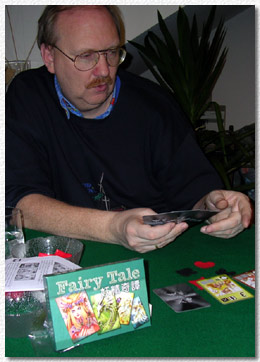
The game uses an interesting “round-robin” principle of card distribution.
There are four “drafts” in the game, and each draft consists of collecting five
cards by passing one’s hand continuously to the right or to the left each time you
select a card. This means that you not only have a certain freedom in selecting the cards
you want but also that you learn a lot about the collections of other players. It is also
possible to take away cards from them without hurting your own collection (because one
only plays 3 of the selected 5 cards). Therefore, if you see the player who gets your
card next collecting dragons for example, it might make sense to keep them for
yourself.
The symbols on the cards are very confusing at first (although they make perfect
sense) and use tiny drawings of manga dragons and nymphs, which are barely discernible to
the unaccustomed eye and some of us were completely baffled by their exact meaning. In
addition, although the rules are translated much better this time, there are still
confusions. For example the rules say that “close all (symbol)” means that all
cards bearing a certain symbol are turned over, but the cards also bear the number
“1” on the symbol, which would only make sense if each player only
“closes” one card of this type (which is already bad enough). We couldn’t
fathom which was correct.
Regardless of these aspects, “Fairytale” is still an enjoyable strange
little game, perhaps not as involved as “Masquerade”, but with a certain
Japanese charm.
Explanation time: 5 minutes (and 30 minutes trying to understand the symbols)
Game time: 20-40 minutes