Italia
reviewed by Moritz Eggert
Phalanx continues to manage a successful line of Euro games and “geek” games, or even
a combination of the two, like in the excellent “War of the Ring”.
Since the time when Lew
Pulsipher was inspired by the now forgotten hex and counter wargame “Ancient
Conquest” to create a comparatively simple wargame that creates what he calls a “sweep of
history” the mechanics of “Britannia” have been a fan favourite, and there are now
many variants of the game that recreate other place’s histories.
For an excellent overview on Britannia-like games please visit the website of one of the world-wide
leading “Britannia”-experts, Rick Heli.
Andreas Steding, designer of Italia I and II, has already created one of the best known
Britannia variants, the monster game “Hispania”, which recreates the history of Iberia,
today known as Spain. There are “Britannia” variants which simplify the basic system –
“Hispania” and “Italia” certainly do not go this road but rather add chrome and
special rules that give the players more choices but also more headaches.
“Italia” is – no surprise here – a recreation of the history of Italy from ancient
times. Unusual for a “Britannia” game it comes in two completely different versions that
cover two different time periods. The first one – another first – is especially designed for THREE
players, and once you consider the history depicted here it makes sense. In 10 rounds the players
play the rise and fall of the Roman Empire, from the Götterdämmerung of the Greeks to the final
days of the empire. One player will mainly be busy with the Romans, and his task is to hold and
expand the Roman position and deal with pesky revolts and upstarts. The other two players play all
the minor or big empires that constantly threatened Rome, most notably the Carthaginians with
Hannibal, whose campaign is actually a major event in the game.
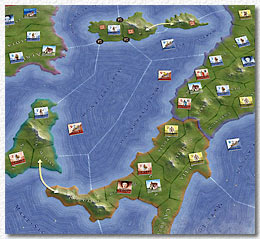
The interesting thing is that the game system constantly forces the two non-Roman players to
either gang up against Rome – which certainly has some power to defend itself – or to go for quick
victory points against each other.
The second game, Italia II, recreates the history AFTER the fall of the Roman Empire, and is
designed, like most Britannia games, for 4 players.
I will not go too much into the rules here, but instead add a list of major differences between
the “Italia” and the “Britannia” system (it’s not a short list) below.
| Summary of what is missing in Italia (VERY minor grapes, as the production value of this game is very high – beautiful counters, sturdy board, etc.) |
|
Andreas Steding has added a lot of chrome to the “Britannia” game system here,
avoiding some overly complicated mechanics that made “Hispania” very long to play. Still,
this is “Britannia” on steroids – the decision making is much more difficult as there are
lots of things large nations can do on each turn: raiding, naval moves, building cities,
campaigning. The latter mechanic simulates the long campaigns of Hannibal and the like, something
like a mini game in the game as other players can react to the ongoing campaign moves, also
something that has not been seen yet in “Britannia”.
All this might be too much for some. “Italia” certainly isn’t a game that makes
“Britannia” more accessible for the common market, rather the opposite. But there are
many interesting ideas here – the campaign system for example.
Where the game shines is in its 3-player scenario (or rather “game” – as the 3-player
version is completely different from the 4-player version, there are different nations, even partly
different rules). This is the first time it has been done right, with basically two sides
representing the nations oppressed by the Romans that constantly struggle among themselves, and the
third player representing mostly the Romans in their struggle to dominate the peninsula.
Game material is top notch, as usual with the “Phalanx” line, which is always put
together with great care and love, although there are some strange omissions (like a historical
reference or an overview over when all nations/armies appear). The rules are not for the
faint-of-the-heart – even Britannia veterans will have some new concepts to struggle with, although
they will still feel at home. Recommended, but not for the casual gamer. You should have a day free
for your first game, 8 hours recommended.
MAIN DIFFERENCES BETWEEN “BRITANNIA” AS WE KNOW IT AND “ITALIA I/II”
NEW PLAYING PIECES
- Consular Legions/Knights (2 hits, regenerate after combat)
- Fleets (transport, naval supremacy bonus)
- Elephants (scare/destroy additional units)
- Cities (earn gold, give defensive advantage)
NEW LANDSCAPE
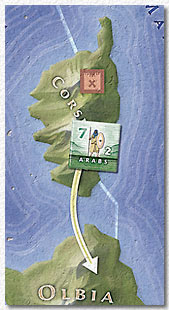
- there are sea spaces in which battles can be fought
- Marshland gives defensive bonus, but is no hindrance to movement
- Highland works similar to “mountains” in “Britannia”
INCOME/SPENDING
- All areas produce one “gold” (instead of population points)
- Cities also produce one gold.
- Gold can be saved indefinitely.
Income can now be spent on:
- Infantry legions, fleets (4 gold)
- Consular Legions (see limit in Italia I, 6.3), Knights, Elephants
- City in standard area (6 gold)
- City in “difficult” area, marshland or highland (8 gold)
NEW UNITS
May appear in “massing areas” which have to be left, otherwise pretty similar
(7.2).
POPULATION LIMIT (2 per space)
Does NOT exist!
STACKING LIMITS
Works very differently.
In short:
- Cities/Leaders do not count against the stacking limit
- Normal/marsh: 3
- Highland/massing area: 2
- Sea area: unlimited
- Declaring as “capital” (like in “Britannia”, presence of a city is
strangely enough NOT required): +1 - Capital declaration can be changed at any time, like in “Britannia”
- Rome is always the capital of the Romans
In addition:
- When moving into combat: +1
- When moving with a leader: +1
- When doing a major invasion: +1
(all cumulative)
In a campaign:
- Unlimited stacking with leader, or also for the other players during some “reaction
moves”.
Stacking limits are pretty much always in effect, even in retreating.
MOVEMENT
- highland stops like mountains, can be overcome with leader
- Straits stop movement like in “Britannia”
- marshland does NOT stop movement
- naval transport: ships may carry 2 land units each, can do naval move if starting in a coastal
space, and then do nothing but naval move, may stay on sea indefinitely - friendly cities negate terrain effects (work like Roman Roads in “Britannia”)
- leaders increase movement by 1 (of their group)
- units have different movement capabilities that are printed on the counters
- Overrun like in “Britannia”
- Ships move through each other, after all moves other players and the active player have to
declare combat in spaces the active nation moved in. If anybody declares combat, combat takes
place, otherwise no combat in sea areas (has to be done immediately after movement)

COMBAT
- Units have different “to hit” numbers (printed on the counters), that have to be
rolled on 10-sided dice, like in “Hispania”. - Elephants, Knights and Consular Legions have special abilities.
- Cities don’t defend with dice, they just add defensive capabilities.
- If victorious, city can be “sacked” and is destroyed (flipped to “ruin”
side). The pillager gets 4 gold. A city that is “sacked” can’t be rebuilt in the same
turn. - Rebuilding: remove one unit (not leader) in the ruined space when it’s your turn, city is
rebuilt from ruins.
Modifiers to the hit roll:
- highland/marsh -1 on roll
- City is defending -2 on roll
- Leader +2 (and this is CUMULATIVE – several leaders can create a super army!)
- Naval Invasion (landing with ships) or strait combat (like in “Britannia”): +2 for
the defender in the 1st round only - Fleets get +1 per transported unit
- Naval Supremacy (if adjacent sea area/s to combat space contain/s fleets of the nation in LAND
combat and total number of fleets of that nation is at least double the number of fleets of the
nation it fights against in those adjacent areas – I know, it sounds complicated, but that’s
how it is, folks…) +1 - Raid combat (see below): one combat round only, and no modifiers to attacker, hits on a 7
Raid combat is a new concept and is directed at pillaging cities if at least one damage is
created. Defending land units are NOT hurt. If city is pillaged, attacker receives 4 gold, and the
city is “raided”, which is different from “sacking” in that it can be rebuilt
IMMEDIATELY out of turn sequence.
RETREAT
Like in “Britannia”, but Attacker can also retreat to OTHER spaces than the one he
entered from, if they are either free or occupied by his own people.
VICTORY POINTS
Nation victory points are much more complicated than in “Britannia” and often
differentiate between “areas” and “cities” controlled.
CAMPAIGNS
This is a new concept. At certain moments in history nations can start campaigns, basically a
huge stack of units (no stacking limit) with leader that has to be paid 1 gold for each move. After
each of these moves nations adjacent to the campaigning leader can, in turn order, do reaction
moves.
Either:
Move to Battle: move any number of units adjacent to the campaigner’s space into battle,
disregarding stacking limit.
Or:
Move and See: Move one stack to one adjacent space ANYWHERE on the board, without initiating
combat, or to join an already existing combat (either the space with the campaigning leader or an
overrun space).
ATTENTION: it seems stacking limit is in effect here!
It is also possible to leave the space the campaigner has just entered, thereby giving ground
(think of the real Romans reaction to Hannibal’s campaign).
Raiding in Overrunning spaces are possible, but only during a campaign (again think of
Hannibal).
“BLOCKING” is a new concept that benefits the campaigner: for 1 gold AND 1 unit
sacrifice he can prevent movement in ONE adjacent space to the campaigning leader.
SUBMISSION
In general different rules for each nation, like in “Britannia”. Otherwise very
similar. The subjugated nation’s income is halved and rounded UP, the subjugating nation gets
the rest.
Areas controlled by the subjugated nation do NOT count as controlled, only in certain
circumstances. Some nations get the possibility to REVOLT. They can be subjugated AGAIN after such
a revolt. Sometimes submission is FORCED when falling below a certain threshold of units/areas. It
is sufficient to simply move one unit into an area of a nation that has forced submission. No
combat will take place and the nation immediately submits.

ADDITIONAL RULES
ITALIA I
Is a 3-player game and totally different from the 4-player game (ITALIA II). It has completely
different nations and time periods, so one can say that Italia is 2 games in one, not one game with
a 3-player variant. Some gamers actually prefer the 3-player game to the 4-player game.
- Rome can only be permanently occupied in Round 10, and is always automatically rebuilt.
- Hannibal campaign has some special rules for elephants and unit drafting (see 13.2)
- Game Turn 10 (the last) has only campaigns, and only three nations move, for all the other
nations game turn 9 is the last one where they can act - Roman legions may defect to another player’s side if controlled by Marius or Sulla
(leaders), see 13.4 - Major Battles: is a new concept that describes battles with 3 or more units ON EACH SIDE. Some
nations get extra points for winning major battles.
ITALIA II
Is a 4-player game.
- Knights have 2 hits like Consular Legions, but may not retreat after receiving such a hit
- Patrimonium Conversion: Twice per game the Patrimonium player can convert any one unit of
another adjacent nation.