King
Arthur
This game was eagerly expected, as we are big fans of games like “Legend of Zagor“. There is something about a game that
talks to you, although of course the novelty wears off quickly…
Knizia is a surprising author for a game like this – One can imagine that Ravensburger
first developed the idea, and then thought about which famous game designer to
ask…
Opening the huge box first impressions are very good – the game material looks very
nice, there is even a big plastic sword which sticks in the plastic stone that hides the
CPU of the game. It was a huge disappointment when I learned that the sword fulfils no
function at all!
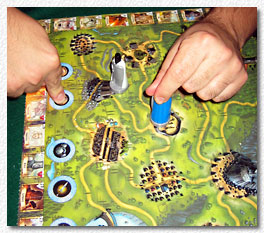
Playing the game has to be learned physically – the rules are very simple. Each player
starts out with an Arthurian knight, travelling the land in search for fame and a better
horse. The beautiful game board shows several locations the knights can travel too.
Although most of the pictures are pretty obvious, it is a shame that the spaces are not
titled – to learn where the “monastery” is for example has to be looked up in
the rulebook, as there are several buildings that could be a monastery!
First the knights are presented to the CPU by placing them on the starting space with
one hand and pressing (rather touching) a button at the same time with the other hand.
This causes a small current to run through your body, and the rules actually warn people
with a pacemaker to play the game – they might be killed by playing it! Thus the danger
and thrill of Arthurian times is reflected in the game design…
The game recognizes the colours and greets each player. Now we set off in search of a
lance, a horse and armour in the magical lands of mythical Britain. Basically this means
visiting the three castles and fight some monsters on the way to find fame. Your actual
fame score is not represented physically, but as a number shown on the stone when you ask
it. Which means that very often the game is interrupted when a player wants to check
his/her score….We found that working the electronic aspect of the game was not
always easy – sometimes the game doesn’t recognize your commands although you did
everything by the book (i.e. putting your figure on a space, holding it between the index
finger and thumb of one hand and touching an action button with the other hand – which
should result in actions like “talk”, “flee” fight” etc.). Our
fellow player Hans was mostly not recognized by the game, so other players had to do his
moves which became a bit annoying after a while. Perhaps his body didn’t conduct as
well? The rules advise to not use hand cream or anything similar, but this didn’t
seem to be the reason…The game communicates with different voices – if you meet a
maiden it will be a maiden that talks to you (and there is a very annoying one which
always wants to be saved by you). The sound quality is not very convincing (technology
doesn’t seem to have advanced since “Legend of Zagor” or “Dark
Tower”), but there is some attempt at acting and humour. We actually had to laugh
very hard when a castle inhabitant with an extremely gay voice is eagerly presenting us a
“wonderfully big lance” and tells us so repeatedly (well, you have to visit
these damn castles all the time, as the money you want to give them is never enough – and
boy, this guy just LOVES his “big lance”).
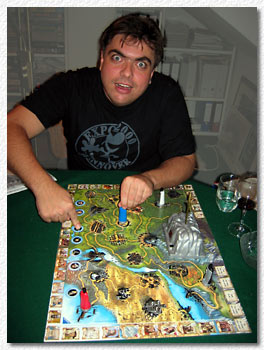
But this is not, where the game fails, actually the sounds have been done with a
certain attention to detail and are mostly quite amusing – it is the gameplay that
disappoints. Basically every player tries to accumulate goods to pay for the “big
lance” etc.. For this you either visit the villages (the villagers seem eager to
give you all they have) or have little adventures. The game also constantly declares a
random space as the goal of a little race – whoever reaches them first gets a little
bonus, and a new space is declared. Sometimes there is a little variation when you have
adventures, but the outcomes seem random and don’t hold your breath for the fight
scenes (the squeaking of the big dragon is especially pitysome – you would imagine the
sound designers could have come up with something more menacing. Perhaps he is afraid of
our big lance?). Even worse – very often you don’t really learn what actually
happened after a combat, and have to look it up by checking your fame score – if it is
lower, you have lost! The rules leave some things open deliberately (you are encouraged
to learn the game by doing), so there is some excitement in learning what happens behind
the scenes. But the longer you play, the more you get the feeling that the same game
presented as a normal board game without the voice gimmick would be incredibly boring and
repetitive (a la: “roll the dice: 1-3 the villagers like you and give you
provisions, 4-6 the villagers ignore you”). Even worse – It is quickly clear where
you have to go and what you have to do after playing for about 20 minutes, and therefore
each game after the first would become old quickly…The influence of master
designer Knizia is mostly evident in the very abstract logic behind the game, which
basically goes like “find resources – bring resources to certain key spaces – the
player who does this most efficiently wins the game”. The game does certainly
“work” in this respect, there is no fault to be found in the rules themselves,
but one gets the feeling that even smaller kids will be bored by this quickly, especially
when compared to the snazzy computer games of our time.
Apart of a certain novelty value this is a collector’s, not a game player’s
item – although I doubt it will acquire cult status in later years… but still,
there is the awfully big lance…