Neuland
reviewed by Peter Riedlberger
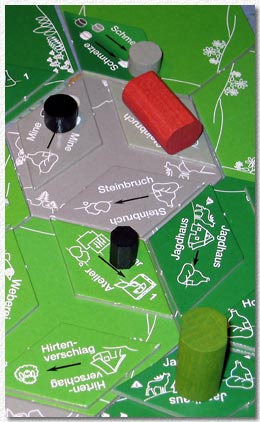
When it’s your turn in Neuland, you have a maximum of 10 actions. You can spend
those actions on the production either of raw products (e.g. wood) or of new production
sites (e.g. lumberjack cabin). The gist of the game is “production sequences”.
I will explain this unwieldy coinage of mine with the example of a turn and you’ll
see what I mean. I produce one piece of food (1st action). I use this piece of food to
produce a piece of rock (2nd action). I use the piece of rock to build a paper mill (3rd
action). Again, I produce first a piece of food (4th action) which I employ this time for
the production of wood (5th action). This wood becomes paper (6th action). Once more, I
produce food (7th action), then stone (8th action). This time, I use the stone to build
some victory point site (9th action). In the next turn (let’s imagine no other player
acted) I produce food (1st action), then stone (2nd action), then I activate the victory
point site with the paper from last turn and the stone (3rd action) and I get some
victory points.
This kind of production sequences can be much fun, e.g. in the computer game
Civilization (cultural advances). It is a gaming mechanism that works very well with
solitaire games since it can be mind thrilling to find the best sequence of production.
However, in Neuland, it doesn’t work out at all. We were four experienced players. No
one would finish his/her turn before having found the best sequences. This means: much
calculating (for the active player), much boredom (for all others). Individual turns
tended to last 10+ minutes. Since production sites are “public” (any player can
use them, no matter who originally built them) you have to carefully ponder whether you
should really establish e.g. a paper mill. Worse: Whenever you build a victory point
site, you make another victory point site available (which was not available before the
other one was built). You are allowed to check the stack. However, this means even more
calculating: If I build this site, I might give the next player the opportunity to build
a site that awards more victory points. Just another factor for your mental
arithmetic!
There are positive things about Neuland. The playing material consists of very nice
wood pieces (but you pay dearly with 44 Euros for that!) and I liked the next-player
mechanism very much: The fewer actions you use, the sooner it’s your turn again.
However, this is not enough to save Neuland. Gameplay is simply boring. It’s not much
fun to watch others calculating most of the time and to do some math yourself once in a
while. Neuland is too complicated for the occasional player and too calculable for the
seasoned veteran.
Westpark Gamers rating: 3.8