Popeln
reviewed by Walter Sorger
Actually, the title (nose picking) refers to an activity in connection with the
human nose and already in Essen at “Spiel 2004” visitors expressed a certain
surprise of bad taste when passing the game tables where this game was played. I, too, do
not find the title of particularly good taste. If you don’t mind I will use the verb
“screw” instead from now on, because in my generation this word has a very
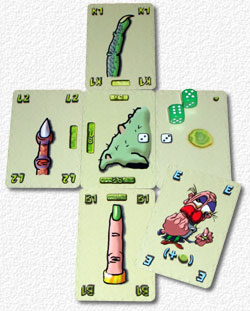
kind, harmless sound. Why not! In the centre of the game table lie five cards with noses
(we’ll stick to the name of our smell organ, here!). The cards lie apart far enough
that an other card can be placed on either of the four of the nose. To the eastern side
of each nose card a “booger” from a draw pile is placed. It shows victory
points, which players try to achieve.
Each player possesses five finger cards from the types north, south and west, which he
may place on the respective sides of the nose card. But only if there is a vacant space,
competitors may not be removed (unless they are of lesser value). Each player must place
at least one finger and can place a maximum of all five fingers during his turn. Once a
nose has been completed it has an exactly defined “conquest value”, calculated
by using the finger and booger cards next to it.
Subsequently, the dice are rolled. If you roll less than the conquest value, you may
take the booger and additionally remove one finger card. A new booger is placed on the
free space, the hand cards are filled up to five, and the screwing continues.
There are a few special cards, which allow a player to affect the conquest value of
the nose to his favour. The general sequence of play remains however unaffected:
- Be lucky and draw good cards!
- Place your cards in a well-conceived way on the one or two possible free spaces!
- Dice well!
That’s already a lot, or isn’t it? It sure is enough to receive two and a half
points from the Westpark.
Dear game producer:
- Couldn’t you have added a little red colour to the cards? There’s sometimes
nose bleeding, you know? At least the optical impression – for a traditionalist like
myself – would have been somewhat more pleasing. - The south fingers and the north fingers cannot easily be kept apart neither by form
nor by colour. Here the artist might have put some more thought into it. - The size of the fingers is not easily recognizable. I had to look at them quite
closely in order to differentiate a two from a three. Is this an intended challenge of
the game?
Small formal improvements and three WPG points would have been possible!