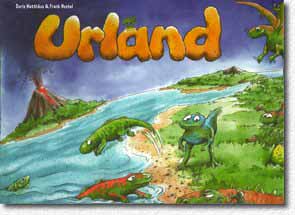
Urland
Publisher: Doris & Frank
Author: Doris Matthäus, Frank Nestel
Tester: Aaron Haag
Game Tested: 2001 Essen release
Scenario: 350 million years ago the ichtos (short for ichtyostega) prepared for
leaving the oceans and to populate the continents. Which ichtos will conquer the Urland
by clever propagation and the use of new genes?
The Game: This tenth game of Doris & Frank uses a similar setting as
Ursuppe published 1997. Again creatures controlled by 3 to 5 players try to survive and
make the best out of their genes. But this is the only similarity between the two games –
Urland uses completely different game mechanics and rules.
As with all Doris & Frank games the game components are very well done and of high
quality (e.g. 30 wooden Ichtos in 5 different color; three blank cards for creating own
genes) and as usual the gene cards and play aids come in an English and German
version.
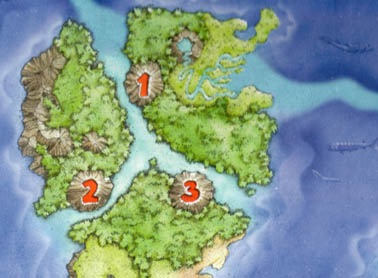
The board is divided into 3 continents each separated into islands (three, four and
five, respectively) by little straits. The surrounding ocean is subdivided into 5 areas.
Players start their Ichtos in 4 randomly selected islands plus 3 Ichtos in each of the
ocean areas and their task is to propagate and move them to land trying to establish a
majority on the islands.
Each round starts with the distribution of 3 roles to the players: the start player
(“environment player”), the dummy and the ichto player(s). The environment
player secretly selects an island that will score this round by choosing one out of three
island chips he is randomly dealt. The remaining to chips are then passed on to the
“dummy” player who may have a look at them but who is not allowed to reveal
them to the ichto players. These actions conclude the turn of the environment player and
the dummy player for the complete round, i.e. they will not move any Ichtos on the board
in that round. Now it is the turn of the Ichto player(s) who are allowed to perform 2
Ichto actions. There are four actions types to chose from: propagation, move onto land,
move between water areas and retreat (i.e. take Ichtos from board back into stock). Genes
provide extra abilities which can be used during the action phase but they come into play
only after some rounds have been played.
Once the Ichto players performed their Ichto actions the environment player reveals
the number of the island that scores by placing the chip he kept on that island. Scoring
is straight forward: any minority Ichto colors are returned to its player. Of the
remaining Ichto colors the majority holder gets 3 points and the other(s) two points. In
case there are identical numbers of Ichtos of each color present all get 2 points. Points
are recorded on a score track similar to Ursuppe.
In the next round roles shift in clockwise order, the dummy player becomes the
environment player and gets one randomly selected island chip so that he can select the
next island to score again from a total of three chips (the two he received from the
environment player in the previous round plus the one he just drew). The round then
progresses as described above. Eventually, an environment player will not be able to draw
an island chip as all but the two he received in the previous round have been placed on
the board. This condition completes an epoch and volcanoes erupt on the two remaining
islands decreasing the Ichto population there to just one per color present. Immediately
before the volcanoes erupt one of the islands is randomly selected for final scoring in
this epoch. Each volcano cases the straight between two islands to disappear thereby
reducing the number of land areas available for the rest of the game.
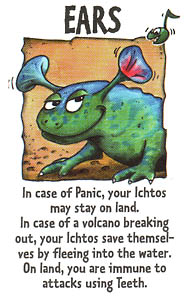
Genes come into play three times during the game when the first time a player reaches
12, 16 and 21 points, respectively. At the beginning of the game 4 genes out of the 11
available are placed face up for all players to see. Once the above condition occurs the
players start a bidding process for these genes. From the Ichtos not on the board players
secretly select a number they want to use for bidding. Players reveal their bid
simultaneously and the highest bidder must new select one of the genes on display and
remove the amount of Ichtos he used for bidding from the board plus one Ichto for
each gene he may already possess. The second highest bidder may now either select a gene
and pay or he may pass this right on to the next highest bidder. Once a maximum of three
genes have been acquired three new genes are drawn and put on display possibly increasing
the overall amount of genes to chose from.
The game ends as soon as one player reaches 30 points on the score track (the current
scoring round is however completed for all players). A final scoring round follows with
points awarded to the player with the most Ichtos an the board and to the player with the
most Ichtos on land areas.
Playing Time: The game can be explained in 10 minutes and played in about 60 to
90 minutes.
Similar Games: Ursuppe, El Grande, Evo, Vendetta (thanks Frank!).
Westpark Gamer’s Opinion: It was no surprise that the game plays completely
different than Ursuppe – the game mechanics are too different for that. The concept of
two players not taking an active part in the movement (i.e. Ichto action) phase is new to
me and it works surprisingly well. Being the dummy in a round may appear a bit boring as
there really isn’t anything you can do that round, hence the name. We first thought
that we misread the rules because this seemed so unusual but the rules state this quite
clearly (as does the German FAQ). Once we got used to this it seemed normal and one of the
mechanisms that make the game challenging.
Because of the ever changing roles during the game proper timing is the most
important factor for devising a sound strategy. Two consecutive Ichto action rounds in
which you have the possibility to rearrange your Ichtos on the board but have no
influence on where scoring takes place are following by two rounds in which you cannot
move your Ichtos but have control about the scoring location (environment player) or have
no control at all (dummy). Therefore most of the time one has to think ahead and consider
what one wants to do in the next round and prepare whatever is necessary to do this in
the current round. At the beginning of an epoch chaos is predominant as it is almost
impossible to judge which location will score. This chaos decreases round by round until
close to the end of an epoch certainty prevaeils and you are able to prepare your move
very precisely. Unfortunately, this is true for all players and again timing is in issue
here when it is necessary to consider which roles you are going to have in the last and
one but last round of an epoch.
Genes come into play very slowly, a lot slower than in Ursuppe. A maximum of nine
genes are in play (only six in a three player game) therefore having more than two genes
per player is clearly an exception. Again, careful planning is required to be able to
acquire genes because you need Ichtos off the board to be able to bid. On the other hand
these Ichtos are desperately needed on the board for propagation and scoring and even
worse, for paying for the genes! This results in a clever “self-regulation” in
so far as you cannot bid high even if you have a high number of Ichtos in stock because
this may result in near self-extinction on the board. On the other hand if you are strong
on the board you could pay a high price but you are unable to bid high as your Ichto
stock is depleted.
The genes themselves seem to be well balanced – so far we could not detect a
particularly strong one which would result in a certain victory. Gene combinations are
not as important as in Ursuppe and anyhow they occur rarely because of the low number of
genes in play. At times “Muscles” seemed a bit strong as well as “Warm
Blood” but we need to play more often to find if these really influence the game too
much.
Overall I really liked the game. The timing strategies are quite challenging and there
is still a lot for us to discover in terms of tactics. The game mechanisms are a bit
abstract but this is very well counterbalanced by the fun theme, the gene abilities and
last but not least the wonderful comic-style graphics of the game components.
I am still not sure whether or not I like the score track rule where positions
occupied by other players are not considered when moving forward. This clearly favors
players who are behind, yet not too far behind. This mechanism was also used in Ursuppe
and I found it a bit too strong there. In Urland the effect seems to be less obvious but
there may still be situations when this rule can only be regarded as a nuisance. There is
also an additional element of luck in the game in the form of a thirteenth land area
“Panic” chip which when drawn by the environment player requires that the land
area with the highest Ichto population must be completely abandoned and all Ichtos be
moved to adjacent water areas. This slightly favors the weakest player as he is the one
to chose the water area in case there is more than one.
Comparing Urland with Ursuppe, Urland can first of all be played in a shorter time. It
can also be explained in less time and playing seems to be not as difficult either.
However, winning the game is a different matter altogether: here I think that Ursuppe and
Urland hold an equal amount of challenges and both require experience and sound
strategies to win. To me Urland is a highlight of this year’s game releases and a
wonderful addition to what may become Doris & Frank’s “Ur” series.
Aaron’s Rating: not yet ranked
Westpark Gamers’ Rating: not yet ranked
| Links to further information: | Luding link to Urland |
| Doris&Frank’s English FAQ for Urland | |
| Doris&Frank’s German FAQ for Urland | |
| Doris&Frank’s Homepage |
|
| Funagain Urland page |