Cthulhu 500
Imagine ancient entities from the edge of the universe duking it out in a car race on
earth, using technology that man was not meant to know….you can’t imagine it?
Well, Jeff Tidball can: Welcome to the bizarre world of car racing combined with the
Cthulhu mythology of Lovecraft.
This new card game of Atlas Games has its tongue firmly in cheek; the idea certainly
deserves to be put into a museum featuring the world’s most bizarre game concepts…
but is the game any good?
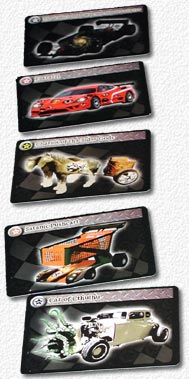
Players select one of 8 car/schematic combos (all with different speeds and complexity
levels), the car is placed on the abstract “track” (simply a row of cards
denoting first to last position), and the schematic serves as a reference for special
abilities that can be added during the game. Much like in “MagBlast” the cars
can be upgraded: there is room for one driver (the car drives without one as well), one
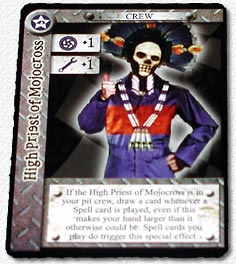
set of tires and two sets of “Mods”. In addition you can play cards in your pit
crew pool – a good crew of Mi-Go’s for example helps to gain speed…
Players have two actions per round: you can 1) play a card into your pit crew 2) play
an action card 3) make a pit stop and 4) make a passing attempt.
Passing is handled cleverly: you add up the speed/modification values of your car and
add to it the sum of a dice roll, your direct opponent in front of you does the same. If
your result is greater you surpass him in the race order (move the card one position
further “upwards”. There is also the possibility of a crash when the end result
of the two opponents is the same. Cars can get damaged (but not destroyed), and destroyed
cards are usually more prone to future passing attempts. If you pass the front runner you
end up at the end of the track again (the race track is a circle), gaining a
“lap” counter (NOT included in the game, typical for Atlas games who take care
of the cards but little else in their games). Ultimately the player with the most lap
counters will win the game after the end is announced when the “flag” card is
drawn. A pit stop is necessary to play car-enhancing cards or to try repairing your car
(then you roll against your car’s complexity). Unfortunately a pit-stop also means
that the car behind you gets a free out of turn passing attempt! But without tuning or
repairing your car you won’t stand a chance, so this is a necessary evil.
All this is a solid and simple enough concept; unfortunately the game falls in the
trap that is somehow typical for many “American” games: the introduction of the
dreaded over-powerful event cards that destroy anything that a game could be.
It is acceptable that a game with a theme like these involves certain chaos, and one
would certainly not expect any less. But while playing this game we actually longed for a
dry but solid makeover by someone like Knizia, so that at least every player has the same
chance to win.
“Titan: The Arena” is a good example of a
game with somewhat chaotic card effects that is STILL playable and gives everybody an
even chance. It is not free from luck, but luck never plays an overpowering role that
leaves the players clueless about what “strategy” to follow.
In “Cthulhu 500” pure chaos reigns, but this chaos is not very much fun for
the players. A good example is the “take over the turn” card, where a player
can suddenly get an extra turn out-of-order and the game continues from this new
position. In our game Andrea was simply passed over THREE consecutive times in this
manner (and was rendered inactive for 30 minutes) – she had absolutely no influence on
this, it was not even an attempt to play against her, it just happened. This is not only
frustrating – it is simply lazy game design a la “hey, this card sounds like a funny
idea, let’s just put it in and see what happens”.
And this is not the only card that totally throws the game off-balance. In fact there
are countless cards like this… and the “mod” cards range from totally stupid
to immensely useful and strong. In a good game ALL mod cards would be equally useful, but
each in a different way.
The most positive aspect of the game was that Walter (who usually hates this kind of
games and complains incessantly – I begin to understand him) was in a very jolly mood
throughout, and that everybody tried to not take it too seriously (which would be
difficult with the subject matter anyway). But it is clear that this game won’t hit
the table anytime soon, and this is not a good thing…
Not recommended!
 |
||||||||||
|
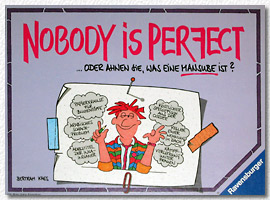
Nobody
Is Perfect
Nobody of us was perfect because nobody of us remembered if this game had been
“Spiel des Jahres” some time ago or not. Today we would certainly give the game
the “SPUD des Jahres”….
“Nobody is perfect” takes the well-loved “encyclopaedia” party
game concept and tries to develop a board game around it. Everybody might have played
this game sometime: One player selects a strange term from the encyclopaedia that nobody
knows anything about. Now each other player writes down a definition or explanation that
COULD be the real meaning of the word. The 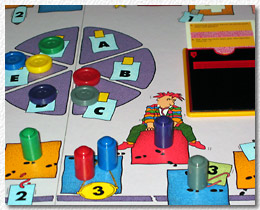 TRUE real definition is mixed in with
these, and read aloud together with the invented definitions. Now each player has to
guess which definition is the right one in his/her opinion. If you choose an invented
one, the player who invented it gets points, if you choose the right one YOU get points.
Part of the fun lies in the fact that you try to invent explanations which SOUND right,
but perhaps are purposefully wrong (it is not uncommon that somebody DOES know the true
meaning of the word, but invents a silly explanation on purpose). It is also possible
that the real explanation sounds like the most unbelievable one, so it is not always good
to avoid the explanations that sound silly.
“Nobody is perfect” uses a race track typical for many quiz games. The
“questions” fall in three categories (one category, guessing what is depicted
on a picture, is totally boring and was generally avoided during play). The authors have
managed to assemble many unusual questions, but there didn’t seem to be a lot of
them. They also tried to make the race game more “interesting” by introducing a
“gamey” element like “the last player who passes this point moves another
4/5 spaces forward”. This is not only unnecessarily “gamey”, but also
silly, as there is no way on earth that you can purposefully pass a space last in a quiz
game where you only move forward by guessing correctly….
What remains is yet another attempt to translate a party/quiz game to the board game
market, and the strong feeling that this has not been really necessary – some games DO
work better as a party game, they don’t improve by adding a board and some pawns.
Play with non-gamers only, it is not devoid of fun, but otherwise beware!