Spielbericht 31.10.2002 (Halloween)
Author: Moritz
at the table: Peter, Andrea, Hans, Moritz
on the table: Quest for the Dragonlords, Cannibal Pygmies in the Jungle of
Doom, Star Wars – Epic Duels
- Quest for the Dragonlords
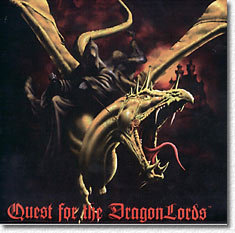
After the games fair in Essen we are again starting the slow process of trying out all
new releases, in our “orc games sub division” group of the Westpark Gamers the
focus is – of course – on fantasy games. I was the happy buyer of the 85th (of 1000) game
of “Quest of the Dragonlords” for 2-4 players, which was released for the first
time in Essen, and which looked like an interesting cross of Axis and
Allies, Risiko and Talisman, , with a high “hack factor”, as the “Knights of the Dinner
Table” would put it.The game presentation is absolutely stunning – hundreds of plastic figurines that depict,
not surprising considering the genre, gigantic dragons, armies and fleets. 4 races
(Elves, Orcs, Dwarves and Barbarians) fight for the control of a fantasy kingdom that is
laid out on a nice but slightly confusing (regarding mountain borderlines, which are
sometimes difficult to detect) map. There are some strange details: For example, Elves
are RED and the orcs GREEN (“tradition” usually favors the other way round).
Also notably different are the special abilities of some of the races – Elves are not
noted for range strikes but for hobbit like sneak attacks here, but well, if you think of
Celeborn’s sneaky elves in the film…. And barbarians are especially good
shipbuilders, well, they didn’t watch “Conan” then!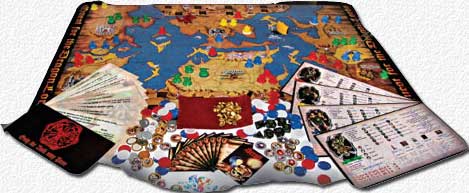 Setup works like in “Risk” – each player takes
turns placing single figures until the map is full, therefore creating different starting
situations. Especially important are “treasure” spaces (some on islands) and
“kingdoms” (gives you control of a colored region of “areas” –
important for army regeneration and income). But even “empty” spaces are
important – they more you have the more gold income you get, also not unlike Axis and
Allies. Another similarity to that game is the fact that armies bought at the beginning
of the turn are placed at the END of the turn, after hacking, so to speak.Gold is depicted in a very nice way – real “lumps” of gold are used, each look
different and “natural”, a good fantasy touch. The coloring used is very
….well, very little water and sweat resistant, so you have to get used to become a
goldfinger like ol’ King Midas.Player “cheat sheets” are also produced lovingly – they are all different, and
even expensively mounted, like the game board. They feature info on spells and turn
sequence, there are even holes in which you can stick markers that show what spells you
have (the holes are rather small for the plastic pieces used, but that is only a minor
qualm – use “the force”).The aforementioned setup presents a small problem of the game – there are 6
“kingdom” spaces to start with, and everybody wants one first, so in a 4 player
game players 3 and 4 will certainly only get ONE kingdom space, the others 2. Not only do
they suffer the typical “Risk”-disadvantage of moving last, they also get less
money to start with. No problem here for 3 or 2 players, though.Now we start – each player’s turn has several phases: First you buy armies, then you
move fleets and dragonlords (which you won’t have at start – it will be one of your
main goals to find one of these very elusive guys!), then you move your quest parties
through the wastelands (two specially separated adventure areas – when you enter them,
your armies become adventurers seeking fame and magical power, when you leave the
wastelands, your adventurers become armies again, hopefully more powerful). Then there is
a kind of “combat move” like in “Risk” – attack to win, then you can
move your victorious armies into the new territory…and beyond, if you want, to continue
your attack!. Then there is a kind of “forced march”, actually a special phase
not named as such, and a “transfer move”, which takes care of spaces that
became empty, but weren’t conquered. Then you collect income for your areas and place
the armies you bought at the beginning.The adventures in the wastelands are much fun – they give some role-playing flair,
although everything is very simplified and basically is decided through one roll of the
die, even when the “flavor-text of the adventure cards might make you think
otherwise. But there is still some tactics involved – you have to have certain items to
survive certain adventures, and there is always a choice to make if you want to lose time
with equipping or boldly go into dangerous spaces. The center space is the dragon’s
cave – you need a certain “Talisman” to get a dragonlord there, and that’s
what you want, really. Why? Although some of the spells and items you can find in the
wastelands are nifty, the dragonlord is the ultimate weapon – he can breathe fire to
destroy fleets and armies, and he can teleport 10 armies ANYWHERE on the board (the rules
dryly note that it doesn’t make much sense to protect borders in this game – there is
too much teleportation going on here…).This is vital to ending the game more quickly than your usual fantasy monster game -the
player who kills all the other “kings” (one army piece is declared to be
“king” at the beginning of the game – protect it at all costs, mate!) wins the
game (you can also win by conquering all kingdoms, but that is very difficult).This is always a slight problem in a game: eliminated players will have to idly sit and
watch – the designers have hinted at publishing alternate victory conditions soon, which
will be interesting. We usually stop when one player is eliminated in our group.Our first game thus actually ended in the first round – before the 3rd and 4th player
had moved at all! One player hadn’t expected that armies and fleets can practically
reach any space on the board, and had placed her king alone! The second game was also
over quite quickly, but this came through a misunderstanding from my side of the rules,
which made the attacker too powerful in a combat. But it was me who was eliminated, so I
was punished for this oversight!Our impression was that “Quest…” is an interesting and fun game – it might
not win a prize for originality, as most game mechanisms are known from other games, but
the clever combination of these elements creates a fast moving (compared to other games
of the fantasy battles genre- we’re not talking “Liar’s Dice” here!)
game with an “epic” feeling, I guess around 3-4 hours if played correctly. The
presentation creates a lot of flair, you can really annoy other players, and the splatter
factor is high. The price is VERY good when you look at the game components, and it is
clear that a lot of love went into the production. The game rules are even additionally
presented on CD (with animated examples) – which is pure luxury, really.Westpark-Gamers say: Recommended!
- Cannibal
Pygmies in the Jungle of Doom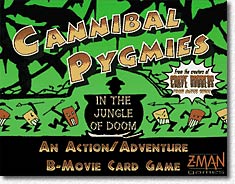
Auch dies eine Messeneuheit, das Nachfolgespiel zu “Grave
Robbers from Outer Space“. Dieses recht einfache Kartenspiel evoziert die Welt
der B-Filme in all ihrer Glorie, diesmal mit speziellem Augenmerk auf
“Dschungel”-Abenteuer-Filme (Tarzan lässt grüßen).Jeder Spieler ist ein Filmproduzent, und versucht “seine” Version des Films
aufzubauen, mit eigener “Location”, und verschiedenen “Characters”,
die auch “props” besitzen. Alle diese Karten haben Punktwerte, die sich zu
einem gesammelten “Defense”-Wert addieren. Dieser ist auch potentieller
Punktestand für den Sieg, wenn die Karte “Roll Credits” gespielt wird. Es gibt
allerdings noch eine zusätzliche Punktequelle, nämlich den Filmtitel – am Anfang des
Spiels wird aus 6 zufällig gezogenen Karten ein möglichst bizarrer Titel zusammengestellt
(in unserem Fall war das “The Mystic Portal of Egypt versus the valley of the
volcano amazons” (nun, vielleicht ein bisschen zu lang, um im Kino erfolgreich zu
laufen). Jede Karte, auf der Hand oder im Spiel, die einen Teil dieses Titels trägt,
bringt 5 Bonuspunkte, muss also eine der ursprünglich gezogenen Karten sein.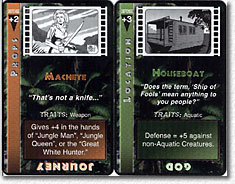 Im Spiel benutzt man Monsterkarten sowie SFX-Karten (letztere sind hundertmal
schlimmer, denn sie können IMMER gespielt werden), um die Filme der anderen Spieler
anzugreifen. Hierbei wird Gott sei dank nicht gewürfelt, sondern einfach nur Angriffs-
und Verteidigungswert miteinander verglichen. Alle Spieler können SFX-Karten spielen, um
das Ergebnis zu beeinflussen. Siegt der Angreifer, stirbt ein “Darsteller”. Und
man staunt – 80% aller Angriffe sind erfolgreich, denn die Monster sind nicht gerade
schwächlich!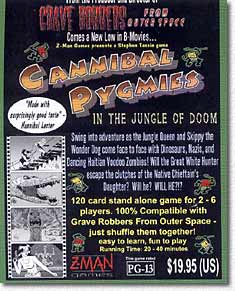 Das Spiel besteht vor allem aus den komplexen Karteninteraktionen –
praktisch alle Karten im Spiel haben einzigartige Sonderfähigkeiten, die die Regeln
brechen können, manchmal ist es gar nicht einfach, den Überblick zu behalten! Der
Chaosfaktor ist extrem hoch – kaum hat man mal mühsam 1 oder 2 Darsteller in seinen Film
gebracht, schon verschlingt sie irgendein Monster oder irgendein Spezialeffekt, die
meisten Züge beginnen damit, dass man seinen gesamten Film erst wieder aufbauen muss, was
einem anhand der mehr oder weniger guten gezogenen Karten mehr oder weniger gut gelingt.
Es macht ohnehin keinen Sinn, irgendwelche Karten (außer der Bonuskarten) aufzuheben,
denn ständig verliert man seine Kartenhand, bekommt einzelne Karten weggenommen, etc.).
Daher gibt es auch keine längerfristigere Strategien – es zählt allein der Spaßfaktor der
im 50er-Jahre-Comic-Stil gezeichneten Karten. Das ist beim ersten Spiel vielleicht ganz
nett, weil die Karten neu sind, wird aber sicherlich beim mehrmaligen Spielen mühsam und
langweilig.Gewinnen tut man nur dann, wenn man 1) Gute Karten in der Runde ausspielen kann 2) die
“Roll Credits”-Karte besitzt und spielt. Dies kann man auf keinen Fall
vorausplanen, es ist pures Glück.Zudem dauerte das Spiel extrem lang – manche Karteneffekte verhindern “Roll
Credits”, und so kann sich das Chaos ewig (zumindest ZU ewig für ein kleines
Kartenspiel) hinziehen.Dennoch: Für Fans der Thematik ein nettes Spielchen, und die Karten sind wirklich
lustig. Ansonsten spielerischer Durchschnitt. - Star Wars – Epic Duels
Dieses Spiel wird spannender und besser, desto öfter man es spielt! Diesmal traten Darth
Vader und Count Dooku, sicherlich die beiden mächtigsten Charaktere der dunklen Seite,
gegen Anakin Skywalker und Han Solo an. Da wir inzwischen die Karten immer besser kennen,
wird das Spiel immer taktischer, zudem spielten wir mit einer kleinen Variante, die es
erlaubt, immer eine Karte des Teampartners zu sehen.Count Dooku wagte sich gleich am Anfang zu weit vor, und konnte durch eine glückliche
Kombination von Anakins Spezialkarten unschädlich gemacht werden. Doch auch Han Solo
starb kurz darauf durch eine Kugel eines Nebencharakters. Nun galt es, Darth Vaders
Sturmtruppen unschädlich zu machen, um einen Spieler auszuschalten (und damit einen
Kartenvorteil zu erlangen). Dies gelang, doch letztlich führte allein die Zähigkeit
Chewbaccas zum Sieg der Guten – Anakin war schon kurz am Abnippeln bevor Chewbacca den
rettenden Armbrustschuss tat.Da hat Darth Vader sich also letztlich selber umgebracht, oder zumindest dabei geholfen!
Dies kann nur bei EPIC DUELS geschehen!