Game Session Report & Review – 26.03.2003
Author: Aaron
at the table: Thomas, Moritz, Günther, Aaron und Walter
on the table: Anaconda, Keythedral
- Anaconda
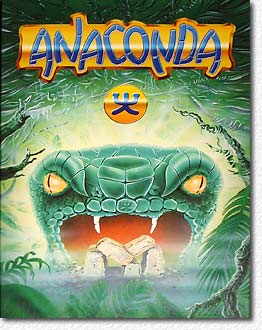
In front of us lies an impressive looking box filled with high quality components –
obviously this is true Ravensburger style. And someone didn’t really have to bother
about the production cost of the game either – no wonder: it’s a marketing game of
Siemens
Business Services about finding “e- and m-business cards” as Siemens puts
it.Well, marketing games do not have the best reputation in terms of game design and the
game designer (or rather design team) “Funtasy Factory” only comes to mind for
their not so well received card game “Der Schuh des Manitu” – a merchandising
product for the hilarious, and very successful, German film of the same title.This in mind we studied the rule book with mixed feelings and learnt that each player
represents an expedition team in the deep jungle near the Anaconda Valley and that their
goal is to collect two mysterious, golden “future stones”, the jokers
(referring to the stones, not the design team). Rather surprisingly, the Anaconda Valley
depicted on the board is “off limits” and cannot be entered but our search for
some logic in this story was going to be challenged even more.Unfortunately, the expeditions have lost all but one item of their high-tech equipment
that will successfully guide them through the valley and help them in case of emergencies
in this adverse environment. Luckily, the game designers created a set of rules that
allow expeditions to regain pieces of equipment: each of the lost items as well as the
joker is located in one of the seven Maya temples placed on the board. And there is a
card deck holding each item twice and its top card tells the players the item to search
for next. To make things easy each player is allowed to look at the content of three of
the seven temples before the game commences.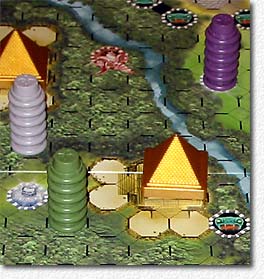 So, off the players go to search for the item, those who already
know the correct temple (and still remember it) rushing into its general direction. The
motor for the movement turns are cards showing a number of movement points that must be
spent completely and usually 2 directions an expedition may move into and each player has
a hand of 7 movement cards. Some cards allow movement in all four directions (diagonal
movement is never permitted) or allow rolling one or two dice to determine the number of
movement points. In addition there are teleport fields on the board that enable players
to travel long distances in one turn.Some of the movement cards carry a symbol indication that the expedition has encountered
an additional challenge described on an event cards to be drawn. The challenges all
require the usage of 2 of the high-tech items in order to be completed successfully. For
example, one of your expedition team members suffers from diarrhoea and you need your
“analysis device” to search for the cause and call a doctor with your
“cell phone” to ask for a cure. If you have both items you get the advantage of
regaining energy points or the like, if you only own one of the items you can still ask
another player who has the item to use it for you, usually providing a benefit for both
players. Only if you don’t have either of the items needed do you have to perform an
action which helps the other players or hinders all (like changing the position of two
temples).Tactically, it doesn’t make a lot of sense to chase for items whose temple position
you don’t know since you are running the risk of finding the wrong item and loosing
energy points as a consequence. And the challenges described on the event cards
aren’t really a problem, even if you do not own any of the items asked for. This of
course is not true the joker item. As with any other item there are also only two such
joker cards in the game. And to win the game a player must possess both joker stones!
Inevitably, each player will rush to the temple holding the joker once this card is at
the top of the item deck. Those who know the correct location will do this on a more or
less straight path; the others are left with the task to determine where everybody else
is rushing to.Once the second joker has been collected there is no real need anymore to collect the
remaining items as the endgame now begins (the designers luckily became aware of this and
split the item card deck in two parts to be played in sequence – each part holding one
“joker” card).We found that the endgame is rather broken. Most of the time two players possess one
“joker” each, finding themselves in the position to hunt down each other to
acquire both. Leaving the other players aside, this task in its own is quite ridiculous.
To get the stone from the other player one has to attack that player by moving on the
same space the player currently is on. This may take a while due to the movement cards
and the requirement that you spend all your movement points on the card. But once this
has been achieved the odds of the attacker to win the fight are only 25% making it very
unattractive to attack someone in the first place. The looser of a fight has to
relinquish the joker stone to the other player (or any other item if he doesn’t
possess the stone). How on earth this game can be completed within 45 minutes without
players giving up by just attacking the other stone-carrier and most likely loosing their
own stone that way is beyond me.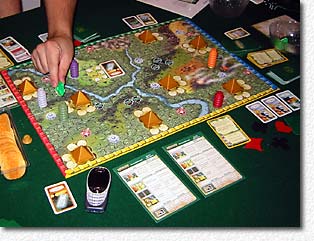 Anyway, Günther and I, both carrying a stone came to the
conclusion that to end the game it is required to fight and, hence moved towards
each other. Eventually, Günther was in the position to attack and to no ones
surprise lost his stone to me. On my next turn I performed what should have been my
winning move by moving onto the “Anaconda Valley Exit” field. Here the
last and final challenge is waiting: a randomly drawn card shows three items and
asks for the identification of the corresponding Maya temples. While I was
absolutely sure about two of the temples I had some doubts about the last item.
Walter pointed me towards the temple he thought was correct (just to end the game I
guess) and I chose that one – only to find that it was the wrong one! As a
consequence I lost both stones which were placed on the base camp fields and my
expedition was moved away far enough to have no chance of regaining them in the next
moves.Thomas and Günther grabbed one stone each in their next turn and Moritz performed what I
would call the best Anaconda tactical move possible: he moved his expedition onto the
exit field ready to fight with anyone wanting to leave the board. Since he would be the
defender his chances of gaining a stone was 75% – not bad. Unfortunately, in his next
turn he had to move away before having been attacked by both “stone carriers”
and Günther in the end won the game.Siemens terms the game quite rightly a “party game”. The story behind the game
is ridiculous enough to catch the first laughs. And while the game unfolds more and more
flaws are discovered by the players which can only be endured if no one is willing to
take the whole thing serious. For strategy gamers Anaconda will be endless and result in
a stalemate. The best tactical advice on how to win Anaconda is: stay close to the temple
with the “joker” stone and ignore the other items (but remember their temple
position!). And most importantly: attack the joker carriers and roll sixes. - Keythedral
Following Keywood, Keydom and Keytown this is the fourth game
of Richard Breese. As with his earlier releases, Keythedral has been published in a
rather small number of only 600 games and after the success of the earlier games it came
as no surprise that Keythedral was almost sold out on the first day of publication.
Luckily, Günther was able to grab a copy in Essen 2002.Keythedral comes in the same good production quality as Richard’s earlier games and
in fact he seems to have been listening to some quarrels about the rule books in the past
as this time we find a full size booklet with clearly described rules and all the
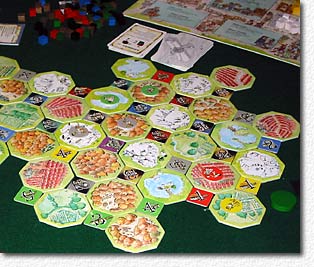
important details in a nicely structured way.The game board this time is variable and consists of octagon shaped tiles depicting
different terrain types for five different resources (timber, stone, water, crop and
wine). Before the game commences four of these tiles (2 stone, 2 timber) are placed next
to each other yielding a square shape. The little square shaped “hole” in the
middle is where the cathedral marker is placed. In sequence each player now takes one of
the facedown tiles and places it along the long side of any of the already placed tiles
and as a second step places one of his five “cottage” markers at any of the
available short sides of a tile. The aim here is to place your cottage in such a fashion
that each of the four sides of the cottage token eventually borders a terrain tile in
order to have a good choice of resource fields you can send your worker to (who lives in
the cottage) in the later phases of the game.Once the board has been completely set up the player turns begin. Each turn has 4 phases
and each phase is played for all players starting with the start player. In the first
phase players select in which order the cottages send out their worker to the fields
(only one worker is allowed per field), in the second phase players collect the resources
their workers produced on their fields (each worker/field combination produces one
resource) and in the third phase players can spend their resources. In the fourth and
final phase the return to their homes and the next round begins.The right to determine the start player of the new round is up for auction – a game
concept already known from Keytown. The player left to the current start player calls out
how many resources he wants to spend to get this right followed by the other players who
have to increase if they want to bid. The current start player is the last to bid and for
him it suffices to match the current bid.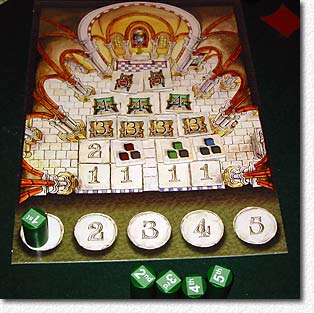 In order to win the game, players must collect victory
points. These victory points are stored on a second board showing the interior of
the cathedral. Here we see 17 tokens, four each in the lower three rows providing 1,
2 and 3 VPs, then a row of three tokens with 4 VPs and two 5 VP tokens in the top
row. When the game starts only the lowest row of tokens is placed face up showing
the required resources to buy each of them. Once a row becomes empty the prices for
the next row of tokens are revealed. Obviously, the number and value of resources
required to buy a token increases with its VP value. In fact, only row’s 1 and 2
tokens can be bought with resources alone while the higher valued tokens require
goods like glass or even gold.All these acquisitions happen in phase three of a turn when players in sequence decide
what they want to do. The buy options are to acquire a VP token with available resources
or goods or to trade resources for goods. Other options are to convert a cottage to a
house (a house can send out two instead of one worker), build a fence to prevent workers
from other cottages/houses to work on a resource tile, or to demolish a fence. All of
these build options cost resources, too. Finally, besides passing, a player may buy one
of the two face down “influential law” action card that are available per
round. Doing so ends phase 3 of that player. Influential law cards provide a one time
special ability when used. Once all players have passed phase 3 of the current round
ends.There are a lot of choices in this game, some of them strategic other more tactical.
Here are a few hints about how to win Keythedral:Clever setup
It’s obvious that you need to place your cottages in such a way that you have access
to all five resources. Since there will be times when the choices for worker placement
are rather restricted it is a good idea to have at least 2 cottages bordering each
resource type. Especially timber and stone are important resources as they are required
for house and fence building therefore you need to make sure that you have safe access to
both. Here you should consider that the fields next to the cathedral have one cottage
less to compete with. Also take into account the seating order and the cottage numbers
bordering a tile: never place a cottage next to a tile which has already an equally
numbered cottage of the player to your right next to it. It’s also a good idea to
have at least timber or stone as a safe field which can only be accessed by you.Building houses
Build your houses as soon as possible to make the best use of them. Remember that the
game will last for only six to eight rounds. Houses can act as a sort of deterrent to
other players preventing them from building a house in close vicinity to yours. It’s
often not worthwhile to build more than three houses as competition usually is very
fierce on the board.Selecting cottage order
You need to constantly watch the board to determine you “safe” fields as
opposed to the fields where you are competing with possibly several other players. If
possible make sure that you select a cottage number which provides you access to one of
the most competed fields.
Trade early
Once the 4 VP tokens are turned over you are bound to need gold and/or glass. So
it’s a good idea to trade these already a round in advance so that you can grab the
cheapest VP token in that 4 VP row. There’s of course a risk here as you do not know
for sure which goods will the required but going for gold with a safe income of timber,
stone and water in the next round will almost certainly get you that 4 VP token. Make
sure that the start player position is favourable, too.Start player position
Being the start player is quite nice but sitting one or two positions left of him in a
four or five player game doesn’t really do any harm either. It’s obviously not a
good idea to sit right to the start player as this will severely limit your options in
this round.Buying VP tokens
There’s a total of 46 VPs in the game so anything above 12 VPs usually means sure
victory in a four or five player game. I believe that it is a good strategy to go for the
low valued VP tokens and then prepare to grab either a 4 VP or 5 VP token to get those 12
or 13 VPs in total. But watch out what the other players are doing! If they follow that
same strategy you may want to consider going for two 4VP and one 5VP token instead.