Spielbericht und Strategie-Tipps vom 15.04.2003
Autor: Moritz
am Tisch: Andrea, Hans, Walter, Moritz
auf dem Tisch: Kings & Castles, 6 nimmt
- Kings & Castles
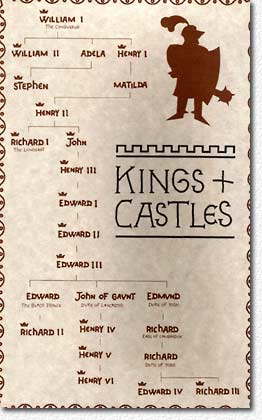
Strategietipps (da bei uns schon mal
besprochen):1. Der erste Spieler
Wie von uns bei den Spielen bisher bemerkt wurde, ist der Anfangsvorteil immens: Man
kann nicht nur bei großzügigem Einsatz seiner Truppen viele Punkte machen (eine Wertung
ist fast Pflicht als Startspieler), nein, man ist auch DER EINZIGE der punktet, da die
anderen Spieler noch nicht auf dem Feld sind. Daher sollte man ruhig versuchen, hierauf
zu bieten. Viele Spieler sind bei ihrem ersten Spiel dabei sehr konservativ und zaudernd,
ich persönlich würde für den Startspielervorteil bis zu 6 Armeepunkte bieten, vielleicht
sogar mehr.2. Die kleinen Länder
Die meiste „Action“ des Spiels wird in England und Frankreich geschehen,
wobei Frankreich vielleicht sogar die meisten Kämpfe sieht, da hier die neutrale Farbe
Schwarz nie ausgerottet werden kann. Danach kommen, in dieser Reihenfolge, Schottland,
Irland und schliesslich Wales. Man sollte versuchen in mindestens einem dieser Länder
einmal König zu werden (wobei Wales und Irland besonders interessant sind), denn dort
platzierte Armeen leben länger. Gerade Wales ist sehr klein und nur zweimal Königsland,
und daher besonders geeignet. Selten wird Wales auch als zweites Aktionsland genutzt, da
es zu wenige Möglichkeiten bietet, unerwünschte andersfarbige Armeen fies einzusetzen.3. Die schwarzen Armeen
Grundsätzlich gilt, daß man möglichst immer schwarze Armeen in einem Regierungsland
leben lassen sollte. Ideal sollte man dann die Felder, in die die Schwarzen angreifen
können, gut verteidigen. Die anderen Spieler sind dann entweder gezwungen, die Schwarzen
erst auszurotten, bevor sie gegen einen selber aktiv werden können, oder sie müssen sehr
viele schwarze Armeen haben, was nicht unbedingt häufig ist.4. Die „uninteressanten“ Länder
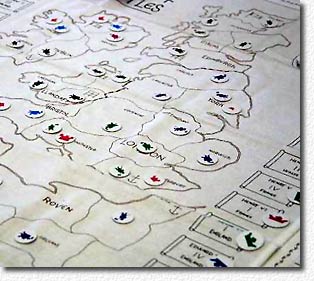 Das Geheimnis des Sieges bei „Kings &
Castles“ sind nicht die Punkte, die man bei seinen eigenen Taxierungsrunden
macht, sondern die, DIE MAN BEI DENEN DER ANDEREN SPIELER macht. Daher sind viele
der Strategien, die auch bei dem anderen Ragnar-Brothers-Spiel „History of the
World“ (deutsch: „Empire“) funktionieren, auch hier gültig.Die wertvollen Felder wie London sind meistens heiss umkämpft, selten macht es Sinnn
hier viel zu investieren. Interessant sind vor allem die Felder, die nicht den Weg zu
einem wertvollen Feld versperren, und die nur einen Punkt wert sind, sogenannte
„uninteressante“ Felder.England sieht gerade im Norden wenig Kämpfe (da es bald keine schwarzen Armeen mehr gibt,
wird meistens direkt im Süden um London oder Bristol gekämpft) – ein Feld wie
Carlisle wird einem eventuell das ganze Spiel erhalten bleiben, dasselbe gilt für
Toulouse oder Rennes in Frankreich, Perth oder Stirling (nicht beide besetzen!) in
Schottland, Cardigan oder Denbigh (nicht beide besetzen) in Wales, Limerick in Irland.Eine Garantie des Überlebens gibt es nie, aber man sollte diese Felder auf jeden Fall zu
erobern versuchen, wenn man es kann.Das beste 2er-Feld im Spiel ist übrigens York (im Norden Englands). Dieses Feld lohnt es
sich eventuell stark zu verteidigen!5. Festungen
Auch bei „History of the World“ wird oft der Fehler begangen, wertvolle
Felder mit Festungen zu verteidigen. Dies ist nur in den seltensten Fällen richtig, man
sollte dagegen gerade die uninteressanten Felder so stark wie möglich verbarrikadieren.
Eine 3er Armee und eine 3er Festung werden in den meisten Fällen gegnerische Spieler von
der Eroberung eines Feldes abhalten, das nur einen Punkt bringt, und nicht durchquert
werden muß, um wertvollere Felder zu erreichen. In einem Feld wie Limerick kann eine
solche Festung das ganze Spiel überleben, und bei 4 Spielern bis zu 17 Punkten machen
(3×2 eigene Wertung, 1×2 Schlusswertung, 3×3 Wertungen anderer Spieler)!!!6. Jammern
Ein bißchen Jammern und gelegentlich auch geschicktes Verhandeln schadet hier, wie bei
vielen anderen Spielen, nicht. Aber nicht übertreiben, manchmal kann diese Taktik auch
extreme Agressionen bei den anderen Spielern hervorrufen!Moritz Eggert, 19.4.2003
- 5 Tips for winning „6
nimmt“
This supposedly light game has more strategy than most people think. Here are some
tested tips to lower your average score (scoring is negative for the player in “6
nimmt” – just for those of you who don’t know)1. Play the card with the least risk of taking a row
This is so obvious that I feel embarassed pointing it out, but some players actually DO
forget this and rather play “from the gut”. Look at your cards, and if there
is a card that is the most safe to play, choose it, as easy as it is. Of course this is
not always obvious, but sometimes it is very obvious that playing a certain card will
most definitely have you take a row. Avoid this card. Understood? Very good, than we can
move on to more subtle strategy…2. Get rid of extreme cards as quickly as possible
It is clear to the experienced player that the very high and very low cards are your
greatest danger. Usually players are more scared of the low cards, as they are more
difficult to play without taking a row, but that can be deceiving. In fact a high card
can become much more dangerous – a “100” is a bigger risk keeping than
a “1”, for example.The low cards are also not attractive, BUT… even a “1”card can come handy
late in the game, when you rather take a small row with one or 2 cards than risking more
with a medium or high card. You might even have your closest competitor take a high-value
row because you mess up the cards with taking an unexpected row – one of the few
events in the game when you can actively play against someone! Some players insist that
it is good to keep at least one pretty low card until the last 3 rounds or so.Most of the time players will play their low cards in the first round – do the
opposite and play your highest cards, when it’s still safe (at least with 4
players), and THEN play your low cards, when the other players have established nice and
safe low rows for your perusal…3. Don’t always try to “set up a series”, especially when playing
high cardsVery often it is tempting to play the first card of a series of cards in your hand (for
example playing the 95 when you have 95, 96 and 98), hoping that you can then deliver the
other cards pretty safely.But most of the time what will happen is that a 5-card row gets blocked, with your card
being the last card of 5. Now you sit on your 96 or 98, and at some point you will be
forced to take the row, if you want it or not.If you have high cards you want to get rid of try to do this in the first rounds, when
it’s still safe. Begin with your highest cards. Immediately play a
“104” for example, if you have one, even if you have the “103” as
well. If all your other cards are lower, you’ll never have to take this card, and
blocking one row will raise the chances of other people taking rows. If there are more
than 2 players chances are better that it is NOT you who will suffer from this, although
you might, of course. But “no risk no fun”….4. The art of playing the “lowest highest card”
In every game there will come a situation when no card you have is safe, and all rows
are pumped up with 4 or 5 cards. Somebody WILL have to take a row. What to do now?If there is a low-scoring row you might consider taking it deliberately with a low card,
better than ending up with lots of “oxens” otherwise. But if there is no such
row, play the “highest lowest” card, as we call it at the “Westpark
Gamers”. You don’t want to play too high, as you might be too close for
comfort to one of the “sitting duck” rows. You don’t want to play too
low, as you might end up with a forced-on-you row as well.What should you do? Check the “margins”: 1) what is the lowest card that
will definitely take a row? 2) What is the highest card in this low row? The best card
for you would then be the card which is as close as possible to the HIGHEST card of the
LOWEST row. If that card is not available for you, the truth lies in the exact middle
– it might look as if this card is a sure “taker” as well, but chances
are that another player is playing a lower card, starting a new row where you suddenly
can play the card safely.This is why keeping your “medium value” cards is so important, as very often
the ideal card in this situation will be something around 40-60 or so. There is no
sure-fire tactic here, you might STILL end up with a row, but playing the “lowest
highest” card is the best – and only – hope to avoid this.5. Wait a little before you play your card and watch the other players
You might learn some interesting things. Let’s say you have 56, and there is a row
with only a 5th possible card left that ends with 54. Everybody knows that there is a
certain risk involved in playing a 56 – if somebody else plays the 55, you’re
busted! But of course the 55 is not necessarily in the game (or has already been played,
but in “6 nimmt” it is more difficult than usual to remember played cards,
because everything happens so quickly).If one of the other players VERY QUICKLY plays a card, s/he most probably will have
played a “no-brainer” card, meaning that it is a “series” card
which is absolutely safe to play. If you’re in the above situation and nobody is
playing quickly you might be safe with the 56, who knows. Of course the other players
might have read these strategy tips :-)But most players I know, including myself, will play “6 nimmt” very quick,
so sometimes you’ll forget to “hold back”. If you remember watching the
others sometimes it will increase your chances, believe me!Moritz Eggert, 19.4.2003