Session Report & Review 21.05.2003
Autor: Moritz, Aaron
am Tisch: Loredana, Günther, Peter, Moritz und Aaron
auf dem Tisch: Alhambra, Amun Re
- Alhambra
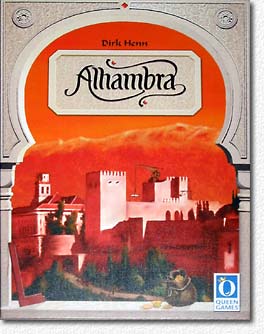
This new offering is part of the selection for „Spiel des Jahres“, this is
why Guenther nudged us gently to play it…The game is similar to other German games (well, aren’t ALL German games similar
to other German games???) and immediately creates associations with “Princes of Florence” (each player builds his own
“Alhambra” palace, in arabic Spain) and Carcassonne (Tiles have to be placed in a tricky way, you try to build
a “long wall” instead of a long road).And of course the long list of games where you have to have the majority in a specific
attribute (buildings in “Alhambra”).Nothing new – how does it play?
Each player gets a hand of numbered cards in 4 colors (the different kinds of money used
in arabic Spain), valued 1-9. The drawing mechanism brings a little luck into the game:
Each player draws up to the exact limit of 20, if s/he doesn’t hit 20 exactly s/he
may surpass the sum, resulting in different sized hands for each player.On a small board 4 building tiles are placed at random (and constantly replaced). Each
can be acquired with only one specific kind of money, so the building next to the
“yellow” money symbol can only be bought with “yellow” money.
Building prices range from 3-13. There are seven kinds of buildings, some are very rare,
some are very common. Hidden in the money draw pile (and therefore functioning as a
random scoring) are two scoring cards, a final scoring happens at the end of the game,
when all buildings have been sold. The more common buildings give you more points, as it
is more difficult to have the majority with them. The first scoring round only scores the
leaders (with scores ranging from 1 to 7), the second scoring round scores the leaders
and runner-up’s (leaders now receive more than double the sum before, the runner-up
the basic sum), the final round includes a third place as well with equally raised
stakes. If 2 or more players are tied, they receive the sums of both scores divided by
their number and rounded down.Each player has only one action (normally).
S/he can:
- Take any of the open and constantly replenished 4 money cards
- Take a combination of money cards up to the value of 5 (rarely achieveable!)
- Buy a building with the correct money cards
- “Destroy” an already built building (goes to “reserve”)
- “Rebuild” a destroyed building somewhere else
- “Exchange” a building with a building from the reserve that
fits
One unique mechanism needs attention: You have to use the cards you have when buying
buildings (no change), so most of the time you have to overpay because your cards
don’t match the exact price. If you however manage to EXACTLY pay the price, you
get an ADDITIONAL action. Theoretically you can gain a string of actions in this way, so
it very often makes sense to sit back and improve your card hand instead of building or
buying at all costs – It might pay off in later rounds when you suddenly have a lot
of actions available!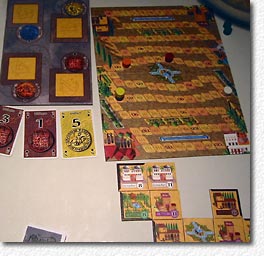 Building buildings is not easy: they all have to be orientated in
one direction, walls have to be next to walls (all square building tiles have none,
one, two or even three walls), and you have to be able to access all placed tiles
from your central “start” tile. Your longest series of walls give extra
points every scoring round. If you acquire a building that can’t be placed
right now, you have to put it in reserve, hoping to build it another time (which
eats up one action, though). In my opinion it is mostly better to accumulate cards
instead of buying a building you can’t immediately build – cards
INCREASE your options, whereas the reserve building takes away TWO actions. In fact
our reserve space was rarely used in our first game.All actions are very important, as the game is over pretty quickly, and very often you
won’t be able to achieve what you wanted to. The final scoring round gives the most
points, and is therefore most important.That’s all there is – no surprises, really.
The sentence to sum up this game is: it works. It is not overly complicated and plays
quickly because of limited options. The tension lies mostly in the management of your
card hand, or if another player gets a specific building before you can pay for it. It is
satyisfying to pull off a string of actions, but that’s about it. There is very
little to none player interaction (you look at what the others have built and plan your
own buys based on that info, that’s about it), and the excitement factor is not
really high.Guenther was the only one of our group who reacted enthusiastically to this game (even
saying that it had a chance for “Spiel des Jahres”, the others liked it, but
not in a very “emotional” way.View/add comments 
Our rating for this session: 6.2
Moritz Eggert
- Amun Re
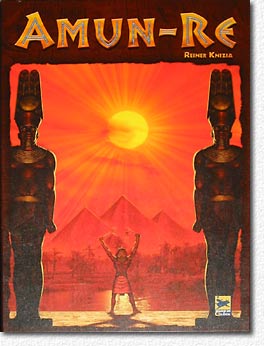
Amun-Re is this year’s “Hans im Glück” major Nürnberg release (besides
another Carcassonne extension) and like “Euphrat & Tigris” it is by Reiner
Knizia. This time the setting is ancient Egypt during the time of the Pharaohs and
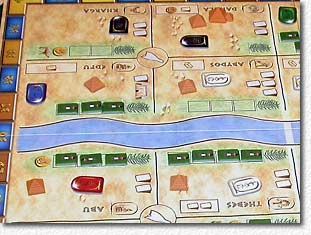
players take on the role of rival dynasties.The game board is an abstract map of 15 provinces in Egypt, divided into
“lower” and “upper” Egypt indicated by a horizontal line that
separates the board into a “south” and a “north” section. The board
is further divided by the river Nile, creating four separate areas on the map. These four
sections take an important role in the scoring phases of the game as certain sets of
provinces may grand extra victory points. The main source of victory points however are
pyramids built in provinces; hence the objective of the game is to acquire provinces and
to build pyramids in them. Both require income which is earned by selling crops. On the
other hand, growing crops requires farmers, which can be hired for money – and we are
right in the middle of this great resource management game.The game is divided into two halves – the old and the new kingdom, and each kingdom is
played in three rounds with each round having 5 phases:Phase 1: Revealing the province cards
As many provinces as there are players are randomly selected in order to be put up for
auction in phase 2. Since each province has different properties players already now have
some input for making up their minds about the strategy they will follow during the game:
provinces have different amounts of farmer spaces or they allow different amounts of
power cards to be purchased, some provide free gold or power cards and others provide
free building material.Phase 2: Acquisition of provinces
One by one the provinces are now put up for auction: beginning with the start player
each player selects a province and bids the amount of money s/he will pay if successful.
Once all players have made their bid any player having been outbid must select a new
province and bid again. This continues until each player has won a province. Here, and
throughout the rest of the game prices increase in distinct steps: 0, 1, 3, 6, 10 and so
on.Phase 3: Buying resources
Players now acquire resources for their provinces. There are three types of resources:
power cards, farmers and building material. For each type of resource the complete number
of resources must be bought at once making large numbers prohibitively expensive (e.g. 2
farmers cost 3 gold, 3 farmers cost 6 (1+2+3) gold. The amount of resources a player may
buy is limited by the numbers depicted on the provinces.While the power cards are maintained by the player (no hand limit) the farmers and
building material must be distributed amongst the provinces. As soon as a province
contains three building materials these are converted to a pyramid.Phase 4: Offering to Amun-Re
 Players now secretly select a number of gold cards and simultaneously
reveal them. The sum of all gold cards played amended by the possible “-3”
cards (each player gets one of these at the start of the game) is then used to determine
the value of the offer and the appropriate position of the temple marker on the temple
track. This marker indicates the amount of gold paid for farmers and pyramids in phase 5
(the higher the sacrifice the higher the income paid).The player who offered the highest amount to Amun-Re is rewarded with three resources of
his choice – power cards, farmers and/or building stones. The player who offered the
second-highest amount receives two items, while everyone who sacrificed at least one gold
receives one item. Any player who played a -3 card “steals” 3 gold from the
treasury, but does not receive a free gift from Amun-Re due to his affront. All gold
sacrificed is returned to the bank, while -3 cards are retrieved by the players having
played them.Phase 5: Harvest and other income
Now players receive income based on the number of farmers they have in their provinces
and the position of the temple marker. In addition players receive gold for some of the
provinces, indicated by a corresponding symbol. Some power cards which can be played in
this phase grand an extra income, too.Phase 6: Scoring
This phase is only played at the end of turn 3 (end of the old kingdom) and at the end
of turn 6 (end of the new kingdom and end of the game).Each player now receives victory points based on the status of their provinces:
- 1 point for every pyramid built
- 3 points for each set of pyramids (a set of pyramids is equal to one pyramid in each
of the 3 provinces) - 5 points for the province with the most pyramids on either side of the Nile
- bonus points for temples in provinces
- bonus points for certain power cards (if played)
At the end of the old kingdom all resources except for the temples and the building
stones are removed from the board and the game continues with playing the new kingdom.At the end of the game – when the new kingdom has been played and scored – extra victory
points are granted to the three players holding the most gold.And how does it play?
Amun-Re is a resource managing game par excellence and in some respects it
“feels” slightly familiar with Reiner Knizia’s “Euphrat &
Tigris”. Money is the most important resource with respect to flexibility of actions
while VPs are generated by provinces, temples and power cards, all of which need money
for their acquisition. Therefore, players find themselves in a permanent dilemma of
spending money on farmers to generate more money or to spend money on building stones and
power cards to generate VPs. Although the rules are clear and strait forward this dilemma
makes the game rather complex – another resemblance to “Euphrat & Tigris”.
That’s why we don’t give it a high chance of receiving the “Spiel des Jahres
2003” prize but it is my personal favourite for “Deutscher Spielepreis
2003”.Here are some hints for good resource management in Amun-Re:
Go for the money
During the first half of the game (when playing the old kingdom) it is a good idea to
generate money with high priority – especially in a five player game, where all provinces
will be played. This is because the old kingdom will generate far less VPs than the new
kingdom (only about 1/3) and you need money to bid on the “good” provinces of
the new kingdom. Which provinces are good for you is determined by the number of pyramids
having been built in any one province. Don’t get nervous if you are behind in VPs
when the old kingdom dies – chances are that your fellow players are short of money now.Get those Power Cards
Acquiring power cards early has a lot of benefits. On the one hand you might get one or
more of those cards which yield special bonuses for certain sets of provinces. If you
have the fortune to receive these cards during the old kingdom you can follow a matching
strategy during the new kingdom. And secondly, it is a lot better to have e.g. a Master
Builder card in your hand that you cannot play (you are only allowed to play one type of
card per turn) than letting another player have it who may be able to play it. And
remember: prices increase depending on the number of cards you buy, so buying small
numbers regularly saves money!Watch those sets
Distribute your pyramids equally between your provinces as this will pay extra VPs for
complete sets at the end of a kingdom. A safe set of pyramids (yielding 3 VPs) is better
than an insecure “most pyramids” bonus of 5 points, so consider carefully where
you place your building stones.View/add comments Our current rating: 7.9
Aaron Haag