Session Report & Review 04.06.2003
Author: Peter
at the table: Walter, Günther, Peter und Aaron
on the table: Stephensons Rocket, New England
- Stephensons Rocket
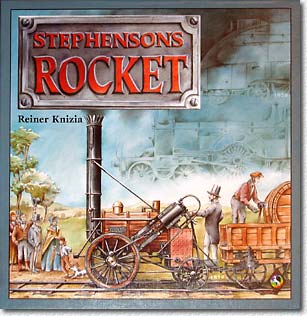
Stephensons Rocket is game by Reiner Knizia, my favourite game designer. My favourite
game of his is Euphrat & Tigris. At the first glance, you might think that those
games resemble each other. At least, that’s what I thought. In fact, they don’t
(at least, that’s what I think now). I do adore Euphrat & Tigris, but I am not
too fond of Stephensons Rocket. I’ll expound this.As Euphrat & Tigris, Stephensons Rocket is highly cybernetic, i. e. there are lots
of different gaming mechanism that interlock like gears in a sophisticated device.
I’ll try to explain some of them so that you might get an idea what I’m thinking
of.There are different railroad lines. Whenever you build one tile for them (like in 1830
or most other railroad games), you get one share (yes, shares are recompenses for
building – you don’t buy them). Whenever you try to build other players might contest
the direction you’re trying to build to. The decision is which the railroad advances
is determined by bidding shares. This means two things: Whoever has done most building
work on the railroad has better odds to determine its further course. But when you force
your will, you pay with your shares, and this will make things easier for other players
with shares.However, shares are not only used for determining the direction of the railroad line.
Whenever two lines merge into one big line, players with shares for the lesser lines get
winning points (called “dollars” in the game, and available in sets of 1.000 –
this reminds of arcades game times when shooting an alien spaceship gave you 10 or 100
points, never 1). Players count the cities connected by the lesser railroad, and the
player with most shares immediately scores as many (multiplied by 1.000 of course)
victory points, the second player half of that. This means: Force your way, and you
won’t get victory points.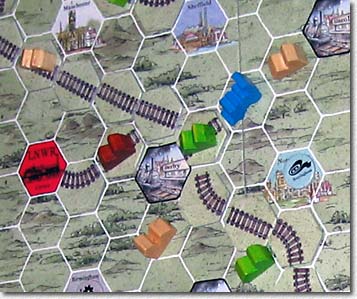 There are three kinds of cities: Those that act as
starting points of the different railroad lines and which have no further meaning.
Then those that trigger a scoring when reached. You get as many points as in the
case of a merger (i. e., number of cities x 1.000), but first and second are
determined otherwise: This time, its not about the number of shares but about the
number of railroad stations of your colour which are on the track. Stations are
built in your turn instead of advancing a railroad line. Of course, you’ll try
to merge your line with many of your stations in the biggest line available in order
to get a majority there (or, if not possible, try to avoid such a merger at all
costs). More and more railroad lines merge and whoever has the majority in the big
lines has good chances to win the game. This resembles of course the growing
kingdoms of Euphrat & Tigris.And things are even more complicated than this. The third kind of city has three markers
each. Those markers have two meaning: First, whenever such a city is reached by a
railroad line the players with markers score a modest amount of victory points. Second,
those markers represent different goods. At the end scoring, players get rather many
victory points for majorities in the different types of goods.Things intertwine at such a rate that every single action has more impacts than anyone
could probably track. At least, I cannot. I am not a bad Euphrat & Tigris player, and
I could always tell you how the other players are doing. In all Stephensos Rocket games
we had so far, no-one was right about the approximate winning order. The rules say that
players don’t show their money (i. e. points scored so far) to the others. But even
if you do, this won’t change much since players get so many points in the final
scoring that the intermediate results don’t matter that much. In every game we had so
far the player taking the last move decided who wins, not because of malice but because
of necessity. Things get crowded at the end, and finally it’s your turn and you
either merge line A to line B, or line C, or avoid the merger. This might have hardly any
impact to your personal score but it decides the game.Just one example: In a game I played at a boardgame club, I was the only player who knew
the game and had a plan. One player understood what I was doing and did his best to
thwart my schemes. He was last. I was third. And I was the one to decide with my very
last turn which of the other two players should win. Both of them did not have any
discernable strategy for the first third (or half) of the game but were lucky enough to
have their lines advanced by others.Verdict: There is no dice rolled, no card drawn yet the game hardly controllable. You
(or at least, I) cannot even approximately keep track of how you and others are doing.
The final scoring submerges all previous game play like a deluge. Since its result
depends on mergers which are decided at the very last moment, it can hardly be predicted.
Stephensons Rocket is highly recommended to any player who complains about luck in board
games. There is no random factor at all yet experience won’t improve your chances of
winning the game very much.View/add comments 