(Bad) Luck in Yspahan
by Günther Rosenbaum
Yspahan, a game by Sebastian Pauchon, was released by Ystari in October 2006.
We already published a review ) of this game. This article is
about the interesting and definitely original dicing mechanism and the probabilities of different
dice roll results.
The Dice Placing Rules
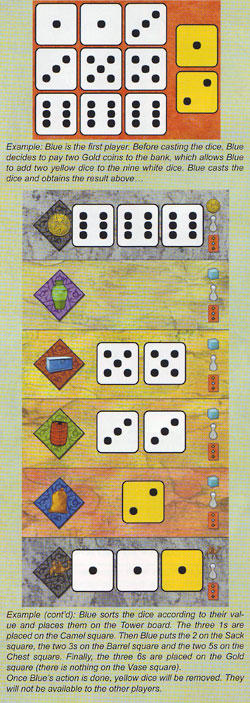 |
| It is obvious that dice on the “vase” line will not be seen very often! |
Normally, you roll 9 dice. However, you are free to add up to 3 more dice by paying for
them.
The cast dice are sorted: All 1s constitute one group, all 2s, …, all 6s. These groups are
placed on the board which is shown at the right hand side following these rules:
- The dice group with the lowest value is placed on the lowest row, i.e. “camel”.
- The next group is placed on the next row, i.e. “sack”.
- and so on, until
- the dice group with the highest value is always placed in the top row, i.e.
“gold”
On the right hand side, you can see an example result. You’ll notice that below the
“gold” row, there can be gaps.
So, it’s time to ask some interesting questions:
What is the probability that the “vase” row gets one, two or three dice?
and
What is the effect of buying 1 to 3 dice in addition to the 9 default dice?
When optimising your strategy, it won’t hurt if you have some idea about those results, and
this is why I have created the tables which now follow. However, it should be clear that there are
several other factors in Yspahan which determine who wins. Besides, I did not take into account the
rule which allows you to add another die to an existing dice group in exchange for a special
card.
Notes on the tables
| 9 W6 | min 1 | min 2 |
| Gold | 100 | 59 |
This is the table for rolling 9 six-sided dice (9 W6). All quoted numbers are rounded
percentages of probabilities.
Since the group with the highest number is always placed on “gold”, the
probability for having at least one die there is 100%. (The latter statement is technically not
true. In case all dice show the same number, they are put on the camel row. However, this is so
improbable an event that the rounded probability for “gold” stays 100% in all considered
cases.)
The event of “at least 2 dice (i.e. 2, 3, 4 … or 9 dice) on the the
‚gold’ row” has a probability of 59%.
Attention:
If you notice a value of 100% in those tables, it is (the camels excepted) a rounded value being in
reality a number between 99,5% and 100%. Of course, for real gaming strategies, such details are
irrelevant, and that’s why I kept to rounded values.
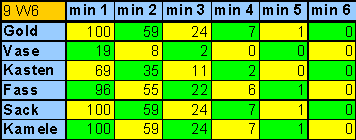 |
| table 1 Probabilities when using 9 dice! |
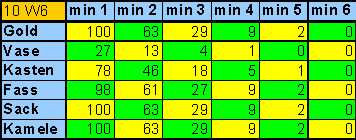 |
| table 2 Probabilities when using 10 dice! |
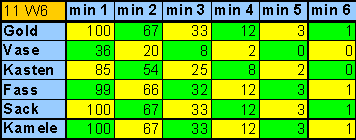 |
| table 3 Probabilities when using 11 dice! |
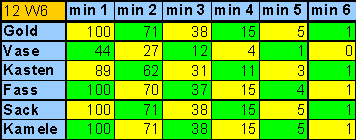 |
| table 4 Probabilities when using 12 dice |
At the start of the game, or when employing the “caravan strategy”, you will probably
go for “mass”. You won’t be picky about which spot to chose, as long as there are
really lots of dice on offer!
Therefore, I’ve put together another table:
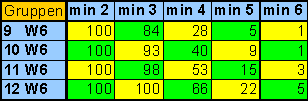 |
| table 5 Probabilities for dicing groups of a certain size! |
Conclusions
Everyone is free to draw his own conclusions from the tables above, and to adjust his game play
accordingly. However, there are some remarks I have to make:
If the number of dice is constant, the probabilities of the lines for
gold, camel, sack and barrel are, more or less, the same! As a rule of thumb, expect a group of at
least 1, 2 or 3 dice with a probability of 1, 2/3 and 1/3.
This leaves the lines of chest and vase as, stochastically, somewhat
more interesting.
Here is another table. It shows how the probabilities are changing when you decide to pay for
adding dice to your default of 9 dice.
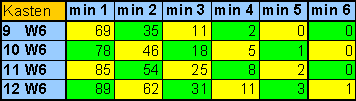 |
| table 6 Probabilities of groups of dice on the chest line, depending on the number of dice used. |
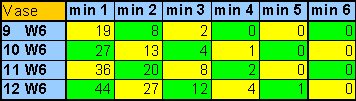 |
| table 7 Probabilities of groups of dice on the chest line, depending on the number of vase used. |
You will notice at first glance that paying for additional dice really does change those
probabilities!
And while we’re at it…
The victory point value on the game board is more or less like this:
- Sack: 1 bis 1,33
- Barrel: 1,33 bis 1,6
- Chest: 2
- Vase: 3 bis 4
2 cubes in the chest line yield 4 victory points – just as 1 cube in the vase line. Now, the
probability for having at least 2 dice in the chest line is invariably higher than having at least
one dice in the vase line. Hence, in the long-term average, cubes in chest line might seem somewhat
more advantageous than cubes in the vase line. However, don’t forget that I didn’t take
into account some rules (see above).
I wish all of you as much fun with this wonderful game as we’ve had when playing it!