Westpark Gamers

Ogallala

rezensiert von Walter Sorger

Wie sich die Zeiten doch ändern! Mit froher Zuversicht hatte Aaron an mehreren Spielabenden sein ergrautes Ogallala mitgebracht, um uns alle an den Freuden vergangener Tage teilhaben zu lassen. Die Erinnerungen der älteren Semester waren durchwegs positiv, die jüngern waren offen für eine Reprise.

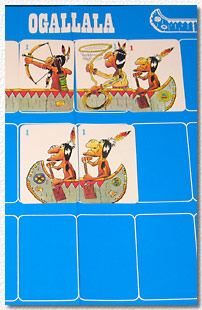
„Ogallala“ ist ein Kartensammelspiel mit Schikanen. Jeder Spieler zieht vom verdeckten Stapel einzeln Karten und muß sie sofort offen vor sich auf sein Spielbrett plazieren. Mit den Karten muß er Kanus bauen, bestehend aus einem Bug, einem Heck und beliebig vielen Bodenkarten dazwischen. Wo der Spieler mit dem Bauen anfängt, liegt ganz in seinem Belieben; die ausgelegten Karten müssen nicht zusammenhängen, sie können irgendwo verstreut liegen und brauchen erst im Laufe des Spieles zusammenzuwachsen.

Wer am Ende die meisten, längsten Kanus mit den wertvollsten Bodenkarten besitzt, hat gewonnen.

Bei seinem Spielzug darf ein Spieler solange Kanukarten ziehen und ablegen, bis er eine Indianerkarte zieht. Dann kommt der nächste Spieler dran. Ein aufmerksamer Spieletester wird hier sofort erkennen, daß ein Spieler bei glücklichem Ziehen (3 Bugkarten und 3 Heckkarten) das Spiel als Sieger beenden kann, bevor irgendeiner seiner Mitspieler überhaupt einmal am Zug war. Als Ogallala erfunden wurde, gab es offensichtlich noch keine Tester. (Keine aufmerksamen!) Das Problem wäre doch leicht zu entschärfen gewesen, wenn ein Kanu mindestens eine Indianerkarte enthalten müßte! Aber vielleicht hätte sich damit sofort irgendwo anders ein Pferdefuß gezeigt.

board

In den Indianerkarten liegt die Interaktion des Spieles. Die ganze!

    • Zieht man einen Pfeil-und-Bogen-Indianer kann man damit eine beliebige Karte aus dem Spielbrett eines Gegners abschießen und vernichten. Lustig, gell?
    • Zieht man einen Lasso-Indianer, darf man aus einem unfertigen Kanu eines Gegners eine beliebige Karte entwenden und bei sich selber einfügen. Noch lustiger, oder?
    • Zieht man den „Crazy-Axt“, dann zerstört dieser sofort und ersatzlos ein eigenes fertiges Kanu, bevor er sich selbst in die ewigen Jagdgründe begibt. Am lustigsten, nicht wahr?

Am allerlustigsten ist es natürlich, wenn man ein Kanu fertig gebaut hat und jetzt einem beliebigen Gegner ein ganzes Kanu wegnehmen, zerlegen und bei sich selbst einbauen kann. To have a plan – kann ich da nur sagen!

Irgendwann ist das Spiel zu Ende. Glücklicherweise hat der Autor mehr brave Bodenkarten in sein Spiel eingebaut als unberechenbare Pfeile, Lassos und Äxte. Sonst würden wir heute noch dasitzen. Oder auch nicht. Im Gegensatz zu den Erinnerungen aus unserer Vorzeit waren wir diesmal vom Spielmechanismus nicht überzeugt. Wenn in unserer Notengebung nicht ein bißchen Nostalgie mitgeschwungen hätte, wären wir wohl alle bei Peters 2 Punkten gelandet.

Im Internet schreibt ein verdienter Kritiker: „Wertung: Das Spiel verdient 5 von 6 Punkten, denn ich spiele es gerne. Die Vielzahl von Karten macht es abwechslungsreich und bei 3-4 Spielern sind Überfälle nicht gerade selten.“ Das war 1992. Der gleiche Kritiker schreibt zehn Jahre später zu einer verbesserten Neuauflage des Spiels: „Wertung: Das Spiel bekommt nach heutigen Maßstäben 4 Punkte. – Wichtige Boote mit vielen Punkten sind bevorzugtes Ziel von Indianerattacken und werden häufig versenkt, wodurch durchaus Frust aufkommen kann.“ Frage: Gab es 1992 noch keinen Frust oder sind wir heute frustanfälliger geworden?


23.08.2005: „Ins Innere Afrikas“, „Neuland“, „Bluff“

Das Hochwasser in Penzberg zwang Günther zur Absage: Er mußte seine wertvolle antike Spielesammlung aus dem Keller in den Speicher retten. Moritz dagegen mußte sein gerade vollendetes Fußball-Oriatorium zur Nachbarin tragen. Und die restlichen Möbel dazu. Als bittere Medizin gegen die Trauer bei den Hinterbliebenen tischten Aaron und Peter dem Rest der WPG-Welt zwei Verriß-Spiele auf, an den wir unsere Immunität gegen Design-Schwächen testen sollten.
Freiwillig und ohne Murren unterzogen wir uns der Behandlung. Mit einer gewissen Feierlichkeit lauschten wir der Spielregel-Aufklärung durch Peter. So etwa muß sich die Szene abgespielt haben, als sich die Brüder Grimm von ihrer Märchenfrau ins Bettchen bringen ließen. Brave, kluge und naive Rückfragen zum Thema, liebevolle Ausführungen und Wiederholungen der Großmutter. In der aktuellen Besetzung mit der aktuellen Stimmung konnte an diesem Abend einfach nichts schief gehen.
1. „Ins Innere Afrikas“
Beim Auspacken der bunten Klötzchen kam mir eine Assoziation zu „die Macher“. Die Versteigerung der Aktionsplättchen ist wie bei „Kogge“. Das Überspringen der gegnerischen Pöppel beim Zählen der Siegpunkte erinnert an „Die Ursuppe“. Aaron prägte den Ausdruck „Ursuppe mit Negern“. (Dazu muß ich aber strikt betonen, daß Aaron ein ehrenwerter Mann ist. Und wir sind alle auch ganz gewiß „political correct“. Es paßte einfach zu unserer Dodel-Stimmung.)
1 ½ Stunden suchten wir nach den „Rückzugsmarkern“. Sie waren nicht einmal in der Spielanleitung abgebildet. Bis sie Loredana endlich unter ein paar Tütchen und Schächtelchen hervorzog, hatten wir uns mit Leer-Plättchen und Null-Plättchen beholfen. Mit den Null-Plättchen hätten wir fast sogar die Spielregeln auf den Kopf gestellt, sie haben nämlich eine durchaus sinnvolle andere Bedeutung im Spiel.
Das Spiel hat überhaupt eine Menge sehr sinnvolle Regeln und Mechanismen. Alles paßt und sitzt. Nur leider gibt es als Gesamtwerk kein ordentliches Spiel. Soll man stundenlang rechnen, um sich seine 42 Siegpunkte zusammenzustückeln? Soll man frisch-fromm-fröhlich-frei drauflos spielen und erstaunt sein, wenn ein Spieler bei seinem dritten oder vierten (!) Zug die (zweite) Hälfte der erforderlichen Siegpunkte erringt und damit das Spiel als Sieger beendet? Eines so unbefriedigend wie das andere.
Bei uns war Peter der Spieler, der mit seiner dritten Aktionskarten-Ersteigerung den Siegeszug machen wollte. Er hatte sich leider um eine winzige Kleinigkeit verrechnet: Er kam nur auf 41 (statt 42) Siegpunkte. Aber sagen wir lieber: er hatte sich verspielt, denn zum Glück hat keiner von uns gerechnet, wir wollten ja vor allem das Spiel nach weniger als 2 Spiel-Stunden über die Runden gebracht haben. Was uns auch geglückt ist: einmütig schenkten wir Peter den fehlenden Punkt zum Sieg! Moritz, was sagst du dazu??
Vielleicht gibt es Spielertypen, denen das Spiel gefällt. Mir fällt allerdings keiner ein. Und Peter schreibt in seiner Rezension vom 31. Oktober 2004: „Actually, I wouldn't know for whom I should recommend it.“ Das ist die Tragik des Kosmos!
Peters damalige Rezension war sogar noch irgendwie euphorisch. Oder sind euere Noten in unserer Wertungsliste getürkt? Schaut sie euch noch mal genau an: Andrea 7, Hans 5, Loredana 5, Moritz 6, Peter 7!
Heutige WPG-Noten: Aaron: 4, Loredana: 2, Peter 3, Walter 3. (Hat die Medizin hat etwa gewirkt?)
2. „Neuland“
Peter hatte genug von der Roßkur und wollte als zweites Spiel ein 7,3-er Werk auftischen. Doch der Rest wollte die Arznei bis zur bitteren Neige auskosten.
Peter hätte sich mit einem billigen Trick noch durchsetzen können: er brauchte bloß eine „Holzfällerhütte“ unter den Tisch fallen zu lassen, dann wäre die Startaufstellung ins Wasser gefallen. Doch fiel ihm dieser Trick erst ein, als wir die letzte Hütte doch noch in einem Säckchen entdeckt hatten. (Die ganze positive Stimmung des Abends wäre aber auch absolut gegen solche billigen Tricks gewesen!)
Bei „Neuland“ bauen die Spieler langsam vor sich eine Welt zusammen. Aus Holz mach‘ Haus, aus Schaf mach‘ Schinken, aus Käse mach‘ Kuchen. Oder was der Dinge mehr sind. Man könnte sich fast wie bei „Puerto Rico“ vorkommen. Peter meinte dazu in seiner gewohnten direkten Art „Puerto Rico für geistige Wohltäter“. (Vielleicht habe ich hier bei der Formulierung seiner political correctness leicht auf die Sprünge geholfen!)
Die Kreise, die ein jeder dreht, sind jedenfalls sehr lokal. Für ein 4er Spiel etwas zu eng. „Dröge“ würde ich zum Charakter des Spieles sagen, wenn ich wüßte, was dieser Ausdruck bedeutet! Vielleicht sollte man es nur als Solitär-Spiel mit sich selber spielen. Aber ohne die Ambition, ständig seinen eigenen Rekord zu unterbieten! Einfach nur zum eigenen ästhetischen Vergnügen auf den Spuren der Pioniere des letzten Jahrtausends! (Es sind ja nur knapp 5 Jahre her!)
In der 4-er Besetzung haben sich die Noten gegenüber der früheren Wertung nicht viel verschoben:
Ursprüngliche WPG-Wertung 3,8: heutige Noten:: Aaron: 3, Loredana: 3, Peter 2, Walter 4.
3. „Bluff“
Nach dem mit Fassung und guter Laune bestandenen Immunitätstest wollten wir uns noch ein richtig entspannendes Spiel-Vergnügen gönnen. Dazu gibt es nichts besseres als ein ausgedehntes „Bluff“!
Hallo Günther: zum ersten Male gelang es, mit der „Immer-4-Strategie“ aus einem 1:4-Würfel-Rückstand noch den Sieg zu holen. Der Goliath Peter hatte Super-Würfe, der David Walter konnte aber immer noch eins drauflegen. (Na ja, vielleicht lag es doch nicht nur an der Strategie!)

Friedrich

rezensiert von Walter Sorger

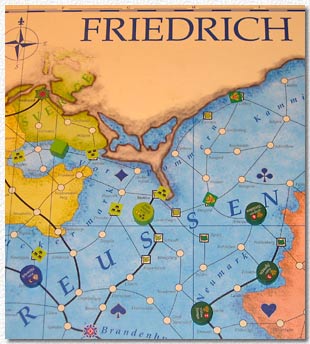
Das Spiel simuliert den historischen Überlebenskampf der Preußen unter Friedrich dem Großen gegen den Rest der Welt. Das Spielbrett zeigt eine politisch eingefärbte Landkarte von Zentraleuropa aus dem 18. Jahrhundert; die beiden blauen Flächen in der Mitte sind die Staatsgebiete von Preußen und Hannover. Die Flächen darum sind die Aufmarschgebiete der Gegner, im Uhrzeigersinn geht das über Schweden und Russland, Österreich und das Reichsgebiet bis zu Frankreich. Viel Feind viel Ehr.

Die Landkarte zeigt nur das Kerngebiet des Konfliktes, es erstreckt sind von Warschau bis Frankfurt am Main. Die Russen stehen schon in Polen, die Österreicher in Böhmen und Frankreich in den rechtsrheinischen Gebieten des deutschen Reiches. Der Sonnenkönig hat gerade die Pfalz verwüstet, Friedrich gerade seinen Erbteil Schlesien eingenommen.

Ein Spieler darf den großen Preußen mit seinem Verbündeten spielen, alle anderen Mitspieler bilden eine lose Allianz gehen ihn. Jeder von ihnen hat sein eigenes Spiel- bzw. Kriegsziel: er muss eine bestimmte Anzahl von Städten im Grenzgebiet unter Kontrolle bekommen. Untereinander dürfen sie sich nicht bekämpfen; sie sind auch froh, wenn jeder einen Teil der Streitkräfte des gemeinsamen Gegners in Scharmützel verwickelt, so dass jeder einzelne von dem zunächst übermächtigen Preußen nicht in die Pfanne gehauen werden kann.

Der Preußen-Spieler kann das Spiel nicht direkt gewinnen. Er muss nur verhindern, dass einer der Gegner sein Kriegsziel erreicht. Wenn ihm das lange genug gelingt, ist er der Sieger.

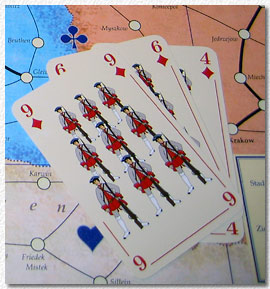
Gekämpft wird mit Armeen, die auf der Landkarte herumspazieren, sich an den Gegner heranmachen und ihm bei passender Gelegenheit eine Schlacht liefern. Die Kämpfe werden anhand von „Taktik-Karten“ entschieden, von denen jeder pro Runde eine definierte Anzahl zugewiesen bekommt. Die Karten haben eine Spannweite von 2 bis 13 und die Verteilung ist zufällig. Hieran ist leicht zu abzulesen, dass ein vom Zufall begünstigter Spieler leicht 3-4 mal so stark ausgestattet werden kann wie sein gegnerischer Pechvogel. Dieses Ungleichgewicht wird noch dadurch verstärkt, dass die Preußen nahezu doppelt so viele Karten bekommen wie ihr stärkster Gegner, insgesamt knapp mehr als die Hälfte wie alle Gegner zusammen.

board

Mit der geballten Kraft seiner Taktikkarten könnte Preußen jeden Gegner unmittelbar vernichten, doch da schieben die Spielregeln einen Riegel vor: Das Spielfeld ist in die Sektoren der Kartenfarben Kreuz, Pik, Herz, und Karo eingeteilt und jede Karte darf nur verwendet werden, wenn die kämpfende Armee in einem Sektor dieser Kartenfarbe steht. Bei schwachem Material an Taktik-Karten kann sich jeder Spieler noch in einen Sektor zurückziehen, wo er wenigstens relativ gut bestückt ist und gute Chancen zum Durchhalten hat. Irgendwann sollte die Begünstigung bei der Kartenverteilung doch kippen. Dann kann man wieder aus seinem Schneckenhaus herauskriechen und versuchen, irgendwo auf dem Felde der Ehre seine Meriten zu verdienen.

Dieses Verhalten bei starken und schwachen Kartenhänden gilt natürlich nicht nur auf der Flucht vor den Preußen, es gilt auch beim Angriff gegen sie. Irgendwann einmal haben die Preußen ihr Pulver verschossen und werden von einem gut bestückten Gegner bedrängt. Dann müssen sie selber nach Sektoren Ausschau halten, wo sie für die Zeit ihrer nächsten Durststrecke möglichst wenig Federn lassen müssen.

Im Angriff und Verteilung besitzt „Friedrich“ ein sehr schönes stabilisierendes Element: den „Tross“; das sind Klötzchen, die jeder Spieler unabhängig von den kämpfenden Armeen auf dem Spielbrett bewegt. Jede im Ausland kämpfende Armee muss einen Tross immer in greifbarer Nähe haben, damit sie nicht unversorgt ist und hungern muss. Der Krieg ernährt keineswegs den Krieg. Eine Armee, die zwei Spielrunden lang unversorgt ist, wird kampflos vom Spielbrett genommen. Dies ist ein starker Heimvorteil für jede Verteidigung. Wenn ein Gegner sich zu weit von seiner Heimatbasis entfernt hat, muss man nur versuchen, seinen Tross zu zerstören, und schon ist die feindliche Armee innerhalb von zwei Runden spurlos verschwunden.

„Friedrich“ ist ein faszinierendes historischen Kriegsspiel, das selbst friedlichen Lämmern unter den Spielerseelen (mir) gefällt. Natürlich spielt die schillernde Figur Friedrich des Großen von Preußen eine große Rolle. Kaum ein geschichtlich interessierter Deutscher kann ihm emotionslos entgegentreten. Wer nicht gegen ihn ist, muss für ihn sein. Auch wenn seine Spielposition zunächst sehr aggressiv anmutet, ist nicht zu übersehen, dass es ihm in der dargestellten Situation eigentlich nur (noch) ums Überleben geht. Selbst als Gegner kann man sich einer gewissen Achtung bei gekonnten taktischen Verteidigungszügen (Angriff ist die beste Verteidigung) nicht erwehren.

Unwillkürlich wird jeder Spieler von den Kampfelementen Abwarten, Sich Entwickeln, Aufmarschieren, Zuschlagen, Fliehen und dabei die Versorgung nicht Verlieren in Spannung gehalten. Knappe Siege und Niederlagen wechseln mit hohen Verlusten bis zur totalen Vernichtung ab. In jedem Fall wartet aus der Heimatfront schon die nächste Armee auf ihre Aushebung und ihren Einsatz.

Auch die Dreierallianz gegen Preußen schafft neue, hübsche psychische Spieler-Konstellationen. Man gönnt jedem Mitspieler den Sieg in der Schlacht, eigentlich uneingeschränkt. Jede Taktik-Karte, die der Preußenkönig verliert, kann nicht gegen mich eingesetzt werden, jede Armee, die der Preuße verliert, macht mein eigenes Vordringen und Erreichen meiner Kriegsziele leichter. Allerdings sollte sich ein verbündeter Mitspieler nicht allzu schnell und allzu üppig seine Vorteile erringen können. Dann gönnt man ihm schon mal, dass auch er einen Kampf verliert oder zumindest jede Menge Taktik-Karten verbuttern muss.

Nach gut 3 Stunden ist das Spiel über die Bühne. Wenn wir Glück hatten, haben wir die Geschichte neu geschrieben und können darüber ein ganz geiles Selbstwertgefühl ableiten. Wenn wir Pech hatten, zieht sich Russland per Ereigniskarte aus dem Schlachtengetümmel zurück, Frankreich leckt seine nord-amerikanischen Wunden und Österreich wendet sich wieder seinen böhmischen Knödeln zu. Dann hat Friedrich gewonnen und alle Spieler dürfen eine Nacht darüber schlafen und träumen, was sie in ihrem nächsten Leben besser machen werden.

Zum Schluss noch ein paar kritische Bemerkungen zum Spielverlauf:

    1. Der Preußenkönig sollte kein Denker sein. Er hat viele Armeen, 8 Generäle, lange Grenzen und viele Gegner. Wenn er sich gemüßigt fühlt, bei jedem Zug sein absolutes Optimum auszurechnen, dann ist seine Denk- und Spielzeit länger als die aller seiner Gegner zusammen. Am Anfang macht das Zuschauen vielleicht noch Spaß. Nach 3 Stunden nicht mehr. (Mir nicht.) Hier würde ich unbedingt den Einsatz einer Schachuhr vorschlagen. (Werde ich mir unbedingt zulegen.) Wer mehr als 1 Minute für seinen Zug braucht, verliert alle 30 Sekunden eine Armee!
    2. Das Spiel ist extrem asymmetrisch und bietet dementsprechend sehr unterschiedlichen Handlungsspielraum für die einzelnen Spieler. Während Friedrich der Große in der Vielfalt seiner Aktionsmöglichkeiten nur so schwelgen kann, hat der große Richelieu gerade mal 3 Armeen, die ohne reichlich Pique-Damen den Hannoveraner nicht einmal unter die Augen treten dürfen. Er ist gut beraten, sich auf die lieblichen Weinhänge am Rhein zu konzentrieren und seinen Frust im fruchtigen Riesling zu ertränken. Für geborene Alkoholiker ein befriedigender Ersatz, für ambitionierte Clausewitze aber nicht.
    3. Jeder Staat notiert die Verteilung seiner Armeen auf seine Generäle geheim auf einem Notizblatt. Das ist absolut überflüssig. Die Kampfstärke eines Generals wird nach dem ersten Kampf ohnehin offenbar und damit jedermann bekannt. Ausserdem ist die Wirkung der Taktik-Karten um ein Vielfaches größer als die Anzahl der zugeteilten Armeen; die geheim gehaltene Zahl hat nur einen marginalen Einfluss. Dagegen ist das richtige Eintrage der Armeen auf dem Notizzettel beim Nachrüsten und Umverteilen einerseits umständlich und andererseits eine ständige Quelle von Fehlern und Misstrauen. Ich würde diese Verteilung öffentlich machen und damit alle Probleme beseitigen.

Und ganz zum Schluss noch ein paar Bemerkungen zu Preußens Militarismus:

Madame de Stael schreibt (1810) in „De l’Allemagne“: „Kriegerischer Geist und Vaterlandsliebe existieren gegenwärtig kaum noch für die Deutschen als ganzes gesehen. Vom militärischen Geiste kennen sie kaum noch mehr als eine pedantische Taktik, in der sie mit Recht und Fug nach allen Regeln geschlagen zu werden.“ (Hierbei kann ich nicht genau beurteilen, ob der Satzteil mit dem „Recht“ und den „Regeln“ richtig übersetzt ist.)

Der Alliierte Kontrollrat entscheidet (1947) in einem Gesetz: „Der Staat Preußen ist seit jeher Träger des Militarismus und der Reaktion in Deutschland gewesen ist. Geleitet von dem Interesse an der Aufrechterhaltung des Friedens und der Sicherheit der Völker wird er, seine Zentralregierung und alle nachgeordneten Behörden aufgelöst.“

Dank dieser klugen Tat ist die Welt sein mehr als einem halben Jahrhundert ohne Krieg. Fast.


Friedrich

reviewed by Moritz Eggert

In the last years there was a definite trend to „Europeanize“ American board game concepts. Prominent recent examples are games like „Age of Mythology“ (a wargame/Puerto Rico-hybrid) and „Bootleggers“ (American „theme“, Euro-game concepts and game length) by Eagle games. So it was only to be expected that the trend might be reversed, that European (in this case German) game designers are tempted by American concepts (in this case the historical wargame genre, practically unheard of in German produced games). Of course this has happened before, but rarely was the attempt so successful as in „Friedrich“ by Histogame.

The game takes place in one of the more interesting periods of European history – Friedrich the Great’s solitary defence of Prussia against enemies from all sides: The French, the Austrians, The Swedish, The Russians and the „Reichsarmee“. „Friedrich“ attempts successfully to bridge the gap between a detailed but complicated and long wargame, and a playable but still historic „Eurogame“.

One player represents Prussia and its wimpy ally, Hanover; two or three other players represent France, Russia and Austria. The smaller factions (Sweden and Reichsarmee) can change owner depending on the game-setup or the game situation.

The board is very large and consists of a layer of hundreds of dots (cities and villages) connected by lines, vaguely reminiscent of the boring travelling games like „Deutschlandreise“ that we played as kids. The topography is very complicated, and even after several games you will overlook certain connections. But exactly this is what makes the map so beautiful and intriguing!

The factions either are in their own countries and always supplied (like the Prussians), or are travelling in large armies (like the Russians or the French) in unsupportive countries. The various colour codes used in the game are usually good, the only problem (in bad light) is recognizing the difference between the light yellow Reichsarmee-objectives or the grey Austrian objectives.
cards

The factions all get a number of „generals“ (pawns) and „Trosse“ (supply trains). Each country also has a set number of „armies“, represented simply by numbers that are allocated secretly to each general. A general (all the historic leaders are represented) needs at least 1 army to „exist“ and is eliminated when he loses the last one. Only when armies are eliminated they can be replaced, so each faction has a set strength that can never be surpassed.

The most important mechanic in the game is the cards, at first glance an ordinary set of playing cards coming in 4 suits and 2 jokers (there are 4 decks that are run through in succession, to assure a relatively equal distribution). Each faction gets a set number of cards each turn (this number can change trough events, but doesn’t vary wildly).

On the board there are sectors (squares) that correspond to the colours of the suits. The idea is simple: an army attacking or defending while residing in a certain „suit sector“ can only use cards with that suit. As the players know their cards they will usually try to move their armies to positions of advantage, but of course that’s not always possible. You might want to defend a spade area but be weak in spades, for example. The combat system itself is very simple, it is basically an open bidding process with players using the cards as a kind of money, once a player can’t play the suit anymore (or chooses not to) he loses armies in the amount of the difference between his bid and the other player’s bid. If his general still lives, his pawn is moved the same number of spaces away from the winner, decided by the winner, usually resulting in the army being out of supply the next turn, as armies are only supplied when in their home country or within 6 spaces of supply train. Unsupplied armies can function normally the next turn, but are eliminated if they are still unsupplied at the end of this turn.

Of course fighting a massive battle usually means being depleted of a certain suit – the next player in turn will then try to exactly attack in this suit, but of course this is not always possible.

The battles are necessary to conquer „objectives“ – a faction that can conquer all of it’s objectives wins the game! Generals „protect“ objectives not further away then 3 spaces, which means that even if you move over these objectives, they are not conquered. Beating an army can result in retroactive conquests of already passed over objectives, an interesting mechanic.

The game ends through an artificial mechanic that introduces event cards at the end of the 6th turn and every turn thereafter. These events either give minor advantages to different players, or reduce or raise the number of cards they draw, and finally remove one attacking nation after the other from the game (this is when ownership of Reichsarmee and Sweden switch to keep the players whose nation was terminated in the game. These players can still win!). If Friedrich survives, he wins, but he never knows how long he has to persevere.

This mechanic is historical (all the events are based on actual events) but of course it also brings a certain element of luck in the game.

Friedrich has a huge advantage at the beginning, he gets 7 cards, Hanover 2, whereas France gets 3, Russia 4, and Austria 5, and both minor factions only 1. Individually no nation stands a chance against Prussia, but the longer the game goes on the bigger the numerical advantage will become, especially if the smaller nations bide their time instead of attacking immediately. Prussia has to move her armies into well-defended positions, constantly avoiding to get overrun, as bringing new armies into play is costly, and armies move very slowly on the map. The other factions rather have a „motivational“ problem: As each of them is weaker than the Prussians, the will to attack first is rather small, as usually your partners will benefit more of the depletion of Prussian resources than you, as you will have to slowly build up your power again after a hard-fought battle. On the other hand Friedrich can’t allow enemy nations to build up their hands – if they hoard cards he has to attack them to use his advantage! France, although having a rather boring position on the map and little to do, has the advantage of being pitted against Hanover instead of heartland Prussia, which is considerably easier. The well-rounded Prussia player has to take note of this, though, and send additional forces to defend Hanover, a fact that benefits the two other nations.

Characteristics
Playing time: 150+ minutes
Explaining the rules: 5-10 minutes
Downtime: high, if Prussia plays it slow
Excitement factor: high, lots of tense and close battles that play very quickly
Brain: required!
Luck: considerable, but not overpowering
Best trait: delivers a fresh concept in a wonderfully simple package

„Friedrich“ is a very subtle kingmaker game, as the decisions of Friedrich basically decide who will win the game. To win with Friedrich is very hard, but you decide where the action is. If you concentrate on one front you basically make it easier for the enemies on the other side of the board. But there is one trait that saves „Friedrich“ from being an unbalanced wargame, and that is it’s „card shark“ element. The basic mechanic is so beautifully simple and elegant that the gamer never bogs down. The rules are covered in little more than 5 pages, and once they are understood the game can be explained to newbies in as little as 5-10 minutes. Bluffing, hand management and simple gaming joy in a light historical context are the main assets of „Friedrich“, and they make the game a winner. The game also easily adapts to 3 players, is in fact especially playable with that number of players (the distribution of forces is much more equal in the 3-player game).

„Friedrich“ can appeal to the strict Eurogamer, the serious wargamer or even the history buff. It is longish in playing time, and the game can become kind of slow if the „Friedrich“ player is inexperienced (always let the most experienced player play Friedrich!), but it still plays amazingly quick for a game of its scope. „Friedrich“ is a labour of love by the game designer, and it is clear that he spend years honing the game design and balancing it, and the work shows off. As it is the game can be fully recommended, it is much more interesting than it looks at first glance! A next edition could use a different system then writing the armies down, though, it would be nice to have counters or pawns for the armies, and to position them behind a screen, like in „Samurai Swords“ („Shogun“). But players can easily find their own solutions here.

 

08.08.2005: „Friedrich“

Peter lud sich mit seiner Loredana rechtzeitig aus: wenn mehr als 4 Spieler zusammenkommen, kann er seine spielerischen Qualitäten nicht mehr richtig entfalten. Günther verwechselte Dienstag mit Mittwoch und hatte sich irrtümlich zu seiner Claudia zurückgezogen. (Oder war es doch eher wissentlich zu seiner Ute?) Jedenfalls saßen wir auf einmal als Trio von dem gedeckten Gabentisch und suchten den vierten Mann. Da sprang glücklicherweise noch Basti in die Bresche und wir konnten uns in voller Personalstärke als vereintes Europa gegen die Preußen wenden.
„Friedrich“
Ein wunderschönes historisches Kriegsspiel von einem nagelneuen Autor und einem nagelneuen Verlag. In einer asymmetrischen Allianz von drei Spielern Rußland + Schweden, Österreich + Reichsarmee, sowie das etwas marginale rechtsrheinische Frankreich gegen den vierten Spieler, der als Preußenkönig zwar schon die Hannoveraner als Bundesgenossen rekrutiert und sich seinen Erbteil Schlesien unter den Nagel gerissen hat, ansonsten aber mutterseelenallein in der Welt nur auf den lieben Gott vertrauen kann.
Die drei Gegenspieler spielen im Prinzip jeder für sich. Jeder hat sein eigenes Spiel- bzw. Kriegsziel, sie dürfen sich gegenseitig nicht bekämpfen. Aber jeder für sich ist schwächer ausgestattet als die preußische Zentralmacht und so sind sie darauf angewiesen, zusammen zu arbeiten, damit jeder an seiner Front dem gemeinsamen Gegner soviel Verluste zufügt, daß für alle anderen die Gefahr einer totalen Niederlage reduziert wird.
Der Preußen-Spieler kann das Spiel nicht direkt gewinnen. Er muß nur verhindern, daß keiner der anderen sein Kriegsziel erreicht. Wenn er das lange genug durchhält, ist er der Sieger.
Gekämpft wird, indem man nach Art von „Risiko“ umherzieht, sich den gegnerischen Truppen nähert und Kämpfe vom Zaun bricht. Entschieden wird jeder Kampf durch Karten, die jeder Spieler pro Runde zugewiesen erhält. Da die Karten eine Spannweite von 3 bis 13 Punkte aufweisen, ist leicht ersichtlich, daß hier dem Zufall Tür und Tor geöffnet ist. Allerdings darf man nicht weinen, wenn man schlechte Karten bekommen hat. Damit darf man halt keine Schlacht anfangen, sondern man muß sich zurückziehen und hoffen, daß die Preußen von einem besser bedachten Spieler in Atem gehalten werden.
Ein hübsches Spielelement ist der „Troß“, das ist ein Klötzchen, das man als kämpfende Armee im Ausland immer greifbarer Nähe mit sich führen muß. Sonst gilt man als „unversorgt“ und wird kampflos vom Brett genommen. Mit dem Troß wird man auf seinen Raubzügen verletzbar und gewinnt dafür zuhause an Stabilität.
Eine böse Szene gab es, als Friedrich der Große unbeirrbar darauf beharrte, meine Franzosen seien schon vor mehreren Zügen halb tot geschlagen worden und ich anhand von Rekonstruktionen beweisen mußte, daß sie doch gerade erst frisch geschniegelt aus dem Swinger-Club herausgekommen waren.
Ansonsten war es eine sehr spannende Session mit einem sehr gelungenen Spiel. Moritz wird eine Rezension schreiben.
WPG-Wertung: Aaron: 8, Basti: 8, Moritz 8, Walter 8.

Australia

reviewed by Aaron Haag

It’s the 1920’s and Australia’s economy is still booming. The government vigorously pursues industrial development and at the same time encourages the development of national parks to support the environment. This is the setting for Wolgang Kramer’s and Michael Kiesling’s latest game.

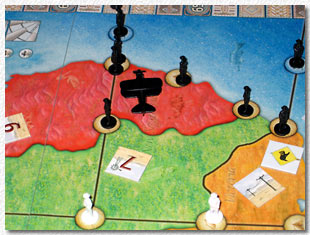
The map shows the six mainland territories of Australia split into 24 land and water regions. It is the players task to complete industrialization and conservation projects in these regions and to place rangers into camps or on ships located on the regions‘ borders. The number of rangers a player has depends on the number of players in the game, ranging from ten in a five-player game to 20 with only two players. Small plastic double-decker airplanes fly the rangers into the region and pick them up again when their task is finished.

During a turn, a player performs two actions out of a possible three. One possible action is to fly his plane to any of the regions in preparation for unloading or withdrawal of rangers. Another action is to unload up to four own rangers into one of the camps or onto a ship of this region. In order to do so the player must play a region card from his hand. Each card shows the colour of the region it can be played for, the number of rangers one may place (one to four) and the money one earns (three to zero dollars) for doing so. The hand card limit is two, which may sound rather limiting, but in fact each camp is adjacent to at least two and many are bordering three or more regions so that there is only a slight reduction of choices by unlucky card draws. If all fails and you do not have the right colour in your hand you may even change the colour of a card by paying money. The third type of action is to remove up to four own rangers from any of the camps bordering the region where your plane resides.

Players may spend money during their turn to either change the colour of a card they play (3 dollars), or to move one of their rangers from any camp or ship to any other valid location (4 dollars), in addition to the other two actions performed. According to the German rules, the latter option is allowed just once per turn, while the English rules‘ wording suggests that it may be performed repeatedly in a turn. Wolfgang Kramer is said to support the English version while Ravensburger is quoted to support the German one. We followed the English rule version because it leaves you slightly more options in case of a required major reshuffling of rangers due to early bad planning.

board

At the end of a turn, players draw new region cards to fill up their hand to two with players having a choice from which of the four stacks they draw, the back of the cards showing the distribution of money vs. rangers.

The completion of industrialization and conservation projects triggers the distribution of victory points. Whenever a plane arrives in an area for the first time, the industrialization marker of the region is turned over, showing how many rangers must be present in camps located around that region to complete the project. As soon as this condition is fulfilled the active player scores three points for completing the project and all players score one point for each of their rangers in camps bordering the region or two points for rangers on ships. Conservation projects on the other hand are completed once all camps and ships of a region are occupied. Scoring is the same as for industrialization projects.

Although Australia comes along with only a small set of rules and is explained quickly, playing the game well is a completely different matter. Placement of airplanes and rangers is tactical and there is not much point in trying to develop regions all by yourself, because you will quickly run out of rangers to deploy. It’s better to predict where projects may complete soon and to try and participate in the scoring.

The number of actions you are allowed to perform is always less than you would like, so planning ahead is essential; the placement of the airplane being of particular importance in order to not having to move it in every turn. Hence, playing the game in a group of brooders and optimizers can result in long downtimes. My experience is that this doesn’t really matter because there is a lot of suspense even when it’s not your turn as you constantly try to determine the other players‘ plans while at the same time hoping that they won’t recognize yours.

During the first few rounds players set up what is deemed to be good strategic positions. Completed projects in this phase can result in some players running away on the score track. However, it is almost impossible for the early leader to maintain his position, not because there is ample possibility to gang up on the leader – in fact there is none – but because an early lead often results from a concentration of a player’s rangers in just a few regions. Consequently, that player needs too many actions later in the game to transfer his rangers to other, still scoring locations.

windmill

Once the board gets filled up with rangers there is a steady increase of suspense when many regions will be close to completing their projects and placing just a single ranger may trigger multiple scorings. Now special attention is required not to overlook scoring regions because other players are not required to point out any missed ones. They may even score the region in their own turn collecting the three bonus points for completing the project! This sounds obvious but I have yet to see a game of „Australia“ without at least one such missed scoring.

Variant (simple game)
In our very first game of Australia we made a small mistake, when we accidentally skipped the rule that rangers may only be unloaded to one camp or ship of a region. The result of this was that we had a lot more possibilities for ranger placing in the first half of the game, triggering many conservation project completions. The map was filled quicker and the camps were occupied with fewer rangers. Yet, the second half of the game was almost identical to when we played using the correct rules.

Overall, the game was felt to have a faster pace in the beginning and the gameplay appeared to be a bit simpler, making it more attractive to the not so seasoned players. I would call this variant the true familiarization game and the windmill version the expert game.

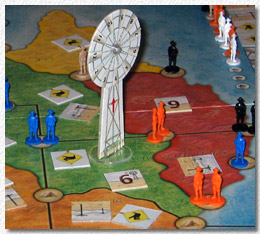
The game comes with two rule variants: the familiarization game as explained above and the full game. The full game adds a little windmill, which is put in an arbitrary region at the beginning of the game. It provides an option to place rangers on a ranger track in addition to the camps and ships if the player’s airplane is in or adjacent to the region where the windmill stands. Whenever a project is completed its associated marker is placed on a windmill track. If an industrialization project marker shows a windmill upon discovery, the windmill is immediately moved to that region and the point value of the windmill is increased. Each time the last position of the windmill track is filled with a marker the windmill scores by giving points to the three players with the most rangers on the ranger track. Then the markers on the windmill track are removed and the top half of the rangers on the track are returned to their players. The windmill feels like a rather pasted on theme and game mechanism. It does provide additional food for thought, though and it is certainly suitable for more mature gamers, but it also bears the risk of increased downtime between turns. We had mixed feeling about the windmill versions for some other reasons. It provides an additional option for placing rangers, which comes in handy if you do not want to place all rangers in a camp because you want to complete a project there while the card allows you to place more rangers than you want to. The chances you can do so are rather limited though, as you have to be close to the windmill in the first place and secondly you must have sufficient rangers to place. Especially later in the game the latter will be a problem. On the other hand, the windmill scoring is very hard to predict in advance and we found planning ahead for this to be near impossible.

Australia plays equally well with two, three or more players; three being in my opinion the best number of players. With five players, I would recommend not to use the windmill variant, as there is not enough possibility to plan ahead for it to make much sense while increasing the downtime considerably.

It has been a while that I have played a Ravensburger game that provides fun for the casual player as well as sufficient challenges for experienced gaming groups. If you like abstract games with only a lightly pasted on theme and if you don’t mind if there is little interaction between players Australia is the right game for you.

(An earlier version of this article has been published in „Games International„, issue #21)


Dividends

reviewed by Moritz Eggert

During my visit to Singapore last year I had the pleasure to meet Nikki Lim and Evelyn Brunner, a game designing couple then on the verge of starting their own company. While there I had the chance to test their prototype of Giza, a tile laying game, with promises of „more games to come“. Now their first published game, „Dividends“, has arrived by post, and I had the opportunity to try it out several times during the last weeks.

„Dividends“ is a pure-breed stock market games, probably closest to games like „Long Short“ or the German „Boersenspiel“. Unusually it can be played by up to 12 players, although playing with 12 might produce a lot of downtime (but I haven’t tried it yet). But it is certainly nice to have a game that can also be played with 7 players, a situation that often arises…

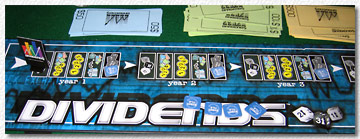
The production quality of the game is nothing short of amazing. Although the board (which is basically a turn track only) is rather small, there is a plastic rack holding the stocks, playing money, metal (!) pegs to indicate dividends, a lot of cards and counters. All the playing material comes fully „punched“, even to the point that the counters have already been put into Ziploc bags. The game can literally be played „out of the box“, simply read the rules and start. Singapore is close to China, and of course this is where the game has been produced, but Evelyn (the graphic designer) has told me that it’s not really cheaper for Singaporeans to produce there. Still, this is certainly an amazingly high quality effort rare for a starting game company (and their other game, „Giza“, also looks amazing).

Game play is deceivingly simple: Each player gets a certain amount of money (depending on the number of players) and tries to multiply it through trades at the stock exchange.

stock panel

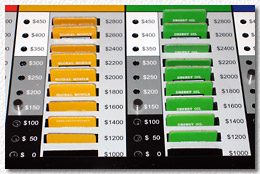
There are 5 generic „companies“ in 5 colours, with an equal number of shares (10). At the beginning of the game (and also later) the dividends are randomly determined through the roll of dice. The system is simple: the dividends can either be in the high (white), medium (grey) or low (black) range. If they are high they can only fall by 1-3 slots, if they are low they can only rise by 1-3 slots, if they are medium they can rise or fall (50% chance). If only the real stock market was that simple :-)

The price of the stocks is determined by the number of sold certificates. The first one always costs 1000$, the next one 1200$, then 1400$ etc. Players start buying the certificates from the bottom up, and if they sell them they are put in the next free slot from the top. This means that what happened with the company in between sells/buys determines your net gain – If many certificates have been sold after you bought your own you might win a hefty gain when selling it back now, but you might also lose a lot if after your turn other players have sold their certificates. The problem is that sometimes you are even forced to sell under such conditions, but more about that later.

This is of course why turn order in the game is all important, and not very surprisingly the order of play is auctioned in free auctioning system at the beginning of each round After that each player has the possibility (in turn order) to buy/sell stock (optional), play influence cards and discard unused influence cards. Influence cards are gained if you hold the majority in a company only – they come in all colours (there are also jokers) and shift the dividends (payout) of the company they are played on by 1 (up or down is indicated on the card). It is possibly to play several cards on the same company in one go, but you can also decline to play cards by simply discarding them (usually the ones bad for the stock you own).

After all players have completed their action phase there is a payout phase, where dividends as they are now are paid. The dividends go up in 50$ steps, from zero to 450$, usually you will always have the feeling you don’t get enough! This is why selling/buying stock wisely will win the game for you, because there the profit can be much higher…

board

Then influence cards are distributed, one for each share of a company in which you have the majority.

After that one of four events is drawn:

    • „Force Sell“ forces each player to sell his most expensive share at the moment for the current price, in turn order.
    • „Buy in“ enables players to buy the cheapest currently available share, in turn order.
    • „Placement Offer“ – players check which company (or companies) have currently the fewest sold shares. Each player can now buy one share of those at half price (in turn order).
    • „Technical Correction“ is the opposite of „Placement Offer“, players check which company has the most sold shares, and owners must sell one of them for half the price, again in turn order.

This procedure is repeated 5 times (equalling „years“), then there is a last chance to play influence cards, then a final payout, then each player sells one share back to the market, in turn order until all of his/her shares are sold. The player with the most money is now the winner.

Of course this makes the turn order in the last round extra important, and one should be willing to pay more than usual for it…

The game sounds simplistic and luck-driven and at first glance majorities seem all-important because they enable you to gain influence cards. This is why the first game I played went relatively slow. Each player basically stuck to the first majority stock that s/he bought, with only little change and variation through the events. The game winner actually only went from owning 3 shares to owning 5 shares!

I didn’t go into the second game with high expectations, but I thought it important to try it with hardened 18xx players who play the stock market more aggressively by nature (at our Westpark Gamers). This time around the game was totally different, as we started buying/selling stock very aggressively. Shares changed their owner more quickly than one could say „Dividends“ and all in all game play was dynamic and very much fun. The winner (me, hehe) actually reached nearly 15.000$, which was very different from the 8000$ in the first game. The following games have strengthened the second impression – the more risks the players take and the more aggressively they play the stock market the more fun this game will be. Still there is the element of luck – one can make mistakes and avoid them, but in close play very often the change of dividends or the appearance events will make all the difference.

Characteristics
Explaining the rules: 5-10 minutes
Setting up the game: 0 minutes (true!)
Fun: yes, if you like abstract stock market games with clear-cut mechanics
Brain: not a brain-teaser, but you certainly need to watch what’s happening closely to stand a chance
Excitement factor: high, if you get into it
Atmosphere: manages quite succesfully to simulate a certain hectic stock exchange atmosphere, although fiddly players can easily produce a lot of unwanted downtime

If you like this game will very much depend on your gaming preferences. As it is this is a more family oriented game that can be played in all kinds of gaming groups without long explanations or wading through obscure rules (the rules are very well laid out and easy to understand). Although it resembles „Acquire“ in it’s simplicity it certainly doesn’t have the same depth in game play, but that doesn’t mean that „Dividends“ is no fun, quite the opposite. My wife, who hates „Acquire“, actually liked „Dividends“ much more, for example! I personally like it a lot, as it is a relaxed challenge while at the same time being quite fast to play, a full game usually clocking in at 1½ hours up to a maximum of 2 hours. The problem I see is neither the game itself nor the beautiful design – it is the theme. There are a lot of good stock market games out there, and although „Dividends“ certainly belongs to the best of them (easily surpassing the awful old „Boersenspiel“ from Ravensburger, which has some similarities) it is difficult to distinguish itself in such a strong competition. The same can be said about nearly every other theme, I guess, but I can only encourage Fun Factory to experiment with more unusual ideas and themes in the future. With „Dividends“ they have shown to be a very professional company already, and I will certainly watch their future offerings closely.


03.08.2005: „Sole Mio“, „Australia“ und „Bluff“

Peter lernt rumänisch. Gleich nach dem Wortschatz zu den Doktorspielchen folgen die Flüche. Aus der 3. Phase der Kleinkind-Entwicklung natürlich. Dort ist er auch noch stecken geblieben. Die Ungarn hätten hierzu noch Ingredienzen aus der himmlischen Sphäre zu bieten. Wer bietet mehr? Sprachen der Welt, meldet Euch!
1. „Sole Mio“
Das Spiel war ein persönliches Geschenk von Grünspan (Wilhelm hat es hier bei uns erstmals vorgestellt) und wird wußten nicht mehr, ob man mit dem Kartenpack hier nur „Sole Mio“ oder auch schon „Mamma Mia!“ spielen konnten. Wir wissen es immer noch nicht, aber so wichtig ist der Name dann auch nicht, die Hauptsache ist, daß der Spielspaß stimmt. Und das kann man bei diesem lustigen, berechenbar-unberechenbaren Kartenspiel in jedem Fall sagen.
Es gab natürlich auch Probleme mit der Regelauslegung, z.B. beim Helfen: Der Hilfe-Suchende muß „genau angeben, welche und wie viele Zutaten er benötigt“, der Helfer darf „für die gewünschte Zutatenkombination natürlich auch Doppel-Zutaten verwenden“. Darf er dabei überzahlen? Darf er einen Doppel-Käse hingeben, wenn nur ein einfacher Käse verlangt ist? Ein sofortiger Anruf beim Wilhelm Volle konnte die Frage sofort klären („Er darf!“). Wenn es nur bei allen Spielen so wenig Rückfragen gäbe und wenn sie nur immer so schnell beantwortet würden wären …
Wilhelm konnte auch gleich die Anschlußfrage klären: Wenn der Helfer mehr gibt als benötigt, dann braucht der Hilfesuchende weniger Eigenmittel einzusetzen.
Peters Fazit zum Spiel: Es gibt wenige Spiele, bei denen die Weiterentwicklung ganz neue Qualitäten gegenüber dem Basisspiel hervorbringt. „Sole Mio / Mama Mia! Grande“ ist ein solches Spiel.
WPG-Wertung: Aaron: 6 (Neuling), Günther 7, Loredana 8 (junger Hase), Peter 7 (alter Hase), Walter 8 (ganz alter Hase)
2. Downtown
Weil die Hotline zur Grünspan-Entwicklung so gut funktioniert hatte, wollten wir uns gleich anschließend das „Downtown“ aus dem gleichen Hause vornehmen. Aber schließlich setzte sich hier das „Down under“ durch.
3. Australia
To windmill or not to windmill, das ist hier die Frage. Günther und Aaron waren gegen die Regel-Variante mit der Windmühle, Peter und ich waren dafür. Die Windmühle besitzt einerseits Eigenschaften, die das Spiel flexibler und berechenbarer machen (z.B. man kann mit seine Pöppel immer in voller Anzahl einsetzen, ohne damit dem Nachfolger eine ungewollt-gute Vorgabe zu machen), andererseits aber auch Eigenschaften, die ins Chaotische gehen, z.B. die Position der Windmühle auf dem Brett und die erzielte Rangfolge beim Abrechnen.
Ich machte fast 1000 Punkte mit der Windmühle, und wenn Peter mir noch eine weitere Abrechnung gegönnt hätte, wäre ich Zweiter geworden. So wurde ich Letzter, meine Ausbeute in den australischen Landschaften war doch zu dürftig. Es ist zweifellos lukrativer, sich jeweils auf die Camps mit den meisten angrenzenden Gebieten zu begeben, dort bieten sich mittel- und langfristig wesentlich mehr Möglichkeiten zum Abkassieren.
Leider ist das Ausrechnen der besten Züge eine ziemlich elende Fitzelei, besonders in der zweiten Hälfte. Wenn dann noch gleich 5 (in Worten fünf) WPG-Denker zusammenkommen und immer erst dann anfangen zu denken, wenn sie dran sind („Australien“ mit seiner Windmühle erlaubt kein früheres Planen), dann zieht sich das Spiel ganz schön hin.
Frage am Rande: Warum ist das Warten auf das Ende des Zuges der Mitspieler bei „1830“, selbst wenn man bei keiner Gesellschaft die Präsidentschaft besitzt, mit wesentlich weniger Leidensdruck verbunden, als bei (fast) jedem anderen Spiel?
WPG-Wertung: Aaron: 7, Günther: 7, Loredana: 6 (Neuling), Peter: 4 (nur bei 5 Mitspielern, sonst 7), Walter: 7
4. „Bluff“
In der ersten Runde schaffte Aaron (oder Günther) einen 5:0 Sieg gegen den Rest der Welt. In der zweiten Runde ging Günther mit 5:1 Würfeln gegen Loredana ins Endspiel. Alles hielt die Luft an, als er schon zweimal einen Würfel abgeben mußte. (Mehr als einen Würfel pro Kampf geht nicht! Warum?) Wenn Loredana im dritten Kampf auch noch Günthers 5er Vorgabe angezweifelt hätte …
Keine neue Wertung

LouisXIV

reviewed by Moritz Eggert

This new game by Alea was the buzz at last year’s Essen fair. There was only one prototype to play with, but even then, it already appeared on many „Top Games“ lists. Unfortunately, I was not able to try it out, so it seemed a must to give the now published game a go.

Alea has certainly come up with a hefty tome as a rulebook this time, but understanding the game is not as difficult as it seems at first glance, as the rules are extremely logical and leave little doubts once you have understood the signs on the cards.

Players are nobles who work out intrigues at the court of the king, but this is not as strong an apparent theme as one would hope for, as this is a rather abstract, albeit extremely clever game of action management. It plays a little like an advanced version of „El Grande“ with many original and new ideas on offer.

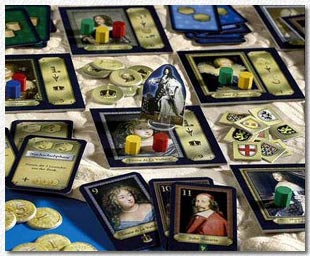
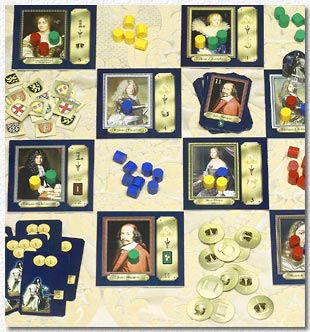
Twelve nobles are on display as tiles, each using nice original portraits of the period. Players go through four rounds, which consist of several phases. Each player manages a handful of influence pawns that are placed on the various portraits for various benefits if you have the majority (and also if you don’t). One can acquire „symbols“ that come in handy when fulfilling „missions“ (more on that later). Or „intrigue“ cards, that enable a player to add to his own number of influence pawns AFTER all pawns are placed. Or additional „influence cards“, that give you an extra go at the end of the 4 turn influence round (as you can imagine in a game about majorities placing last is a BIG advantage). Or one can „beam“ influence pawns to somewhere else, either before or after they are „counted“ (it is possible to leave pawns for the next round, thereby already having a majority which might discourage other players). Or „insignias“, which count as 1 VP and might reap additional VP’s at the end of the game. Last but not least you can go for money only (also important). All Tiles fall in three „counting“ categories.

  1. „1st place tiles“. These tiles are the trickiest, as only the player who truly has the most pawns will win the prize; the others go home empty handed.
  2. „Exchange tiles“. These are safe but costly; placing the necessary number of pawns brings you the benefit without worrying about majorities.
  3. „Money Tiles“. If you have the most pawns you get the prize for free, the others can also get the prize, but have to pay for it.

board

Players work with two piles of influence pawns, like in „El Grande“. One is „your own“ and active, the other is the reserve. Moving the pawns from the reserve to your court counts as an action. Winning a prize means that the pawns you use wander into the reserve, but if you buy or trade prizes, your pawns will be immediately active again, so sometimes it is actually desirable to be second place. There is also a moving „Louis“ figure, which means that being first in the designated tile enables you to reap additional prizes.

All this sounds complicated at first and needs some getting used to, but it plays very logically. Placing pawns brings in a tactical element: You play influence cards that correspond to tiles. Only there can you place your pawns and „move“ them on the „board“ via diagonal connections. Usually you place 3 pawns, and each move means you have to leave one pawn there, so the maximum of tiles you can „influence“ is usually 3 per card played (playing jokers means you only get 2 pawns).

After the influence round is over the tiles are „counted“ in numerical order, giving prizes to each player in turn. After you reap the prizes, the most important phase begins: fulfilling missions. Each player has two mission cards (in three categories: easy, 1 defined and 1 „any“ symbol, medium two defined symbols, and hard, 2 equal symbols). Fulfilling the missions means expending the prizes (symbols) you managed to get. To fulfil one mission per turn is a must, fulfilling two or more is ideal. Each mission gives five VP at the end of the game, so these make up the majority of VPs at the end, but more importantly, they give you special abilities that give additional benefits like extra pawn placement or insignia income. The harder missions give better benefits of course, but the game only has 4 turns, so going for the one-time benefit of a hard mission in the last turn might not be a good idea.

board

After the final turn, the insignias (who come in various designs) come into play when counting VPs. Now a majority in each design gives an extra VP, so a player collecting lots of insignias can make many points more through such majorities. This was perceived as the weakest part of the rules, as there is no way to influence the majority in insignias during the game, it is just pure luck of the draw. In a game which mainly consists of careful planning this jars a little, but one can easily leave away this rule.

„Louis XIV“ is a very challenging game that lends itself to many strategies. Going for insignia is sometimes easier than going for missions, but gives less VPs and no special abilities. But neglecting any aspect means failure, you carefully have to balance what you expect to gain and act accordingly. The turn order is important (the starting player changes, of course). If you come late, you can go for the risky prizes, if you go early or first you should plan a failsafe move, preferring „money“ or „exchange“ spaces. It is especially gratifying to place last when some tiles are still completely empty, actually this can happen quite easily if the other players are not careful. Nevertheless, „Louis XIV“ is far from being a multiplayer solitaire game. Although it is impossible to hurt other players in unfair ways like stealing pawns or moving them around, it is very much possible to place them in a very annoying way. But the complexity of the calculations and interactions makes kingmaking very difficult, and also undesirable in a way.

Our judgment? We were very impressed with this new Alea game and applaud Rüdiger Dorn for another great design. While certainly not a game creating a funny beer-and-pretzel atmosphere it will keep you engrossed throughout, a true gamer’s game. Recommended!

Explaining the Rules (carefully): ½ hour


27.07.2005: „Enix““,“Long Short“, „Zoff im Zoo“ und „Bluff“

Auch wenn die Wochenenden in München verregnet sind und die Westpark-Seebühne über schauerliches Wetter klagt, die Mittwochs-Spielabende im Freien vermitteln bis weit nach Mitternacht ein mediterranes Lebensgefühl.
1. „Enix“
Nicht zu verwechseln mit dem bayerischen „Eh nix“. Ein hübsches, kleines Karten-Brettspiel, gesponsert von der Schweizerischen Vereinigung für Sonnenenergie.
Zum Glück für das Spiel kommt die Ökologie außer als Design-Motiv nicht zum Vorschein. Jeder Spieler sammelt Karten in verschiedenen Farben und mit möglichst günstig bewerteten Zahlensummen. Die Methoden, an Karten heranzukommen sind durchaus neuartig und bemerkenswert. Ansonsten ist alles sauberes Chaos. Und wenn man Lust hat, kann man dabei versuchen zu denken.
WPG-Wertung: Aaron: 6, Günther: 4 (kommt mit Chaos-Theorien besser zurecht als mit Chaos-Praxis), Loredana: 6, Peter: 3 (hatte sich schon vorher im Negativen festgebissen), Walter: 6
Ich werde eine Rezension schreiben.
2. „Long Short“
Echt „klassisches“ (Originalton Aaron!) Wirtschafts- und Börsenspiel aus den 80er Jahren. Wird hoch gepriesen, als „einziges“ seine Art, weil man auch beim Fallen von Aktienwerten Gewinne machen kann. Ist das nicht bei allen Börsenspielen so? War das 1982 tatsächlich eine neuartige Idee?
Für Peter war am Ende Aarons Klassiker leider doch nur ein Moritz-Klassiker!
Wenn Moritz seinen Report zu „Dividends“ fertig hat, kann er ihn im Handumdrehen auf „Long Short“ umschreiben. Zwei Fliegen in einer Klappe! Ist das nicht viel effizienter als die vielen tausend Noten für das Fußball-Oratorium?
WPG-Wertung: Hallo, wir haben die Noten vergessen! Bitte nachreichen! Von mir gibt eine 5.
3. „Zoff im Zoo“
Jeder konnte sich an die Tierbilder erinnern, keiner wußte mehr so genau die Regel-Details. Diesmal machte uns Peter den Moritz. (Was die „Klassik“ betriff.)
Ein Stichspiel, bei dem das Mannschafts-Prinzip eine hübsche Wertungsvariante darstellt. Natürlich ist die Kartenverteilung das A+O. Dazu gesellt sich eine gekonnte Kartenpflege und ein Gedächtnis, über die schon gefallenen Karten. Und ein Gespür dafür, wann man mit seinen Löwen und Igeln auf den Markt zieht. Geduld haben, auf keinen Fall einen frühen Stich an sich reißen, wenn dabei die Kartenhand zum Teufel geht!
WPG-Wertung: Aaron: 7, Günther: 8, Loredana: 7, Peter: 8, Walter: 7
4. „Bluff“
Hoffentlich beschweren sich meine Nachbarn (die übernächsten, nicht die nächsten!) über die mitternächtlichen Lacher nicht. Bei Bluff sind sie unvermeidlich. (Wenn auch die Tageszeit nicht vorgeschrieben ist.)
Ich schied in allen drei Runden vorzeitig aus (was bei „Bluff“ ja kein Unglück ist). Loredana gewann alle drei Runden, obwohl sich Peter zwischenzeitlich erfolgreich mit fremden Sternen schmückte!
Keine neue Wertung