Puerto Rico
Publisher: Alea/Ravensburger
Author: Andreas Seyfarth
Tester: Aaron Haag, Hans R. Frey
Game Tested: German release, 2002
Scenario: Puerto Rico – the small island of the West Indies is the setting for
this fight for wealth and honor of 3 to 5 players. By building plantations and production
plants as well as important support facilities, and by exporting goods, players try to
accumulate victory points. Players start with just one little corn field and no
buildings, and face the task of setting up a prosperous production chain of goods ready
for export or local sale in order to generate the money necessary for further
expansion.
The Game: Each player is given his own placemat depicting the town of San Juan
with 12 available spaces for buildings and a settlement area with room for up to 12
plantations. A separate board represents the “Bank” for doubloons, the currency
of the game, and holds the available buildings. Buildings come in two flavors: there are
plants to produce goods from crop (like e.g. the sugar mill) and there are buildings that
provide the player with special abilities (like e.g. a market place which allows the
player to sell goods already present in the trading house).
The motor of the game are the “character cards” or “roles” which
provide the players with a means to control the sequence of phases in which the game is
played. Beginning with the start player (represented by “Governor” card) each
player selects a character. Different to other games with a number of roles all
players perform the action associated with the selected character. The benefit for the
selecting player (besides first choice when performing the action) is the right to make
use of a special “privilege” each character provides. Basically, this mechanism
makes the players determine the sequence of actions performed in a round and is of great
tactical importance. Also, there are 3 more character cards in play than there are
players, making it possible to avoid certain actions in a particular round at all. Once
all players have selected their character and hence all have played the actions of all
characters selected the round ends and the Govenor is handed to the next player not
before a doubloon each is placed on the 3 character cards that have not been selected in
this round (making them more attractive in the next round).
The actions and privileges of the character cards are:
- Settler
Each player selects a plantation to be placed on his island. Privilege: the player
may choose to place a quarry instead. - Mayor
Players receive colonists from the colonist ship. All colonists on the island may be
redistributed. Privilege: the mayor receives one extra colonist from stock. - Builder
Players may build one of the available buildings by paying the appropiate cost in
doubloons. Privilege: the builder pays one doubloon less. - Craftsman
Players receive goods according to their production chains. Privilege: the
craftsman receives an extra token of one of the goods produced. - Trader
Players may sell one goods token to the trading house. Privilege: the trader
receives one extra doubloon for his token. - Captain
Players must place goods on available ships and receive a victory point chip for
each goods token placed. Privilege: the captain receives one extra victory
point. - Prospector
No action. Privilege: the prospector takes one doubloon from the bank.
At the start of the game the settler and the builder are the most useful characters
because they are required to build plantations and buildings – both being vital for
successful production chains. Plantations come in 5 different types: indigo, sugar, corn,
tobacco and coffee, in order of abundance. 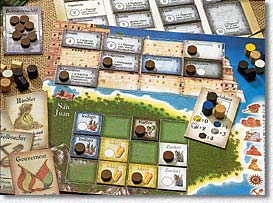 With the exception of corn
all other crops require a processing plant in order to generates goods for sale or
shipment. Some plants come in two different sizes with the smaller size being available
at a lower price. A production chain requires that each plantation used for production as
well as the production plant itself is occupied by colonists.
While plantations come for free in the Settler phase building need to be paid for and
money (doubloons) is very scarce in this game. Players start the game with between 2 to 4
doubloons depending on the number of players and buildings cost between 1 and 10
doubloons to construct. One way out of this shortage of money is to place quarries
instead of plantations, as each quarry occupied by a colonist lowers the building price
by one doubloon in the Builder phase.
There are, of course, ways to generate money. The first way is to sell goods to the
trading house. Each commodity may only be present once in the house and the storage
capacity is small as well (4 tokens). If a good can be sold in the Trader phase the money
a player receives depends on the commodity sold, ranging from zero(!) doubloons for corn
to four doubloons for coffee. The second way to receive money is by selecting character
cards with doubloons on them. Often at the beginning of a round some cards have two
doubloons on them making them rather attractive to take. Sometimes even a prospector has
this two doubloons bonus because that role has not been chosen since two rounds making it
an attractive 3 doubloons deal this round. Anyway, generating money is certainly not an
easy task.
Another very scarce resource of the game are the colonists. No plantation, quarry or
building operates or provides special benefits if not occupied by one or more colonists.
As explained before, this is most important in producrion chains. Colonists arrive on the
colonist ship in a varying number depending on the number of players and the number of
open positions in buildings. In the Mayor’s phase all colonists are distributed
amongst the players in sequence and the players may place these colonists on any position
they have vacant at the time (plus they may redistribute all colonists on their island).
Most of the time a player will receive only 1 colonist per round so getting one’s
plantations and buildings fully operational takes time.
The decisive element, however, are victory points. On the one hand they are generated
in the captain’s phase by placing goods on available ships. As there are only three
ships available, each ship has a limited capacity, and each ship may only carry one
commodity at a time, often some goods cannot be placed at all. This can pose a serious
problem as goods must be placed on a ship if possible but goods not placed due to the
unavailability of a ship must either be placed in an operational storage building or are
lost – a situation to avoid at all cost.
At the end of the game victory points are also credited for each building a player
has, irrespective of whether it is occupied by a colonist or not. The four
“large” buildings (if occupied !) generate extra victory points (the fortress
for example provides 1 extra victory point for every 3 colonists on the players
board).The game end is variable: it occurs at the end of the round where either an
insufficient amount of colonists is available to fully stock the colonist ship or at
least one player has buildings on each of his 12 town fields or when all victory point
chips have been distributed.
Playing Time: The game can be explained in 15 minutes and played in about 2
hours.
Similar Games: Princes of Florence
Westpark Gamer’s Opinion: Like many good games Puerto Rico has a strong
timing and resource management (i.e. tactical) component combined with several strategic
options. It has actually been quite a while that we have seen a new game which leaves
such a wide scope for different strategies and at the same time provides the permanent
challenges of tactical decisions. Many times during a game one is faced with a situation
that the obvious best move for oneself has just been destroyed by another player by
picking the character card one wanted to select, too. Therefore, most of the time you are
forced to devise a “plan B” and sometime even “plan C” which you can
use as alternatives. This sounds complicated and hard to grasp but we found that this
comes quite naturally when getting familiar with the game while it does no harm if the
players are not yet familiar with all strategic options.
Overall, the number of strategic variants seem to be quite high. Until now we have not
yet found a sure winning strategy though and in fact we believe that there is none which
will work all the time – again a sign of a good game. A Player needs to constantly be
watching the moves of the others in order to adjust his or her strategy accordingly and
at the same time prevent the other players to build up “winning combinations”.
For example, allowing a player to build lots of corn fields, a hospice and a shipyard
most likely means victory for that player. Similar situations arise if a player is
allowed to build more than one large building generating extra VPs at the end of the
game. This aspect of the game is what makes it rather complex because depriving other
players of certain building does not necessarily match with your own strategy. Sometimes
this means that one has to play the Captain just to create e.g. a “coffee” ship
with one coffee in order to prevent another player to get VPs for all his corns. Or you
may already have sufficient doubloons but are faced with a situation where you need to
take a prospector with 2 extra doubloons just to prevent someone else to get enough money
for that winning shipyard. Throughout the game players are in the type of dilemma
situation where they would like to do several things at once but are only allowed to take
one action – another indication of a good game.
Player interactions are quite low though and are mainly limited to cautious hints to
other players or “I wanted to take that role, too” type sighs. This can lead to
a rather “quite” gaming session but due to the fact that everybody feels
involved all of the time we never found this to be a problem.
Some words about strategies: in our games the number of VPs required for winning the
game varied between 28 and 43 – a rather wide spread although the distance between first
and last position in most cases was rather small (less than 10 points). This can be
attributed to the different strategies we followed as our experience grew. From what we
have learnt so far it seems to be wise to keep a good balance between VPs generated by
production and those generated by the buildings (a 50:50 share seems okay). And unless
you are playing with newcomers to the game it is a good idea to try and produce at least
3 different types of goods. Clever building selection also plays a major role. Keep an
eye on the “hospice” and if possible try to grab one of the two available. We
found this building to be one of the most powerful of the game and one has to prevent
other players from building “power combinations” with it (like
“hospice”/”builder’s hut” or
“hospice”/”shipyard”).
Hans’ strategy hints: A word of caution in advance: I have never won in
this game yet, though I haven’t lost very badly, either. What I like best in this
game, is that the actions of all players interact and create a different feel each time.
What works one day, need not work another. This said, let me propose a few ideas:
Life is short: The last round inevitably comes too early for you. Running down
the game clock can be your best strategy, or it can ruin your best plan. Normally,
colonists run out fastest, but watch out for the other two types of game ending.
Don’t do anything in the endgame which bears fruit too late!
Build big: Normally, you will (at game end) need one of the X-large buildings
for extra victory points. Get two, and you’re top dog. It is essential to know where
the money is to come from in that final builder phase. And remember, you need to shuffle
a colonist on it later!
Take the money and run: Sometimes, the best way to make money is by selecting a
not-so-hot character with many doubloons on it – but don’t do that too often (see
hint #1).
Play along: In most rounds, you’re not te governor, and if you are: good
luck, as you’ll be the last to pick a character next time. It is very important to
have an idea which characters will be picked before you’re up next. Let’s assume
You want to trade goods for money: First, you need a plantation and a production
plant, then you need to shuffle colonists on them, then produce goods
tokens, at last – you are forced by a captain’s phase to convert the tokens
into victory points (if you’re lucky and there’s a ship for them) instead of
trading them in a trader’s phase. In Zen words: the shapeless form is the strongest.
In my words: play so that the others are forced to help you while serving their own
interest.
Experience tells: So far, our group of players finds the hospice, the hazienda,
and the constructor’s hut to be the most rewarding support buildings. Try to get one
or two of these right away. Get all three, and you’re unstoppable. Get none, and Your
only hope is in a short game. As well, to have one of the storage buildings is regarded
as indispensable by most of us (not me, though). Quarries are the best plantations, but
it needs time until they make their weight felt.
Closer views:
The heavy strategy: You want to get four quarries asap, in order to construct a
high-price, high-victory-point city. You must have a constructor’s hut, so you know
what to do in the first builder phase. You will be short of plantations, colonists and
money for a long time, so be careful if there’s a lot of production chains in the
other player’s cities. These attract many colonists in the mayor phase, and the game
may end so soon that You can’t harvest the returns of your investment. Best friends:
hazienda, hospice.
The yellow strategy: You want to make use of the fact that corn fields need no
factory in order to produce goods. In fact, you don’t need a single building, at all!
Just make sure you get all corn that pops up in the settler phase and pick the captain
yourself as often as you possibly can. You won’t have money – but you don’t need
it, anyway! You will never have too few colonists. Ships at the quay, that’s what you
need, and an early end to the game. Best friends: storehouse, wharf.
The scented strategy: Be the first to produce tobacco, later coffee. Trade like
lightning and spend your income on buildings. Your problem is that you may be unable to
trade sometimes, which can be a major setback. The good thing is that the money gives you
flexibility. You will have to develop an idea how to make the best of the end game. Best
friends: office, market.
The sweet strategy: You want to strike a balance between export and trade, between
cash and victory points flow. Sugar is a very attractive commodity to produce in this
case – the plantation is the second most abundant type, the trading price is reasonable,
and the factories are not expensive to build. The problem is that you may end up a little
short of money for that decisive building and with too little export for that extra
victory point chip. Best friends: your keen sense for opportunities that open up. A short
game probably doesn’t hurt.
The drugstore strategy: You want to produce as many different commodities as
possible. It’s easier to implement than it sounds, and it avoids the pitfall of the
trading business, i.e. not having the right commodity to sell. Beware of a short game, as
it takes time to build the production chains. Obviously, the drugstore can develop out of
the other strategies in the middle game. Best friends: harbour, factory.
Add your comments here |
Westpark Gamers’ Rating: 8.17
| Links to further information: | BoardgameGeek’s page on Puerto Rico |
| Alea’s page about the game |
|
| Rio Grande’s page about the game |