Spielbericht 16.10.2002
Autor: Moritz
am Tisch: Peter, Aaron, Walter, Andrea, Moritz
auf dem Tisch: Das Amulett, Im Zeichen des Kreuzes, Drakon und Expansion Set,
Powerplay, Bluff
I was slightly worried about missing the European soccer championship game that
evening (Germany against Faroer Islands), but that game apparently was so bad that we
surely had better entertainment value with our selection of all-star games!
- Das Amulett
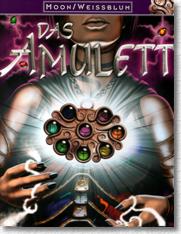
This relatively recent German offering includes many elements that I like: bidding,
variable player powers, and fantasy. Well, the last element is really flavor only, as the
game is rather abstract. Players collect gemstones – the first player to collect 7
different ones (or ANY 8) wins. Similarly to “Die Kaufleute von
Amsterdam” there is only one token on the map – whoever won the last bid can
decide where it moves next. The board is divided into various areas with 2 different
gemstones initially (there are more than 7 different colors, with different total amounts
in each color), there are also “cities” with 3 different gemstones. All areas
apart of cities have one metal symbol (there are 4 different metals of which each player
initially receives one each). In these areas it is only possible to bid with this
specific metal, only in the city can you use all 4. There are also areas with pyramids,
and areas close to the “big wall”. These areas grant you special abilities, if
you have certain “power cards”.The power phase is the most interesting of the game: each player has a stock of 10 energy
markers that will either be “free” or bound to cards. As many power cards as
there are players are drawn and auctioned off. The amount of energy that you pay not only
beats the other players amount, it also defines how long you can use a card, as each
round one or two energy markers (depending on the strength of the power card) are removed
– if there are none left, the card ceases to function.Normally players will have from 2-4 “energized” power cards. Some of them let
you draw specific metal cards each round, some of them make you select any metal card you
want, some of them give you special bidding powers (for example forcing players to always
bid at least 2 higher than you), some of them let you take energy away, etc. The
abilities on the cards are varied and interesting, and basically through these cards the
game is won.After the power bidding a number between 4 and 6 is drawn, this is the amount of
movements the single pawn will make. At each stop the players bid their metal cards that
fit the area (it is very often possible to bid with ANY card – if you have, for example,
a power card that allows you to do just that in a pyramid space, for example). The
highest bidder takes the gem of her/his choice. Then s/he decides where the pawn will
move next. It is very interesting to watch what gems other players have acquired so far,
as it is often possible to move the pawn to a space where the leading player (preferably)
will get a gem s/he already owns, thus making victory more difficult. But again, beware
of the power cards, as some of them can move gemstones on the map!The game is over pretty quickly, or rather more quickly than you wished for (“what,
already? I wanted to win!”). It makes you want to play again immediately, which is
always a good feature in a game. Probably not an evergreen, but a very nice and deep
game, with elegant mechanics and nice material. I thoroughly recommend it, though
non-gamers might have to get used to the rather nebulous fantasy theme. - Drakon, mit Expansion-Set One
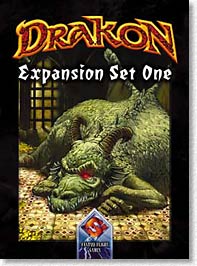
Diesmal zwang ich die Kollegen, das nicht so unglaublich geschätzte “Drakon”
doch noch einmal auszuprobieren, diesmal mit einer kleinen Regelvariante (geliehen von
“Carcassonne“): Es liegen immer 3 Dungeon-Tiles offen aus: wenn man
nachzieht, wählt man sich ein Teil aus!Das hat 2 Vorteile: erstens besitze ich die erste Auflage des Spiels, sah aber nicht ein
nur wegen des Expansion-Sets die ZWEITE Auflage des Spiels zu kaufen (in der 2. Auflage
haben die Dungeon-Tiles eine andere Rückseite, die nur mit der 2. Auflage kompatibel
sind, was ein normales “Ziehen” unmöglich macht). Zweitens kann man die gerade
ausliegenden Dungeon-Teile noch mal Allen erklären, was bei diesem zwar simplen, aber
durch die vielen unterschiedlichen Effekte der Räume doch recht unübersichtlichen Spiel
nicht schlecht ist.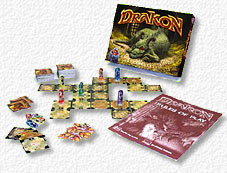 Noch mal kurz worum es geht: 2-6 Abenteuer versuchen aus einem
Drachenverlies zu entkommen, das sie während des Spiels selber erstellen. Der erste
Spieler mit 5 Goldstücken gewinnt (anscheinend ist es nicht so wichtig, WIRKLICH dem
Dungeon zu entkommen- “reich stirbt halt glücklich”). Fast alle Räume haben
einen bestimmten Effekt, der nur beim Betreten wirkt, man bekommt Geld, dreht Räume,
teleportiert durch die Gegend, klaut anderen Geld, usw. (es gibt unglaublich viele
verschiedene Räume). Mit dem Expansionset kommt noch ein lebendiger Drachencounter (der
beim Betreten bestimmter Räume durch die Gegend bewegt wird) hinzu, der vor allem andere
Spieler ärgert (go back to the beginning, lose 1 gold), außerdem ein gutes Dutzend neuer
Raumeffekte durch neue Tiles.Durch die oben beschriebene Regelvariante wurde das Spiel kürzer und schmerzloser, und
der sonst stark empfundene “Kingmaker”-Effekt trat schwächer als sonst zutage.
Kein supertolles Spiel, aber mal ganz nett zwischendrin. Das Glücksmoment sollte man
allerdings sehr hoch einschätzen! - Im Zeichen des Kreuzes
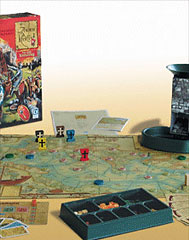
This predecessor of “Wallenstein” also uses the “dice-tower”, an ingenious
device which serve as an interesting randomizer for combat. You throw in the wooden
armies of the enemy and your own armies at the same time – 50 percent will stay in the
tower and come out at a later time. Armies that DO come out are compared, higher total
wins. Foreign accidentally released armies will be transformed into reserve armies for
you (i.e. “freed prisoners”). A surprisingly simple and fun system – ok, there
is luck, but it makes for much more fun than throwing dice…“Im Zeichen des Kreuzes” lets the players reenact the horrible crusades – as
crusaders of varying reputation. The game is played on a map of the Mediterranean. Each
crusader starts with a handful of armies and treasure chests in predetermined areas. The
goal of the game is to reach Jerusalem, which, at the beginning of the game, is fortified
with 15 armies (more will be added during the game). There are also two independent
pirate and land armies each, which mostly serve as an annoyance for other players.Movement works through playing region cards: there are 3 sorts (mountain, plain and sea)
and a joker which can be used as any region. Some of the cards bear army or ship symbols
– these move the neutral armies. There are an abundant number of both Christian and
Muslim cities on the map, ready to be plundered. It is actually often equally good to
attack Christian cities, as the booty is the same, but the reputation will suffer
slightly (making you redraw less cards, which is bad). Christian cities also serve as
places to pray (gain reputation) or to hire new armies (with treasure chests, presumably
from the last ransacked town). Once a city is sacked, it is removed from the board and
cannot be used again. Certain event cards force you to never attack a certain city to
gain defined bonuses. After conquering a small number of Muslim cities it quickly becomes
your duty to attack Jerusalem. Your first attacks will be hopelessly outnumbered, but the
pope will give you new armies as a bonus, so next time you will be stronger. After
probably 2 hours of play one player will be the first to conquer Jerusalem and win the
game.Basically this is a racing game, not a war game. As battles mostly cost you the same
number of armies as you will gain through plunder, so you will try to reach your quota of
conquered Muslim cities and then proceed as quickly as possible to Jerusalem, to gain the
bonus armies for your first attacks (which usually end in losses).A light, not very deep game, which still manages to project a reasonably detailed
“historic” atmosphere. There are lots of opportunities for annoying the other
players, which adds to the fun. Combat can become repetitive, but is rather quick, so it
doesn’t matter that much. It is also not important to win ALL battles – you have to
win the RIGHT battle in the end. All in all this is a game that certainly will appear
again on our table.But careful: Check if you have assembled the tower correctly before you start playing –
we discovered we hadn’t in the middle of our game, and this forced us to stop playing
as many armies had become stuck in the rim and therefore created an unfair situation for
some players without us knowing it! - Powerplay
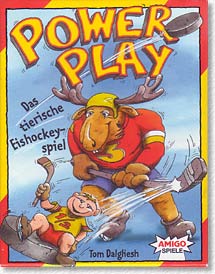
This is the German version of the excellent American card game “Slapshot“,
which, slightly inspired by the black film comedy with the same name about ice hockey
(starring Paul Newman), became most known in it’s old Avalon
Hill edition.You won’t find a Paul Newman card, but rather an assortment of fantasy and parody
characters very removed from real ice hockey in the German version. Each player randomly
draws a team of 3 attackers, 2 defenders and a goalie. Every turn each player has 3
options: 1) exchange one player card for a randomly drawn card of the same type
(presumably in the hope of getting a better player). 2) Randomly steal a card of another
player and replace it with a card of your choice from your own hand (risky, but worth it
if the other player is known to have a strong team). 3) Challenge another players team
(you have to challenge each other player before challenging the same player again).Who can score 5 matches wins the game.
Games (or rather battles) work a little like the card game “War” – Each player
selects a card secretly, the higher card scores a goal, with some special rules (goalies
always stop attackers, or concede to the higher goalie, certain defenders have the
ability to incapacitate the opponent’s card, forcing him to exchange the card after
the game, etc.). There are even players with “special abilities”, like the
“Hydra”, which is stronger if played late in the game.All 6 cards are played and the higher scorer wins (sudden death continuation is
possible, if there is a draw). Card play is relatively random for the first 3 cards or
so, but becomes increasingly tactical, as you know what cards have been played and which
ones not. Also, the other players will watch the game like hyenas – if a player is known
to have a weak team the others will certainly take advantage of that knowledge.All in all this is a really fun game – it plays quickly, uses at least parts of your
brain that other games do not use, and it is also cheap. A true classic, especially as a
quick starter or light finishing game. - Bluff
’nuff said: Aaron won!