Session Report 19.11.2002
Author: Aaron
at the table: Andrea, Hans, Moritz, Walter, Aaron
on the table: Trias, 6 nimmt, ZooSim, Anno Domini
- Trias
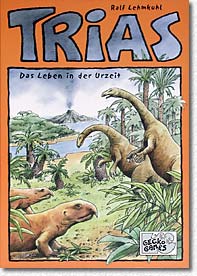
38 hex-tiles form a large island of three different terrain types. Following the name of
the game this large island will eventually break up into several smaller islands due to
player actions which cause the tiles to “drift” into an outwards direction.
Players start the game with a small group of four herds on the large island and their
objective is to have a majority of herds on the soon to come smaller islands.A player’s turn consists of a mandatory “drift” of a tile followed by up
to four actions of herd propagation, herd movement and optional tile drift.
“Drifting” is performed by taking a tile that forms the shore of an island and
placing it further away from the central vulcano tile of the central island. Removing
tiles from the central islands shores eventually generated smaller islands. Whenever a
new island is created by tile drifting scoring is triggered for the island where the
drifted tiles has been placed. The player with the majority of herds on that island
receives two victory points, the runner-up gets one VP.In the course of the main island breaking up players receive already some victory
points. Since herds cannot move between islands players every now and then will try to
join islands to gain majorities which otherwise would not be possible. Envisioning such
moves, preventing other players to perform them while at the same time taking care that
there are sufficient options open for oneself is the zest of Trias.Eventually the last round of the game starts when the “comet” card is drawn
from the stack and each player is left with just two more actions. Once that round is
completed the last, but decisive victory points are allocated: this time herd majorities
on islands yield points depending on the number of tiles the island consists of. And just
as in any previous victory point allocations, the main island (or fragments thereof) does
not yield any VPs.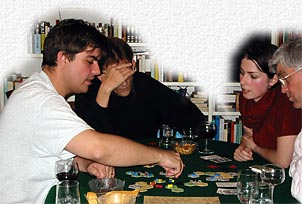 After my misfortune last week when I had the majority on the largest
island but did not get any victory points because it was still connected to the central
vulcano tile I knew what to look out for this time. Although the optional tile drift
action costs three of the available four actions it is the one option that prevents
exactly this mishap. Some sort of diversification is also required in order to
participate from other player’s moves and to build alliances. Sometimes this can be a
bit of a problem as the number of possible good moves is fairly large and it is difficult
to decide which are the ones that need to be played now and which can be postponed to a
later turn. In comparison to last week, when we played Trias with only four players we
found that planning ahead in a five player game is much more difficult and sometimes even
impossible – just too many things change while it’s not your turn.Moritz managed to win the game by being present on nearly all of the islands present and
thereby collecting an enormous amount of victory points by being at least the runner up
in terms of herd majority. His diversification strategy definitely worked out.
- 6 nimmt
Since Hans had to leave early tonight we decided to play a quick round of 6 nimmt, a game which had not been on the table for quite a
while. Again we had a lot of “highest lowest” situations, a situation described
by Walter in his German review of the game, and for
whatever reason it was mostly I who had the “lowest highest” and consequently
having to take lots of negative points. This game has a wonderful mechanism which makes
you believe that you have some means of control where in fact most of the time it’s
sheer luck which determines the result.Not having had a single round without taking at least five cards it was all too certain
that a will lose the game. My only satisfaction was that our usual sure winner Moritz
managed to only make second place. - ZooSim
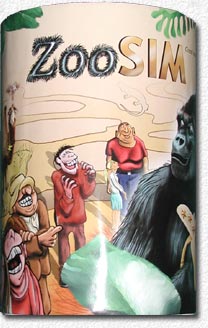
Like last year’s Essen release Titicaca, ZooSim also comes in a round box – the
trademark of Cwali games. The objective of the two to four players is to create a zoo
which attracts many visitors, a theme which is already known from various computer games
(I guess that’s the reason for the game’s title). Unlike other Cwali games,
ZooSim is a short game (less than 45 minutes) and is far more simpler to explain and
play.The game consists of 25 tiles with zoo exhibits, paths and trees printed on them.
Exhibits come in five color-coded categories (birds, apes, sea animals, reptiles and
other mammals) and have a point value for attractiveness (one to three stars) printed on
them. The objective of the players is to get the most attractive exhibits of a category
as well as to boost attractiveness by having the most trees and circular pathways in
their zoo.The game is played in five rounds and in each round five zoo tiles are revealed and
auctioned one by one. Auctions are fast, with each player placing their bid in a closed
fist and all revealing their bid at the same time. A clever mechanism has been selected
to deal with ties: each player has a little flag marker next to a flag pole and the
player with the flag at the higher position receives the tile in case of a tie. Then the
flag marker is placed to the bottom of the markers.Won tiles must be placed so that paths line up with paths on existing tiles. Players
will try to place tiles in such a way that exhibit categories are next to each other
because only then the whole group counts as one exhibit for majority determination. As
soon as the tile is properly placed the majority situation is re-evaluated. The player
holding the majority in an animal category or trees places two visitor tokens on that
exhibit and the runner up places one visitor on the some exhibit in his zoo. If a
circular path has been created the player receives one visitor token for that as well.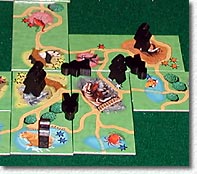 Once a set of five tiles has been auctioned a round finishes and players
receive victory points depending on the number of visitors in their zoo. Each visitor
equals one point multiplied with the round number, thus making round five, the final
round, counting five times as much as the first round. Players then receive new money
tokens equal to the number of tiles they have in their zoo and five new tiles are
revealed before the next auctioning round commences. After five such rounds when all
tiles have been auctioned, the player with the most victory points wins the game.ZooSim has some nice mechanisms which leave players with constant decision making and
involving all players at anytime during the game. It’s important to decide which
tile(s) to go for in the auctions – not all tiles have favorable paths or animal
categories. Money is scarce with players starting the game with only eight tokens and
receiving new tokens depending on the size of their zoo. Their is also an important
tie-breaker on exhibit size: the player who equals the highest attraction value last
takes the two visitors leaving the second place to the original leader. Together with the
sometimes complex path layout this can lead to extended pondering at the beginning of an
auction round. Latest after round three all animal categories are present in the zoos and
from now on visitors are shifted between the zoos and new visitors only arrive for
circular paths. This is where some long-term strategy of securing majorities pays off.Having played the game once before Walter and I had a good start in the first two rounds
of the game, collecting most of the visitors for our exhibits. Round three turned out to
be a disaster for Andrea when she lost most of her visitors to the other players. Walter
managed to take two important majorities from me in round four but Moritz quietly had
designed a clever path structure allowing him to build several circular paths in the last
round and making him the winner of the game. - Anno Domini

As often before, we decided to play this game as a quick closing game only to find out
that it lasts a lot longer than one imagines. This time we found out that seeting order
is of some relevance in this game when we saw that Moritz sitting in front of Andrea was
very often successfully challenged by Andrea, who herself was in the position that she
knew that Walter would challenge her if there are more than four cards on the table.Andrea soon had only three cards left and even our joint effort to make her getting new
cards failed and she finally won the game.