Session Report & Review 13.08.2003
Author: Moritz
at the table: Andrea, Aaron, Hans, Günther, Peter, Moritz
on the table: Tutanchamun, Restaurant, Medici, Bluff
- Restaurant
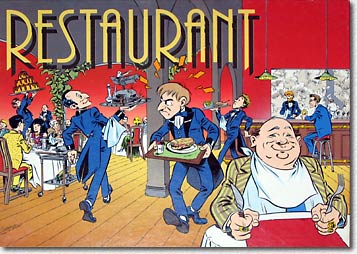
This older game from the otherwise pretty reliable and long defunct company Flying Turtle
did not rock our world – instead it garnered laurels as being one of the worst rated
games in our group ever! The theme and cards remind one immediately of a more long-lived
game: “Café International“, but whereas in “Café International” the
goal of the game is placing the guests for victory points, “Restaurant” deals
with fulfilling orders to become the most successful waiter.The game consists of two phases: In the first phase players collect orders from the
various tables by “exploring” the orthogonally adjacent table next to the last
explored table and leaving a pawn of their own colour on the empty space. You’ll find
various menus ranging from 100-600 points worth, “Jump cards” (enable you to
choose any table as your next table), “Go twice” cards, which enable you to,
well, go twice, and “Fast food” cards, which let you steal menus from other
players (drawn blindly). There are also “reserved” cards, which let you place
the orders you collected until then in a “safe” stack that cannot be robbed.The phase continues until either all tables have been explored, or the players have
manoeuvred themselves in a dead end (which you can’t until at least 30 tables have
been uncovered). Now points are counted and the lowest scoring player begins the second
round. Now you have to place the cards on the tables, i.e. “serving”
them. Only cards you place on your “own” spaces (with a pawn) will give you
points, therefore it is important to have your pawns well spread in the first phase. The
other cards can be used like before, with the difference of the “fast food”
cards, which can now be used as worthless cards to be placed on other players tables (if
you can’t reach your own ones). For some strange reason the “cover at least
30” rule does not apply here, therefore the game can end very quickly by a player
moving into a dead end (and the leading player will always do that). Now the cards are
counted again, but this time the cards in your hand count negative (and the
“reserved” cards double negative). The scores of the two phases are
added and determine the winner.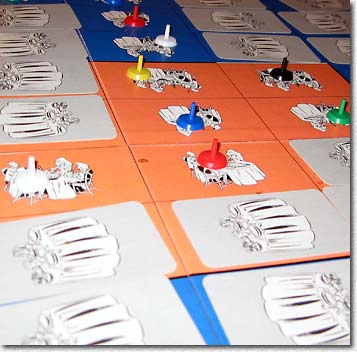 Many problems become apparent in the description
already. The worst aspect of the game is the fact that the luck of the card draw is
actually heightened by being able to use them twice (you keep all your cards and go
through them again). The “Jump” and “Go Twice” cards are the
worst offenders. “Jump”, for example, not only gives you the ability to
spread your pawns to other areas of the board, no, you can use it again to
safely place your cards on your tables in the next phase (which otherwise is very
difficult to achieve). This makes the drawer double lucky (and the other players
look on sheepishly). In our game I only drew menu cards and two reservation cards.
Most of the cards were stolen by other players with their “fast food”
cards, until I could use the reservation cards to protect the other cards. The
second phase started with Peter and then Guenther played a jump card to place an
order in a dead end, thereby ending the game without giving anybody the chance to do
anything. As he had earned the most points in the round before, he therefore also
became the winner. My reservation cards now pushed my negative points to the max,
and I didn’t even get to have a turn!From the perspective of Guenther this was the best play, but of course a mechanism which
allows this makes for a very unsatisfying game, in which you certainly feel
“played” rather than being a player.For a German game this one has a very high luck factor, and there is practically no
decision making, so it is easy to say that this is simply not a good game (and the
artwork is bad and uninspired, too). The only thing going for it is its short length, but
you can play more interesting games that have the same trait. Avoid, if you can…Moritz Eggertview/add comments 
How to win “Restaurant” – a well-researched and extensive strategy guide by
Moritz Eggert: Draw the right cards!