Princes Of The Renaissance
Review by Moritz Eggert
One of the games that I awaited most in Essen was this new offering from Martin
Wallace, who is increasingly becoming one of the best and prolific game designers in the
gaming world. So it was easy to talk everybody into trying out this game immediately
after the fair.
“Princes of the Renaissance” (or PotR) is thematically very close to games
like “Princes of Florence” or “Age of Renaissance” – Players are
noble families in Renaissance Italy who vie for power and influence in the various large
cities of the time. The game covers three decades of intrigue and war, and each decade
equals one round with an undetermined number of player actions (a decade ends when all 4
event cards of the decade have been auctioned off). After the third decade, victory
points are counted (quite an involved process – but more about that later) and the winner
is decided.
First each player selects a noble house of the 6 available ones – each family has one
small special ability connected to one of the game mechanisms, two families can buy
artists (most of the events are artists who give you victory points or raise the status
of cities) one gold cheaper for example. As you buy perhaps 2 or 3 in a complete game
this is not really that big an advantage – you save only 2-3 gold!
Then the game begins: On the relatively small board the 5 major Italian cities of the
time are depicted: Venice, Rome, Naples, Florence and Milan. Each city has a marker which
shows its status at the beginning of the game: Status can range from 3 (lowest) to 10
(highest). 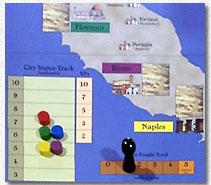 ATTENTION: The first edition
misses any mention of where these makers start – These are the correct starting
positions: Venice 7, Florence/Milan 6, Rome/Naples 5!
Each city has 6 tiles connected to it which can be bought after a player auctions them
off. These tiles work a little like shares in 1830 – The city status will change during
the game through wars and artists, and at the end of the game the value of the city’s
status will be transformed into a point value between 10 and 2 that will be the net value
of each of the owned tiles. A player can buy a maximum of 6 tiles of up to three
different cities, so great care has to be taken when buying tiles.
In addition all tiles have some special ability, which is historically flavoured.
Merchants earn money, the Borgia family excels in treachery and gets free treachery tiles
(see below), some historical personalities give bonuses with certain army tiles, and so
on. The different abilities are quite daunting at first play (one has a selection of 5×6
tiles plus the pope tile at the beginning of the game), and you should take your time to
look at and explain all the city tiles before starting the game, as they are the most
important element of the game.
Each player takes one action when it’s his/her turn. One can either buy one tile
of the various groups of army tiles (these give bonuses in defence or attack when war
looms) or one of the random treachery tiles, using the two currencies of the game,
influence (square tokens) and money (round tokens). Treachery tiles function like event
cards that give players advantages – one tile paralyzes one army tile in war through
bribe, another prevents the next player from bidding higher than you, and so on.
Or one can auction off a city or event tile – the first bid of a city tile has to be
double its influence, so successful cities become increasingly expensive! The third
option (apart of simply passing) is starting a war, which is always very exciting. The
warmonger determines an attacking city and a defending city. Then “condottiere”
rights are auctioned off, first for the attacking city, then for the defending city. Each
condottiere also earns the value of the city in money as a fee for fighting, but this can
only be collected at the end of the decade. Now each combatant rolls a die, adding the
various bonuses of his armies and special abilities. The higher result wins – now the
winning city gains one status (or two, if the result was double that of the defender),
and the losing loses one (or 2) status. In addition the winning condottiere gets one
“victory” marker, the more you have of them the more dramatic the victory point
gain.
There can be a maximum of 4-5 wars per decade (depending on the number of players),
but it is also possible to have a couple of “extra” wars by playing certain
treachery tiles.
Players can either “push” the decade end by auctioning off the 4 event
tiles, or delay it as long as possible. But before long money and influence run out, and
the actions become increasingly limited – so one moves on to the next decade. Now each
player gets his basic allowance in money and influence, which can be increased by income
from wars and income from special tiles owned (for example “Merchants”).
A special tile deserves to be mentioned: The Pope, which is a single tile that
“leaves” the player after one decade. The Pope gives the special ability of
being (once per decade) able to assist another player in a war without being part of it.
The Pope becomes especially interesting in the last decade, when he gives 3 extra Victory
points.
After the third decade the game ends. Now each city tile gives VP’s as explained
above, but also other tiles like artists might give extra points. The player with the
most and second most money gets 6 or 3 VP’s, the player with the most influence 4.
The Victory counters from wars also increase the tally considerably, if you have lots of
them.
So how does it play? As with many of Martin Wallace’s games, there are many ways
to win. One can play the game as a kind of historical stock market game, watching the
city tiles that other players buy and trying to be on the sunny side of business. Or you
act aggressively, building a large army that attacks the cities of your enemies to
destroy their value. Or you act treacherous, deviously stealing influence and money from
other players via the use of special abilities and treachery tiles.
The rules are elegant and simple (they come on 4 pages, one of which is a long example
of play), and the first game should take around 3 hours with 4 players. But be warned –
it is very difficult to decide what to do sometimes, as the choices are overwhelming
(especially in the first rounds of play). Even our experienced group seemed a little
befuddled at first. But quickly the game runs at a good pace, as the actions of each
player usually don’t take long, and there is loads of interaction through the bidding
and the treachery. Through the complicated victory point calculation the winner can be
something of a surprise, which is not necessarily bad.
Comparable games that come to mind are “Republic of Rome” (through the role
of wars) and even “Puerto Rico”, as there seem to be many strategies that can
be realized by the careful selection of city tiles and their special abilities. The only
complaint was that some of the treachery tiles were considered a bit annoying – The
“Pope” cost reduction tile was useless after the pope was acquired, and the
“steal 3 gold” or “steal 2 influence” were regarded as bringing too
much needless “little” aggression into the game – Walter was especially annoyed
by them! Also the game’s graphic design, although generally good, was considered
confusing – the German and English tiles use different colour codes for the gold symbols
for some reason, and the army tiles confusingly use squares differently than in the rest
of the game, which doesn’t make them easy to decipher. And of course there is the
omission of the city start status on the board itself. But “Warfrog” is a small
company that tries very hard (and successfully) to produce professionally looking games
in sturdy boxes, so these are minor complaints, especially when you compare them to the
sometimes incredibly awful typo orgies of Euro Games for example.
Our first game was not yet an extensive insight into the game, certainly one would
play the next game very differently, and the one after it probably as well. This is, all
things considered, certainly the sign of a good and lasting game design. In our opinion:
Highly recommended!
Westpark Gamers rating: 7.5 (on a scale of 1 to 10)