Rumis
“A building game with tricky stones” – this is how “Murmel
Games” describe their game “Rumis” – “rumis” being the Inca word
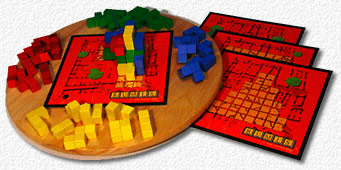
for stone. And that’s what it is. The game contains 4 sets of 11 “stones”
made up of between 2 and 4 wooden cubes plus 4 game boards with different layouts of
“Maya” temples. In clockwise order players place one of their stones on the
board, carefully observing three conditions:
- a stone must touch a previously placed stone of one’s own color (except for the
first round, where a stone must touch a previously placed stone of any color), - the height of the resulting building must not exceed the limit indicated on the board
at this location, - overhangs are not allowed.
If a player cannot place a stone according to these conditions s/he passes for the
rest of the game. Once all have passed the final score is calculated by counting the
number of cubes of each color visible looking at the top of the building and
subtracting the number of stones of that color, which could not be placed. The player
with the most points wins the game.
That’s all there is in terms of rules. Explained in two minutes.
While the rules are simple the game itself is very challenging. There are a lot of
conditions that need to be constantly monitored and evaluated the players:
- Where to best place a stone to maintain sufficient degrees of freedom for the next
round? - What stone are left in one’s own stock in comparison to the stock of the other
players? - Are there any safe stones to play which will count victory points at the end?
- Is there a possibility to lock out another player?
As in any good game you are left with many things you want to do in your turn and the
difficult decision about what is best in the long run. Especially the balance between
maintaining “freedom” for your own stones and locking in other players needs
careful consideration. As it is not too difficult to determine the current leader, this
balance easily tips towards playing against the leader only to find yourself locked in by
the next turn.
The key to Rumis is a good amount of 3D perception. Being able to determine and
anticipate the possible positions of the remaining stones in play definitely helps to
win. This is particularly important in a 2-player game, which is a pure tactical
placement game similar to Sogo, only more difficult to grasp. With 4 players the game can
be quite dry if played by 4 “thinkers”, which want to consider all possible
combinations before making their move. This is when a game will last 45 minutes as stated
on the box. However, a mixed group with a good deal of three-dimensional perception will
be able to complete a game within 15 to 20 minutes.
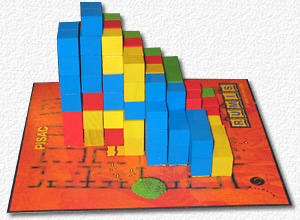 The box contains four boards with different levels of difficulty asking
for different tactics. In addition, Murmel Games made a new map available for download on
their homepages. This provides an excellent replay value of the game.
This leaves us with the task to compare “Rumis” with “Pueblo“. Both games use a board and “tricky”
stones that need to be placed on it. “Rumis” is a sort of “Pueblo
light” in the best sense – it is faster, it uses less rules and it is more
“constructive” than “Pueblo” thereby making it more suitable as a
family game.
Rumis was nominated for “Spiel des Jahres 2003” as well as being runner up
in the 2001 Hippodice Award. So it
may not come as a surprise that we selected Rumis as our “Game of the Month” in February 2004.