Session Report 26.5.2004
at the table: Hans, Andrea, Günther, Walter, Moritz
on the table: Lost Valley, Zug um Zug, Bluff
Author: Moritz
 |
||||||||||
|
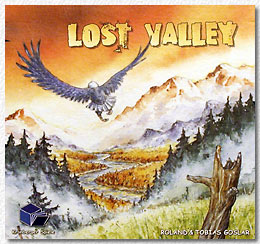
Lost
Valley (first impressions)
First we decided to test this brand new game from the Goslar’s (Walter
graciously decided to just watch to make this possible. Although he was a mean
ice-block-roller in the end game!).
Players are prospectors who explore the lost valley (of Klondike?). The game combines
a realistic approach with abstract and logical rules: Each player has a backpack for
“raw materials” (food, timber, tools) and 6 more spaces for wares (whiskey,
cart, boat, horse, rifle, axe, fishing rod, sieve, dynamite). The cart gives 4 more
spaces for raw materials. Like in the computer game “Diablo” some objects
take more space, for example timber and the sieve, so each player has to decide what
objects are most important to her/him.
All players start at the main trading post (others can appear through exploration).
The exploration itself is handeld very nicely – players can decide where to put the
diamond shaped land tiles and river tiles that they discover. As the diamond tiles
don’t always leave room for a complete tile there are also special
“triangle” tiles to fill these enclosed spaces. These diamond tiles are
usually more interesting – in our first game we completely overlooked the methods
to specially create the “triangles” which is something that should be
explored more in future games.
Tiles depict different landscapes – Gold can be found as “river
gold” or “mountain gold” and is placed face down in values of 1-2
(river) or 3-4 (mountain). “River gold” needs water, but can also be found on
land tiles – players have to build canals (by using timber) to get at the latter
variety. They expend one “food” when looking for it, and a
“sieve” doubles the amount of gold counters gained. “Mountain”
gold is only found on mountain tiles and needs a working mine which first has to be
built. Also getting mountain gold costs one timber in addition to the food (and using
dynamite doubles the find).
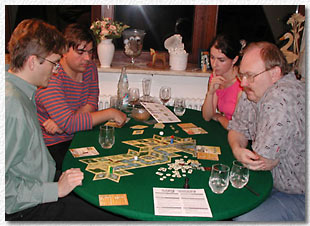 Getting gold nuggets is the object of the game – but
you can also use gold to buy additional equipment at trading posts.
Food is in issue – you need it for getting gold nuggets. You can hunt (by
rolling a die against the animal – plus 3 if you buy a gun), as certain tiles have
(hidden, various food values) animals on them. Fishing at the river is also possible
– the fish trap and fishing rod come in handy here.
Timber is necessary for mountain gold and canals – you can get it in wood
spaces, easier if you use a sawmill (which has to be built first) and/or an axe.
Players move along the tile edges – very slowly if by foot, and quicker if using
the boat or the horse. It is not possible to block movement of other players, but
non-river locations can only be occupied by ONE prospector, so you can protect certain
spaces by simply standing there. This is sometimes necessary as EVERYTHING you build can
be used by everybody – if you build a mine other players can use it as well!
This very often results in races to gather the most gold from a specific location
before others do (all gold locations can be depleted after the initially placed counters
are gone). Therefore the game is mostly about the most efficient use of a limited number
of actions (each turn every player has only ONE action). To get an edge in this you can
also use “whiskey” (a very nice idea), which gives you an additional move OR
an additional action.
The game ends in two ways: 1) When the river has been fully explored the
“source” is placed together with an ice block. Now every player rolls the die
after his/her turn – on a 5 or 6 the ice block moves towards the original trading
post, when it reaches it, the game ends. 2) When any player reaches the original trading
post with 10 gold counters.
In any case all formerly secret gold counters are revealed and counted, who now has
the most “nuggets” printed on these counters wins. In our game we had a
probably unusual end: 3 players ended up with 19 nuggets in the lead! As there seems to
be no tiebreaker mechanic this probably means all three have won!
The game has beautiful components (although good storage probably needs a couple of
extra ziplock bags). Game aids as well as rule book come in several languages (German,
English, French). The rule book itself is a very good example of how to do it right: only
4 (small) pages with clear and precise rules, all well illustrated directly next to the
rule to avoid any misunderstandings. Very well done! This is one of these rule books that
you can practically sight read to your fellow players without having to read it yourself
before – it will take 15 minutes maximum to get into the game.
The game mixes elements of action management (Puerto Rico, Goa), discovery
(Carcassonne, Die Entdecker) and even adventure/simulation games like “Valley of
the Mammoths”. Turns go quick as player actions are limited – there is
interaction (without obvious “kingmaking”) and some (but not too much) luck
(hunting, nugget count). The theme should appeal to adults and kids as well, the only
danger being a disappointment for the latter when they discover that behind the theme
lies a pretty unforgiving mechanic that needs perfect resource management to win.
The game’s “strategy tips” say that one should not hover far from the
other players, which seems to be true, as basically the game makes the players into
hyenas who lurk around until some poor soul builds the next mine or canal. One has to
count the available gold counters and make sure that his action management results in
getting more of the share than the others – only then should you build before the
others do. As this is something that you have in your own hands the game is both
challenging and rewarding, but also very often frustrating. But “wanting to do more
than you actually can do” seems to be the sign of a good game, isn’t it?
Recommended!
 |
||||||||||
|
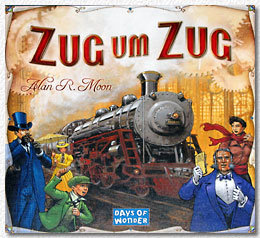
Zug um
Zug
Another play of this worthy successor to “Transamerica” (with nicer bits
and more tension). Guenther won with best hand management. Lots of conflict around
certain routes ensued, but was only revealed in the end game. After the game I
contemplated a possible killer tactic: The deck seems to be limited – what if one
player simply refused to build at the start (preferably choosing very easy low point
score routes at the start) and simply collected 2-3 colours necessary for his routes
until they are completely depleted? He then could play his hand in the endgame without
any interference from the other players while they would not be able to disturb him at
all. This seems to be an interesting approach in the 5-player game, where one goes pretty
quickly through the deck….
Next time I’ll try it!
Bluff (Liar’s Dice)
Nothing new here – Andrea won easily against Hans in two end duels. Guenther
made gaming history by losing all his 5 dice in one bad guess….