Struggle of Empires
reviewed by Moritz Eggert
The “master” (Martin Wallace) has struck again – fresh from Essen we played
his new labour of love, the ambitious “Struggle Of Empires”. In this game,
Wallace tries to meld some ideas from his earlier games and form a larger whole, and he
is, to keep it short, mostly successful.
“Struggle Of Empires” is a simulation of the Victorian Age, an age of
conquest and increasing European domination of the planet. The players play the Empires
of Britain, Prussia, Spain etc. and battle it out for world domination (=VP). The
relatively small board (for the amount of counters) depicts literally the whole world: We
find Europe and the “Colonies”, Africa, the Americas, East Indies… all
divided into a relatively small number of “areas”. The game is played in three
“wars”, consisting of up to six player “phases” which consist of up
to two actions. At the beginning of each “war” (and they are rightfully called
like that, because players will find it necessary to use their military force to win the
game) 10 country counters are drawn, which represent “opportunities” in the
different areas. Some of them can be won over by war (which involves dice rolling and the
elimination of the counter, to be replaced by a “control token”), some can be
won by other means (the “slave” counter can be exchanged into a control token
if the player has a fleet in Africa, for example). Control tokens can in turn be attacked
by other players, which will certainly happen after opportunities become sparse at the
end of the a “war”.
The heart of the game is the ingenious “alliance” system, which bases
alliances on a bidding mechanic at the beginning of each round. Basically, two
“sides” are determined, and you can never attack your ally once these sides are
determined. In the first “war” these alliances are of less importance than at
the end of the game, where it really helps to be on the same side as your worst
enemy/competitor. However, you will have to pay for being on his side!
The simple system works nicely as an anti-kingmaker mechanism. A clever player can
make it virtually impossible to suffer from “bash-the-leader” attacks in the
endgame, but at the same time he has to weigh the amount of cash he spends for this
privilege. Players can take unlimited cash, but they pay for it (and for the loss of
armies) with “Unrest” markers, which can only be lost by expending extra
actions. In addition, a certain number of “unrest” makes you lose the game in
the end, and the players with the highest unrest at the end will suffer VP penalties.
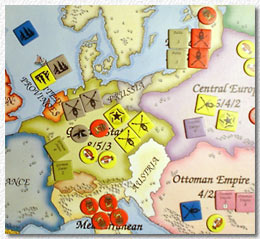 The “meat” of the game is the
“upgrade tiles”, though. If you thought “Princes of the Renaissance”
was daunting in this respect, the possibilities (and number of different upgrades) will
overwhelm you in this game. Even our dauntless group went very silent in our first game,
while we desperately studied various playing aids with tiny writing. Everybody felt that
one would try out different combos in the next game, which is a good sign.
At the end of each “war” victory points are awarded for majorities in areas
in typical Wallace fashion (if both players have the same number of control tokens, each
gets the full amount of VP). After three “wars” the game ends.
The Warfrog rulebook is – as always – an eternal mystery. While you read the only 2-4
pages the rules usually have you think “hey, this is not too complex”, but when
you get to actually play the game one is always surprised at the sudden complexities and
abstract handling of certain aspects. Wallace tends to be a minimalist in his rules –
there is not one superfluous sentence in any of the rules – each sentence states
something very essential to the game, so that you often overlook the details. Whereas
“Euro” rules tend to be very verbose and filled with examples recently, even if
the rules are simple, Wallace takes exactly the opposite approach.
His games are also always full of unique mechanics, which often need a bit of getting
used to while usually making a lot of sense. But also here the Wallace fan (and I would
count myself as being one) recognizes certain elements, like the VP distribution.
The final question is if there is enough novelty here to demand a buy. I personally
find the not-too-recent “Princes of the Renaissance” more to my taste, but one
would be hard-pressed not to admit that “Struggle of Empires” is an excellent
game in its own right. It is one of Wallace’s more aggressive and bleaker games,
which has to do with the theme. Interestingly there has been no attempt to avoid certain
issues like the depiction of slavery for the sake of political correctness. The cover
even has a naked, sad-looking black slave on it – will it be published like this in the
US, I wonder? I can already see the discussions at “boardgamegeek” shift from
the silly anger about the brown colour of the population markers in “Puerto
Rico” to discussions about this game. Hey, it was even supposed to be called
“Birth of a Nation” once!
There is no question that players of this game have to play “evil” to win –
just like their historical counterparts, they exploit the world for their own devious
means, and the game has no intention to hide this sad historical fact about the history
of Europe.
If you can get along with that, you will be in for an intense gaming experience.
However, do not complain if you are backstabbed – it will happen!