Grosse
Geschäfte / Mall World
reviewed by Aaron Haag
Remember your last visit to your favourite shopping mall? Plenty of shops, outlets,
and restaurants cleverly located under one roof and aligned in perfect order to persuade
the unsuspecting target groups to spend their money. This is what “Grosse
Geschäfte” claims to be about.
Permission has been granted to build a new shopping mall and you and the other players
are managers deciding about the location of shops in the mall and later in the game to
whom they lease a particular shop. Of course, it’s all about money in “Grosse
Geschäfte” and successful deals will provide a healthy income, appropriately
transferred to your Swiss bank account. Every now and then, a bit of slush money changes
hands in order to ease the signing of contracts or permissions.
Sounds like an interesting business game, doesn’t it? Reading the rulebook
certainly makes you believe this as the concepts described and the elements used are just
what I have described above. But once you’ve come to the end of the rules you’re
most likely pretty puzzled and start reading over again. It is not because the rules are
written poorly; in fact, they are quite good with examples provided whenever necessary,
but you probably didn’t get the idea about the shop contracts, permissions and target
groups. Why is that? Because the game is a very abstract tile placing game with a theme
grafted on top, which neither conveys a certain atmosphere nor does it help understanding
the game principles. I hope the designer, Andrea Meyer, will forgive me that I
describe the game principles here in more abstract terms rather than using the shopping
mall scenario.
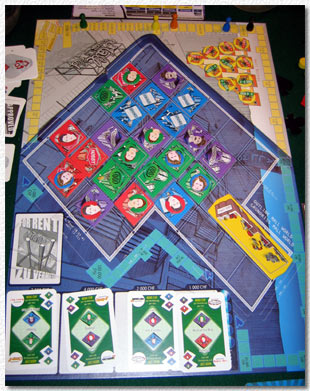
The board setup is semi-variable by placing one or two (depending on the number of
players) blocking tiles together with one tile of each of the four colours randomly on
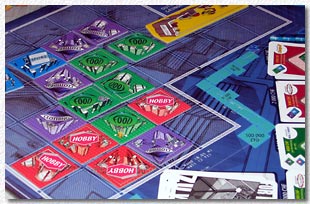
the board. Tiles come in two versions, rhombus shaped normal tiles and round upgrade
tiles. Further game components are: contracts showing combinations of two tiles,
placement permissions for tiles, bribes for contracts, and slush money for bidding on
placement permissions.
It is the players’ goal to fulfil contracts, which are combinations of tiles on
the board. Fulfilled contracts earn money at the end of a round. Three rounds are played
in total and the player with the largest amount of money wins the game.
Each round consists of several phases:
- A player may buy one of the openly available contracts and put it in his hand.
- Next, the player may either
- confirm a contract by placing it in front of him and either receiving or paying a
bribe for doing so (early contract confirmations are sweetened by receiving a
bribe), - or by putting a maximum of three placement permissions up for auction. All
permissions are auctioned off using slush money rather than money from the Swiss account.
Tile placement is performed immediately when a permission card is acquired.
- confirm a contract by placing it in front of him and either receiving or paying a
- Now, the player may draw up to two new permission cards provided he has not reached
his hand limit of eight cards. - And finally, any money in the slush fund is distributed evenly between all players
(rounded down).
A round ends once six or ten (round 3) contracts have been confirmed.
“Grosse Geschäfte” is a game full of player dilemmas. Since contracts are
bought openly, the other players will try to prevent one from completing the contract, at
least they will prevent a multiple completion at several different locations. Next, the
contract cards in the deck are arranged in such a way that early contracts are not using
upgrade tiles while later contracts use them. This forces players to confirm contracts
without upgrades early in the game to rake in money for them because upgrade tiles
invalidate those combinations (by the way, this mechanism is required to force players to
confirm contracts during the first round). Correct timing here is vital for winning the
game.
In any case players are always faced with the dilemma to either confirm a contract or
auction placement permissions, when in fact they would like to do both (which is only
permitted during the final third round).
Chance does not play a big role in the game. The only hidden information is the
“special contract” dealt to each player when the game commences and it is hard
to prevent the other players from correctly deducing your special contract combination (a
combo of two normal tiles plus 2 upgrades) once you are in round two.
“Grosse Geschäfte” plays fast with three or four players and tries to
involve all players most of the time, so downtime is rather low. In the five player
version downtime is of course higher and player control is reduced a little because
rather a lot is happening on the board before your next turn, but you still feel in
control. A minor quibble is the increasing downtime in round three because players can
now calculate the pros and cons of their moves almost exactly. We even experienced a
kingmaker effect during the last turn, as it is possible for a third player to exchange
the position of the two leading players without any harm to his own position.
If you are interested in games that transmit their theme nicely and provide more than
an abstract flair, “Grosse Geschäfte” will not appeal to you. However, if you
like abstract tile laying games (“Einfach genial” comes to mind here) and want
to see some new game mechanics that foster player interaction and provide player dilemmas
this is the game for you.
WPG Rating: 6.0