Die
Gärten der Alhambra
reviewed by Moritz Eggert
This game has been published under the title “Karat” a couple of years ago,
and Queen Games has used the recent success of “Alhambra” to
publish this game again with beautiful artwork reminiscent of its “sister”
game. But game wise this has little to do with “Alhambra”, in fact “Die
Gärten…” is a truly abstract tile laying game.
The large game board is filled with empty, semi-octagonal spaces that surround square
building spaces of different numerical (VP) value. These buildings are placed at random,
but the values are open from the start. Each player now in turn plays one of the
octagonal tiles that are designed in a way that 4 of them surround a building space.
Each octagon has flowers on each side, in equal quantity, but in different orders. The
flowers represent the player’s “influence” on the various buildings. If a
building is surrounded by 4 octagons it is immediately scored, and the player with the
highest number of flowers adjacent to the building wins the points. In the (often
occurring) situation that two players have the same amount of flowers present, the player
with the next highest number of flowers gets full points, and the others nothing. This
can even mean that a player with NO flowers present can get points (if the three other
players cancel each other out that is).
These are, not even in a nutshell, the complete rules of “Die Gärten der
Alhambra”. 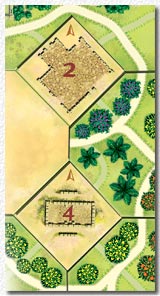 Game play is not as easy, as the board becomes cluttered very quickly,
and it is easily overlooked what repercussions each play has. The buildings at the rim of
the board are attractive as they can be quickly scored, but these plans are also easily
foiled by making playing a matching numbered tile easier. You can have two kinds of tiles
in your hand – if you draw a high one you will try to bolster your expected scoring
buildings, if you have a low one you might use it to score a building by making a play
safe for you but bad for the other players. Rarely you’ll have the exact tile that
you need or want!
The game ends after all tiles have been placed, a running score is tallied and one
player wins.
The game, although physically attractive, holds one big caveat for the ambitious
player, and that lies in the fact that you are “played” by the placement of the
other players. In fact up to three quaters of your VP will be achieved through actions no
at all your doing!. As each player first of all cares for him/herself, the placement of
your own coloured flowers will very often be what you want. However, in which order the
OTHER 3 flower colours are placed on the tile and which players will profit from their
placement is very often a result of pure chance, even if you might achieve one or two
naughty and damaging plays. This is especially true in the endgame, when open spaces
become rare and tiles are simply played as they come. In the several games we played the
winner was always the player who profited most from this undirected placement, in fact
you could have thrown the dice instead of playing the game in a way. But it is probably
easy to devise variants. The game offers two: In the first variant each player has three
available tiles (which gives your play a bit more of direction), in the second two
players play with each having TWO colours. The latter variant can actually be very
challenging and can be full heartedly recommended to the pro-gamer, whereas the
“normal” game is probably more fit as a “relaxed” family game, for
which it’s easy rules make it work well.
The game can be explained in less than 5 minutes, actual playing time is 45 minutes to
an hour.