Haselwurz & Bärenklau
reviewed by Aaron Haag
Murmel Spielwerkstatt is one of the two game companies that spring to mind when
associating Switzerland with gaming. Other than Fata Morgana, Murmel is devoted to
releasing games with educational, ecologically rather than economically oriented games.
This description does not necessarily fit their best-known game Rumis, which was one of
the nominees for “Spiel des Jahres 2003”, but their recent releases
“Enix” (Essen 2004) and “Haselwurz und Bärenklau” (Essen 2005) have a
clear educational message.
“Haselwurz und Bärenklau” has been developed in cooperation with the Swiss
Federal Institute of Technology in Zurich to celebrate the 150th anniversary of their
Institute of Geo-Botany. Hence, it does not come as a surprise that the name of the game
refers to European ginger (Haselwurz) and hogweed (Bärenklau). The goal was to develop a
game, which demonstrates the importance of a large variety of landscapes required for a
high diversity in plant and animal life and the creation and maintenance of biodiversity
are the main theme of the game.
Looking at the game from an educational point of view I can state that it has been
done very well. The game contains 48 cards showing the required habitat of species, their
rarity, and a photograph of the species together with their common names in German,
English and French. Furthermore, the game includes a 44 page booklet describing all the
habitats and species of the game in quite some detail together with a few articles about
the importance of biodiversity.
By now, many gamers may think “Oh, no, another one of these“. So
let’s have a closer look at the game inside this educational tour de force.
When opening the box and looking at the game components your first thought will be:
another Siedler von Catan clone. There is a variable board layout made of hex tiles
showing different terrains and lots of differently shaped wooden pieces. However, the
game mechanics and game play bear no resemblance to Siedler whatsoever as a look at the
very well written rules quickly reveals.
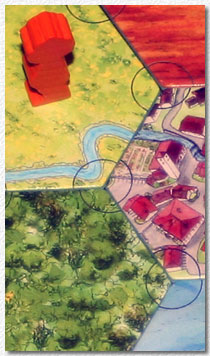
The game starts with a board setup of seven hex tiles in a standard layout. The tiles
represent seven different types of terrain across which the player’s pawn, a gnome –
or pixie as the rules calls it – travels to discover rare plants and animals. Discoveries
yield victory points depending on the rarity of a species. Four open discovery cards
display the species that are currently available for discovery, and most importantly
showing their respective terrain requirements.
In his turn a player first extends the board by adding one of his three terrain tiles
in hand. The only restriction for this extension is that rivers must join and may never
end in other terrain. Then a player may place one or more differently coloured wooden
pieces as hedgerows, copse and flowers on the board in order to make areas more
favourable for rare species. Next, he moves his pawn to a new location, using one of four
means of transport: a dragonfly, a grasshopper, a badger and a yellowhammer bird, each of
which can travel only through the type of terrain they prefer. The tricky bit here is
that a particular type of transport may only be used again once all other types have been
used.
After having travelled the player checks, if his pawn resides on a tile that, together
with its two neighbouring tiles, reflects exactly the combination of three terrains
required by one of the species on the four discovery cards. If so, the player has
successfully made the discovery and receives the card as a proof. To show that the area
is no longer available for discoveries an indicator – a red wooden disk – is placed on
the intersection of the three terrains. As the last action in his turn, the player
replenishes the discovery cards on display and the terrain tiles in his hand. The game
ends as soon as either the card or the tile stack is depleted. Each player now adds up
the rarity score of all his discovery cards; the highest scorer wins the game.
The rules are short enough to be explained in a few minutes but mastering the game is
a different matter. Players are faced with some difficult decisions to make: which tile
to place, which terrain enhancements to use, which transport to use and which route to
travel to make discoveries. Placing tiles and enhancements as well as travelling are
predetermined by the four open discovery cards and are hard to plan in advance. Even in a
two player game one cannot assume that the discoveries available at the end of a turn
will still be available at the start of your next turn. Therefore, performing the above
actions is a matter of optimizing your options at that very instance with almost no need
to consider your next move. Deciding about which transport to use is a different matter
however. Here, your goal is to reach discoveries in your current turn while at the same
time leaving you with as much freedom of movement as possible for your next turn. This is
the most difficult decision to make – and the most vital just as well because all
transports but the bird requires a particular terrain to start in. One small oversight
here and you are left with no movement options in your next turn but still being required
to “use” one of your transports. Finding a sequence of transportation means
that will enable you to travel each and every turn given the current terrain is very hard
if not impossible. Luckily, your opponents are faced with the same problem.
My first reservations about the educational aspect of the game have completely
disappeared after a few plays. The game is educational from the point of the material
provided and playing it delivers some insights into the habitats of many rare animals and
plants. At the same time, the game provides some nice tactical challenges that also attract
the seasoned gamer, which overall makes it a very nice concept. Maybe on your next
excursion to the countryside you will recognize some of the habitats that are in the game
and maybe even discover rare species in real life.
(An earlier version of this article has been published in “Games International“, issue
#23)