Byzantium
reviewed by Moritz Eggert
Martin Wallace does not disappoint with his newest game, the unusual wargame
“Byzantium”, which was presented at Spiel 2005 by his “own”
publishing house, “Warfrog”. In fact “Byzantium” might be one of his
best games yet.
“The Year is 632 A.D. …” begins the rulebook, and we, as players,
find ourselves in a time when the Byzantine Empire, descended from the glory that was the
Roman Empire, face a new enemy in the growing Arabian empire.
The map shows a simplified area of the Middle East. At the beginning the Byzantine
Empire dominates all; only Tabuk, Medina and Mecca are Arabic. In the east there are some
“neutral” Persian cities which will soon fall under both Arabic and Byzantine
invasions. In the north the Bulgars threaten the heart of the empire, Constantinople.
One might think that this is a wargame in the classical sense, one player playing the
Byzantines, one the Arabs, and so on, but in fact the most unusual feature of the game is
that ALL the players play the Byzantines AND the Arabs (and the Bulgars) at the same
time, and they have to play them all well to be successful.
To make this work Wallace uses a solid rule system that has many
“Euro”-characteristics. Players have one action each round. Moving and
attacking is always unlimited (as long as you have cubes as resources), but many actions
are special, and can only be done a couple of times per turn, so they are marked with a
cube as “used”. One could compare this to “roles” common in games
like “Puerto Rico”, and the turn order will play a large role in who will get
the most interesting choices first. Players spend cubes for practically every action, so
at some point they will run out of cubes and the turn grinds down to a halt. Whoever
passes first is first in the next turn, of which there are only a maximum of three in the
entire game.
When you do something as “The Arabs” you will mark your VP’s on the
“Arab” track, if you do something as the “Byzantines” you mark them
on the “Byzantine” track. You always have to strive for a balance of points, as
when you earn more than double the amount of the other VP score, the lesser one does not
count. This automatically makes for an “equalizing” mechanic in which no side
never really dominates, because you have to switch back and forth.
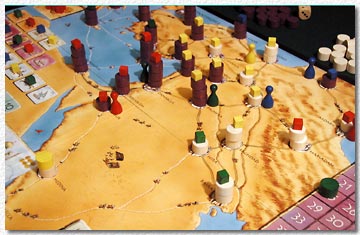
Typically for Wallace’s games dice DO play a role, but as all players can profit
from the successes of either major side, the game is not dominated by luck as some other
wargames.
Each player owns a tableau on which he openly deploys both Arabic and Byzantine
forces. The first space is reserved for elite troops, the second for normal troops, the
third for militia and the 4th for movement. Wooden cubes in each of these spaces show the
strength of each “trait”. The players can bring in new cubes from the (limited)
reserve onto the tableau as an action, but once they’re there moving them costs
money. It is of little surprise that also the treasuries of each empire are kept
separate. Moving a cube on the tableau is paid by the faction that profits from the
movement (for example weakening the Arab elite troops by moving a cube from there to the
Byzantine militia helps the Byzantines, so they have to pay for it).
Each player moves up to two armies on the board, which he calls his own, one Arabic
and one Byzantine army. The “Bulgars”, in essence “Barbarians from the
North”, can be moved a total of two times per turn, by whoever chooses their action
space. When the Bulgar’s attack the side NOT being attacked gains the points they
make.
There are three sizes of cities, one, two or three wooden disks high, which equals the
victory points they bring when you own them at the end of the game. Once a player has
placed a cube on a city, he “owns” it and his militia on the tableau is
responsible for defending it in case there is no “real army” present.
Alternatively the army present can always decide to retreat before a combat, an action
which probably doesn’t make the always inferior militia very happy, we can
assume.
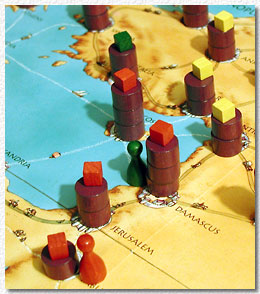
Obviously Arabic armies only attack Byzantine cities and vice versa, but once or twice
per turn players can choose the “civil war” as a special action and attack
their friends. Combat is simple – each army gets as many dice as they have
“normal” troops/cubes, up to a maximum of 3. Elite cubes can add one dice each
ad libitum, but they also cost more upkeep at the end of a round. A 6 is a hit, both
sides roll at the same time. Whoever has the larger army present after this process wins
and the losing army retreats. After that there is a siege roll, one dice for each city
disk, each 6 destroys another army. If you then still have more cubes of your army than
the number of city disks, you can proudly walk it’s streets as a conqueror. Spoils of
war include money and VP equal to the new size of the city, which is obviously one disk
less as it was razed by you.
Cities can also be fortified or “grown” (up to three disks) via an action;
other interesting one-time actions are gaining temporary control of either the Arab or
Byzantine elite troops. Arabs and Byzantines have slightly different movement rules
regarding sea travel (the Byzantines are better), and the use of captains can shift this
balance, but I have yet to see a game where this option is actually used. There are two
more options each round, one is exchanging cubes for money, the other is erecting mosques
and temples for VP’s (costs 6 money).
When the turn ends, each player has to pay hefty support for his troops, which can end
in tears if the money doesn’t cut it, so players tend to completely destroy their
armies in order to reduce the cost, as at the end of the turn half of your destroyed
cubes are regenerated for free. But this is not always a good tactic, especially if you
want to defend….
| Characteristics | |
|---|---|
| Playing the game: | 90-120 minutes |
| Explaining the rules: | 15 minutes |
| Rulebook: | a step forward for Warfrog – it’s glossy and more detailed than former rulebooks |
| Theme: | high |
| Medieval Atmosphere: | nonexistent apart of the title |
| Luck: | If players are on equal terms dice rolls WILL decide the outcome of the game, if you don’t like a little luck in games, stay clear from this one. But skill plays a higher role |
| Material: | Lots of wooden cubes and disks, sturdy board, sturdy tableaus, nothing left to be desired |
| Artwork: | Nice and fitting for the theme |
After three turns the game ends and an alternative end occurs when Constantinople (a 5
disk city) falls to either the Bulgars or the Arabs. As the Bulgars start out pretty
close to Constantinople they can be used as a constant threat to end the game, in fact
all games I played ended with a Bulgar conquest of Constantinople by the player leading
in VP’s.
“Byzantium” is a tense and challenging game with an ever changing board
situation. Where you place your armies plays a huge role, as movement is expensive (it
costs cubes) and you don’t want to get stuck in a “dead” corner of the
board with nothing interesting to attack. As attacking is practically the only way to get
money, there will be a lot of exciting battles, and they will also usually be fair
battles, as retreat is practically always an option. And even if a player loses one of
his armies he is far from losing the game, AND he can always construct a new army. In the
end its VP’s that count and they are gained through conquests on the board, but not
necessarily lasting conquests.
As in any good Euro game the road to victory is not obvious, and many strategies are
valid. The miser could go for VP’s through temples, spending little money for his
army instead. The conqueror fights as many battles as possible, with little regard for
defending “his” cities. The hoarder concentrates on defending a few valuable
key cities. All these strategies are valid and can be successful, depending on the
actions of the other players. As actions are limited rounds are fast and exciting, and no
player ever gets into a situation where he can’t do anything worthwhile (apart of
running out of resource cubes).
I enjoyed “Byzantium” immensely – it is one of the more accessible
“heavy” games by Martin Wallace, and can be taught reasonably quickly (and
played quickly as well). It is less unforgiving than the equally excellent “Age of
Steam”, so it might draw some new Wallace converts. I am already a big fan of his
games, and this is certainly one of his most interesting efforts to date.