 |
||||||||||
|
||||||||||
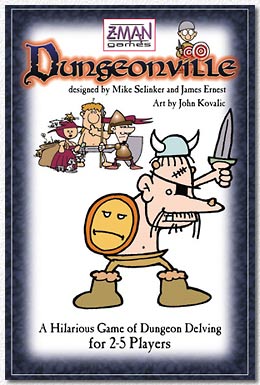
Dungeonville
reviewed by Moritz Eggert
John Kovalic must be a very busy man. Not only does he draw the successful gamer’s parody comic
“Dork Tower”, he also has to practically draw playing cards all the time, as it seems there is a
new game using his designs published every day (think of “Chez Geek” and “Munchkin” and
their myriad expansion sets). James Ernest is also no idle man, having already countless “cheapass”
games under his hood, as well as more designs for other companies.
These games cater mainly to the role-player who occasionally dabbles in board and card games and who
usually is too impatient to learn the more demanding designs like “Caylus” or “Puerto
Rico”. The funny graphics are another big selling point, whereas the game play often seems a bit shallow
or very luck dominated. Although I am a big fantasy fan and appreciate the humour apparent in many of these
games one would have to work very hard on inventing a torture device that has me playing a game like
“Munchkin” again, perhaps one of the most torturous games ever invented…
Is “Dungeonville” any better?
Well, it’s much quicker for a start, which is already a huge plus in my book.
Two to five “evil masterminds” try to have the dungeon with the most adventurer kills. I stress
the word “have” here, as “build” would have been much more interesting, but alas, this is
not possible.
The game goes through rounds with 5 phases. In the first round you buy adventurers, which are ranked in
cost and fighting power and constantly restock. In this phase you have some choices as to the specific skills
of your various adventurers. These skills are represented by letters (A=good to E= bad) that will become
important later in dungeon exploration.
The second phase has you sending your party of intrepid adventurers to one of the 5 dungeons. Which
dungeon “deed” you “own” is decided by a random and secret card drawn at the beginning,
so nobody knows which dungeon belongs to whom. Part of the decision is made for you, as the selection of
adventurers available has a certain preference for certain dungeons. One adventurer’s “A” skill
might become an “E” skill, depending on which dungeon he enters.
In the third round there is a possible combat at the dungeon entrance when several parties want to enter
the same dungeon. Here the fighting skill comes in (the higher the fighting skill of the party member the
worse are his skills) each player orders his adventurers secretly and matches them off against his opponent.
Whoever wins may enter the dungeon. Here, in the fourth phase, cards are drawn from the “dungeon
pile”, that determine if any adventurers die or if you find treasure. You can continue as long as you
want (or live), but drawing a lettered card forces you to dispose of an adventurer with the same skill level.
But you also might find item cards with special abilities, or gold, which helps you buy more powerful
adventurers in the next round. In the fifth and final phase you get the gold collected in the dungeon and can
potentially buy an additional dungeon from the unused dungeon deeds, but you won’t know which dungeon it
is until you draw it.
All this ends when someone accumulates 7 player kills in his/her dungeon, and wins immediately.
| Characteristics | |
|---|---|
| Playing the game: | 45 minutes – 1 hour maximum |
| Explaining the rules: | 5 minutes |
| Interaction: | little, you can attack other adventuring groups, but even there choice is limited |
| Designing your dungeon: | Get out your Dungeon Master’s Guide if you want that, here you will not find the slightest possibility to create your “dungeon” in your own fashion. You could mix the draw pile though, if you really want, but that might be a giveaway to the other players. |
| Appeal: | low to Eurogamers, high to beer and pretzel gamers |
And herein lies the biggest problem with the game – as the goal is collecting blood tokens for killed
adventurers in a dungeon one might think this is where one can use a strategy to win. But no: neither the
decision which adventurers travel to your dungeon or how many will get killed there is in the least
influenced by your decisions, not a tiny weeny bit. You might manage your party like a master, accumulate
treasure, travel intrepidly into dungeons by carefully calculating your risks, attack other players who are
richer than you, etc., but it will absolutely have no influence in you winning the game or not. Even worse –
there is no bluffing or guessing element involved in what dungeons players own or not. You will avoid your
own dungeon, as blood tokens collected there count negatively, but that’s about it about guessing other
player’s dungeon deeds. Very often the game decides for you which dungeons you have to visit, as the
make-up of adventuring parties leans towards certain dungeons, and the selection of adventurers available is
also largely governed by luck, so no strategy here as well. Creating a victory condition like this that is
totally disconnected with what you actually actively DO in the game is a very weird design decision, to say
the least. But as in “Kill Dr. Lucky” the game is decided by the simple fact that the other players
are out of cards preventing your victory this design principle might be something that James Ernest really
likes, who knows…
This game is also clearly intended to be a light game to be enjoyed by the above mentioned crowd, and in
this it might as well succeed, as the drawings are indeed funny, and the tone is light. So if you like it or
not will depend on what games you play more, role playing games or board games. If you read this review on
the “Westpark-Gamers” or on the Boardgamegeek site you might very probably be one of the latter
ones, so perhaps you should avoid it even though others might find this game “cool”.