Alexander the Great
reviewed by Moritz Eggert
Alexander the Great has a varied history as a game theme. First there was
“Battles of Alexander the Great” which had reportedly one of the most garish
game boards of all time (described as looking like a pile of puke by one reviewer), then
there was a series of board/computer games (“The Great Battles of Alexander”)
that successfully captured the feel and strategy of ancient warfare, then Colin Farrell
came along in a stinker of a film that again prompted Phalanx to produce this fine
boardgame (that is obviously not based on the film licence). The fear of encountering
anything resembling the film might be one of the reasons why geeks may overlook this
game, which would be a shame, because the design is – while not being a groundbreaking
endeavour – certainly solid enough to reward a closer look.
The map reminds one of an area wargame, which is very far from what the game actually
is. Only a small part of the map is used at a time, and a lot of map space is
“dead” space – it’s never used at all because as players we follow
Alexander’s route of conquest and there were some lands he never actually went to,
even though many think that the guy was simply everywhere (while being haunted by the
image by Angelina Jolie as his mum).
The players represent unknown lesser generals (or underlings) of Alexander, who lead
his armies to some temple and city building on the side, while competing to be the
biggest honcho doing this. The game is played in a succession of “areas”, a
couple of board spaces connected by various movement arrows. Each of these areas is
played a maximum of three rounds, but impatient generals can shorten this by prematurely
moving their armies to the respective last space of each area.
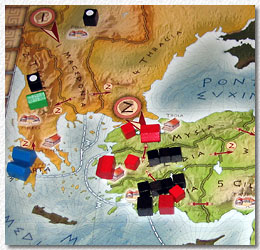
At the beginning of each area players secretly place their 15 “resource”
cubes on the 4 spaces of their “planning” board, hidden from the prying eyes of
the other generals. One can place cubes on the “turn order” space, the
“army” space, the “temple” space or the “city” space. After
all players have done their planning, the most decisive phase in the game, they reveal
their choices. Whoever invested most in “turn order” can now move his turn
order pawn to any space (usually coming last is most desirable), the others following in
order of the amount bid. Then the armies placed on the “army” space are brought
in the play (this is the only time that armies enter the game in an area). Each army has
three movement points and can move independently, but the crossing of movement arrows
often demands the expenditure of extra resource cubes that have to be taken from the
cubes placed on “temples” or “cities”. After you have moved your
armies you can “threaten” to build temples or cities in each space (if the
space itself allows it) – if you have at least one army cube there – by placing a tilted
temple or city meeple.
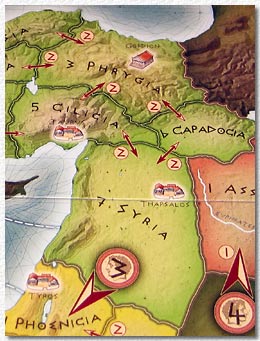
After all players have gone through these phases each space is checked in numerical
order. If one player has the majority in army cubes there, s/he gets two points for a
start. Then the generals decide among themselves who will build the city. The player who
invested most cubes in the “city” space will build the city (on rock and roll,
presumably), paying as much as the player with the second most cubes plus one or at least
two cubes if no player competes. A city immediately brings 5 VP as well. The other
players grudgingly destroy their half built city, probably pouting a lot. Temples work
similarly, but they only give 3 VP, while building them costs one less then cities. With
this building and competing a round is finished and players can now use the still unspent
cubes to distribute them again on their temple and city spaces respectively. No new
armies appear in the next rounds though, one has to live with what one brought into the
area at the beginning, which of course favours the player who went for majority VP’s
and brought a lot of his fighting buddies into the area. Also players who spent a lot for
their temples and cities now look on sheepishly as their opponents still have many cubes
to act while they are empty handed.
When the last area is played through, players count majorities in each formerly played
area (who has the most cities or the most temples in each area gets 5 VP) and their total
of built temples and cities (most temples=15 VP, most cities=10 VP). As one can guess the
final scoring can change positions wildly – it is not uncommon to see one player moving
from last place to first place here. Also it is a little strange that majorities of
temples and cities per area are not counted immediately but only at the end of the game,
as these majorities never change until the end of the game, once the hordes of Alexander
have left the lands not a stone is moved there anymore.
| Characteristics | |
|---|---|
| Playing the game: | up to two hours, depending on the number of players |
| Explaining the rules: | 15 minutes |
| Brain: | a lot, more for geeks than the casual gamer |
| Historicity: | little |
| Space required: | bring a large table |
| Eye vision: | not for the short sighted or badly lit rooms |
| Colin Farrell does not: | bear his naked bum |
One of the nice aspects of the game is the “starting afresh” mechanic. When
an area is played through and you messed up totally you can start on absolutely equal
terms in the next area. All used cubes are regenerated, and all players start again with
15 cubes, regardless of how successful they were before.
It is even tactically valid to deliberately fall behind, as player last on the scoring
track are always preferred when deciding turn order, even if they don’t bid
anything.
With freaks the game can become quite tense. As all cube selections are open and there
is absolutely no element of luck involved there can be quite a lot of “calculating
your move”, turn angst or analysis paralysis. Very often things can also get quite
complicated when several prospective temples and cities are in the making and you have to
calculate the losses of your opponents through until you arrive at a “perfect”
move. Therefore this is a “silent” game with relatively little in-game
communication – each one ponders their move and that’s it. But then skill is usually
rewarded, and each area differs slightly from the previous ones in tactics, so players
who play the game without thinking a little longer will usually lose.
The game board graphics are nice (although one has to look at some spaces with a
looking glass when looking for temple or city symbols, and some spaces can also become
very crowded – perhaps several smaller boards would have been better?), the rules are
well laid out and simple, although some concepts could have been explained a bit more in
detail. But all in all this is a solid effort which rewards repeated play and might well
turn out to be one of the many unjustly overlooked games of 2005.