Bootleggers
reviewed by Moritz Eggert
“Eagle Games” is mostly known for “light” wargame-type games with
monstrous boards and tons of plastic figures. Not all of these games have been equally
successful, but so far the company has been willing to learn from it’s mistakes and
to constantly improve their designs. Their newest game, “Bootleggers”, is a
radical departure in many ways. Already “Age of Mythology” had some “Euro
Game” elements, but “Bootleggers” is their first game to be officially
presented as a “Euro-American-hybrid” game, purposely mixing the best of the
two worlds. But “Bootleggers” is also NOT a wargame. Although the game material
is lush as always with Eagle games, this time the map is only 1/3 as big (still big by
any account), and there are definitely no combat dice to be rolled. Instead players take
over the role of roaring 20’s gangsters, who try to make big bucks by selling illegal
whiskey in the speakeasies on the gameboard.
The rules are very extensive and include many pictured examples. One might think at
first glance that this is a complicated game, but it ain’t. In fact, the game
mechanics are very straightforward.
The game is played over 12 rounds. Each round’s turn order is decided by the play
of “muscle” cards (a “Euro” mechanic), of which none has exactly the
same number, but everybody gets a roughly equal distribution of high and low cards. This
is in fact one of the more ingenious ideas of the game, as “muscle” also
decides who places his trucks first and so on, so it is an interesting decision when to
play your high or low cards.
Players now select “action” cards (also a “Euro” mechanic), which
allow them to do various things like getting influence markers (represented by mean
looking guys with a Tommy gun; they are first placed on your distillery, then move to the
various speakeasies to gain influence). They are also used for upgrading your distillery
or the consumption of speakeasies, or come as “take that” or “thug”
cards, which usually mess with other players (an “American” mechanic). One can
also buy additional trucks, which are necessary to bring the whiskey to the speakeasies
(you start with a “4” truck, which can handle 4 crates of evil spirits).
Next, your distillery produces whiskey, the amount of which is determined by a die
roll (“American” mechanic) for each distillery or distillery upgrade you
have.
Some players will now want to trade, as they either have too much or too little
whiskey, and the game explicitly allows all kinds of deals and backstabbing.
Next, you load your whiskey on the trucks (the whiskey crates are represented by
wooden cubes, which fit nicely into the trucks) and line up at the various speakeasies.
Now your mobsters with Tommy guns come into play. You’ll either have a majority (more
influence than each other player, but not more than all other players combined),
controlling majority (more than each other player AND all other players combined), or a
simple minority, or no influence at all at a speakeasy. If you have the majority, you
will sell your crates first, which is very important because each speakeasy only has a
limited consumption capacity – they can only take THAT much of your vile illegal brew! If
you have controlling majority, you also get a bonus on EVERY whiskey sold, even by other
players.
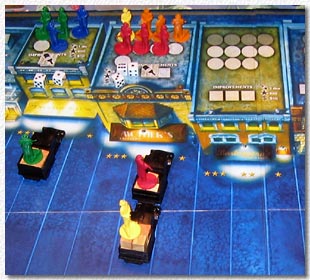 The other players (minority) line up at the middle
dock, whoever comes first – determined again by muscle – will sell first (in fact it is
very cute to line up the trucks at the various speakeasies physically). The public dock
remains for players with no influence at that particular speakeasy, and they have to
grease the palm of the majority player to be allowed to sell there.
This is the only aspect of the game, which can create some confusion with newbie
players, as one, two, or three “stars” instead of a description represent the
various “docks”. Some players thought that only controlling players could line
up at the “3 star” dock, whereas in fact also the normal majority player can.
It might have been good to create a fourth dock for players who cash in the bonus, but
the game board is already pretty crowded as it is with the huge trucks and figurines.
All this majority/minority business is “very Euro”, as you can imagine!
AFTER placing the trucks, the consumption is rolled for each speakeasy
(“American” mechanic), which means that either all whiskey crates will be sold,
or only part of them. The players last in the row will suddenly have a very sad look on
their face (when the whiskey consumption is lower than expected), because all whiskey not
sold (or not put on a truck in the first place) will simply wither away, not to be
stored.
Selling whiskey will give you 1000-3000 bucks per crate, depending on the speakeasy,
and the bonus is always 1000$ a crate.
That is the core of the game, but of course many wild things happen through the play
of “thug” cards. It is for example possible to steal your opponent’s truck
and sell the whiskey as your own, or to remove influence markers from your opponents.
This somewhat “chaotifies” the “Euro” aspect of the game, but also
helps a bit against the staticness of the basic play.
In rounds 4 and 8 all players get free influence, the player with the least money more
than the others. Also from round four on, a “copper” appears, who always
threatens the most prolific distillery, shutting it completely down for one round when a
“5” is rolled (“American mechanic”).
The player who first amasses 100.000$ wins the game with “sudden death”, or
whoever has the most money at game end (the former is more likely in our opinion).
We liked our game of “Bootleggers”, the atmosphere is captured well and the
game mechanic doesn’t feel too abstract (an “American” aspect), but players
who expect a deep thought experience like “Puerto Rico” will certainly be a bit
disappointed, as the action cards mess a lot with who’s leading and who’s
not.
A very “wild” aspect of the game is the whiskey production. We had players
rolling strings of 1’s, and others strings of 6’s, and of course the latter will
have a big edge in income, even though the game partly tries to remedy that with the
introduction of the “copper”. But that so much is depending on a dice roll
might turn some players off, especially if they are used to games like “Puerto
Rico”. Winning or losing might only be a “pip” apart!
This is why Aaron Haag of our group thought of a variant for “Euro Gamers”
which links the production to the number of influence markers in the back room, and the
consumption to the number of influence markers in the speakeasy. For this, a ratio of two
should probably be introduced, and it also might mean that you should gain 2 instead of 1
influence marker per card. A more strategic game could be imagined, for those who find
the current game to random for their taste. Perhaps some players will be tempted to try
out such a variant and be willing to report their experience to us? (As an
alternative, Steve Gross suggests on Boardgamegeek the “Mensa” version of the
game where all die rolls are replaced by a constant “3” [ah])
But as it stands this is a valid and interesting effort, and might be the most
“playable” Eagle game yet. To explain the rules one should expect around 15
minutes, the actual playing time varies wildly with the ambition of the players. If they
tend to think deeply the game might drag on for 3 hours or more, but a relaxed round
might finish it in a much shorter time, more like 90 minutes or so. Fact is it is longer
than your typical family board game, but not as long as a fully-fledged wargame (and
therefore much shorter than any other “Eagle” game).
“Eagle Games” has taken an interesting path here, and we will look at their
next games with heightened interest. Now give me back my bottle, will you, buddy?