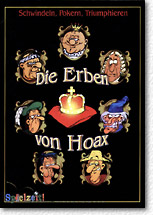
DIE ERBEN VON HOAX
Publisher: Spielzeit Verlag, Am alten Pastorat 42, 51465 Berg.-Gladbach (under
license of EON)
Author: V. Hesselmann, rework of the original rules by EON (J. Kittredge, P.
Olotka, W. Eberle, E. Horn)
Game tested: German Edition, 1999
Tester: Moritz Eggert
Scenario: Who will inherit the “Legacy of Hoax” (translation of the
German title)? Will it be the fat baron with his ability do declare practically
everything as illegal? The wily judge who turns these accusations into lawsuits mostly
profitable for himself? The preposterous Monk who can pardon the poor punished git…for
a price? The sneaky thief who can steal even the hidden treasures? The shrewd trader who
exchanges goods with you – even against your will? The mysterious magician who can steal
riches with his magic – and basically annoys the hell out of everybody by being immune to
most actions? Or the peaceful farmer, who is the only character in the game who seems to
be happy just harvesting his grain while leaving everybody else in peace?
To find out you will have to assume all this roles – whenever and however you want.
But be aware that you only have one true identity…which makes you an imposter most of
the time, because if anybody finds out who you truly are…you’re out of the
game!
The game: Even today the name EON is almost legendary. This group of dedicated
and imaginative gamers invented more all-time classic games than you can shake a stick
at. One most only mention games like “Cosmic Encounter” (their most famous
game, re-published only recently by Avalon Hill/Hasbro, also in German),
“Dune”, “Runes”, “Borderlands”, “Quirks” to bring
a gleam into the eyes of collectors and gaming buffs. There was always a common trait of
all their games: they were wilder, whackier and more interactive than most other games.
You will never sit quietly waiting for your turn in an EON game – all-round chaos and
player communication are always part of any EON-design. But EON seemed to be a phenomenon
of the 70’s/80’s, slightly out of joint with the current fads of gaming. I was
very intrigued when I found out, that the original EON team was still alive and kicking,
working on an Internet-version of Cosmic Encounter (see link below). And even more when I
was introduced to a German reissue of their classic game “Hoax”. And “Die
Erben von Hoax” is more than a new edition – it is an improvement on an already
genial game done in collaboration with the original authors, adding a point-scoring
system, many clarifications and even a new character, the trader.
Describing the game does not do it justice, but I will try nevertheless…Each player
(up to 8, minimum 4 to be fun) is dealt a secret identity from the ones described above.
To win you must survive (which means nobody discovers your true identity) and also guess
successfully what the other players are (kicking them out of the game and earning
points). When it’s your turn, you can act as any of the characters (apart of one you
choose before the round starts and which is “blackened out” on your game card),
mostly to get some kind of resource (there are three in the game: grain, gold and wine).
You try to get “trio’s” of resources (one of each kind) which you can
exchange into a “question” about another player, which he has to answer
truthfully by secretly passing you a card with an identity he is NOT playing (therefore
increasing your knowledge about the identity he IS possibly playing). All other players
can always react to any statement of identity: for example if a player takes 2 grain as
the farmer, a baron might declare this illegal, another player might punish it as the
judge, and yet another player might pardon you as the monk, but taking one of your grain
as a price. In fact this combination of events will happen all the time, and you will
find it EXTREMELY difficult to gain a trio. Once you have one, you might be safe, as a
trio can not be torn apart…except by the thief. Bummer!
But of course nobody forces you to believe any identity declared by a player. You can
always “hoax” him, which means raising your finger and stating “I
don’t believe you are the…”. If 50% or more of the other players join in, the
so accused has to say the truth: Either he “blackens out” the false identity
for the rest of the round, unable to use it anymore, or he indeed IS the identity he
stated – meaning he is out of the round, but with 3 safe victory points more than you.
There is also the real “accusation” “I believe you ARE the…” which
is dealt with secretly by passing accusation cards, and which is extremely dangerous as
either the accusing player (if he was wrong) or the accused player (if the suspicion was
correct) gets kicked out. The surviving player of this duel gets 1 VP, which isn’t
half-bad as well. If you make it to be one of the 2 last players in a round you get at
least 1 VP extra, if you are THE last, you get 3 VP.
Several rounds (usually 3) are played to determine the winner – you win the moment you
have 10 VP’s.
Playing time: The first rounds will be very confusing for new time players –
This is not a complicated game, but you have to know all 7 roles well to act
convincingly. A game, once in flow, will last about an hour, not more, take 10-15 minutes
for explaining the rules thoroughly. The rules (in German) are very complete and might
seem overly detailed at first glance, but in fact are very intelligently done and
unambiguous.
Similar games: “Sein oder Nichtsein” (first German edition, closer to
the original hoax – as a curious side note: This game used caricatures of the then German
game-of-the-year jurors as pictures for the various identities), “Hoax” (the
original game published by EON)
Westpark Gamer’s Opinion: This is a highly enjoyable game with lots of
laughs. It is mostly a game of psychology – each player slowly develops his own strategy
of deception and bluff. One of the most obvious ones will be to use your true identity to
do something extremely annoying to as many players as possible (like the baron raising a
tax), therefore provoking the “finger” “I don’t believe you
are…”. If you indeed are, you will have 3 points, and be normally well off. But to
be successful you’ll also have to understand the strategies of the other players,
though, and that will be much more difficult. This makes just watching the game and the
other players as important and fun as being active in it. The best strategy will have
everybody insecure about your identity all the time, therefore preventing the
“finger” and the unwanted blackening out of identities (which reduces your
action possibilities). The Victory-point element is a brilliant improvement on the
original game, as it now also induces tactical thinking – sometimes it’s better to
doubt a player even if you’re not sure, if it makes you one of the last 2 players
with the potential to garner even more points. This prevents the stand-still-situations
sometimes apparent in the old game, when everybody was scared to doubt as it was an
automatic win for the wrongly doubted player. Now “tactical out-doubting” is
crucial to the game.
“Die Erben…” might wear off slightly if you constantly play it with the
same people, but even one single new player changes the whole complicated equilibrium of
doubt and certainty. In short: a wonderful classic which everybody should know and play
again and again. And a truly innovative game design unlike no other game.
Moritz’ Rating: 10 (ok, you guessed it)
Westpark Gamers’ Rating: 8 (19.9.2001)
Links to further information:
- www.cosmicencounter.com
(Online-project for Cosmic Encounter, includes project video’s and cool stuff. There
are also links to buy EON-games, including “Die Erben von Hoax”) - www.spielbox-online.de/indxtemp.html?/spielarchiv/sbkritik/derbhoax.htm
(Extensive review in German)