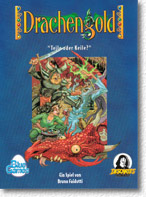
DRACHENGOLD – DRAGON’S GOLD
Publisher: Eurogames
Author: Bruno Faidutti
Tester: Aaron Haag
Game Tested: published 2001, advanced rules
Scenario: Three to six players use their adventurers to slay dragons. Every
dragon guards a treasure, which is distributed between the participating players by
negotiation and diplomacy. Once all dragons have been slain the player with the most
valuable treasure collection wins the game.
The Game: Each player has four hero cards of different strength (two knights, a
thief and a mage) in front of him, which are used in combat against the dragons. Dragons,
too, come in different strengths with stronger dragons guarding a larger number of gems.
Numbers printed on the dragon cards indicate the amount of visible gems and the number of
gems still “covered” by the dragon – latter will only become visible once the
dragon is slain.
Fighting a dragon is straight forward by playing one of your hero cards next to a
dragon. Once the total number of hero strength points matches or exceeds the strength of
the dragon it is killed and the treasure is distributed. Most of the time several players
will have participated in a fight, i.e. will have played cards on a particular dragon.
Therefore the treasure needs to be distributed amongst those players. This is the zest of
the game! Distribution of the gems (gold, silver, magic plus 6 different colored
gemstones) is done through a negotiation process between these players. In order to avoid
having endless discussions this process is controlled by a timer (about 1 minute), which
is started once the negotiations begin. If the participating players do not reach consent
about how they want to distribute the gems before the timer elapses the complete treasure
is discarded.
Since at the end of the game extra points are awarded for complete sets of gems and to
those holding the most gems of any of the colors each player tries to maximize the value
of his set of gemstones. This can lead to situations where players have a hard time to
agree about a distribution as all of them know that a particular gem is of high value to
one of them (which of course is heavily denied by that player). Every now and then one of
the players may deliberately refuse to agree on any distribution proposal – a tactical
move that sometimes may come as a surprise to the rest.
In the advanced rules a special meaning is given to the red gems: whenever a mage is
in the party that killed a dragon the player who played the mage gets all red gems in the
treasure plus a magical item card providing that player with a special ability (all but
one may be used exactly once throughout the game). If more than one mage is present then
the red gems are distributed equally between them if possible (otherwise they are
included in the negotiation process).
Playing Time: The game comes with a well written set of rules plus a
description of the scoring system on the back of the shields used for hiding one’s
gems from the eyes of the other players. Hence the game is explained in a short time.
Playing time is about 30 minutes.
Similar Games: Ohne Furcht und
Adel (Citadels), Democrazy, Shipwrecked, OrcZ
Westpark Gamers’ Opinion: The game plays fast and everybody feels involved
most of the time. Even those not participating in the gems distribution negotiations are,
because they have a high interest in watching the timer just hoping that the others
cannot cut a deal before it elapses. This negotiation process is actually the best part
of the game if you play with the right people. What you want is a group that is not too
easy going on finding compromises. If possible there should at least be one not
following the principle “you scratch my back, I’ll scratch yours”.
Killing dragons is simple and straight forward – not a lot of decisions here. You want
to be part of many adventure parties, taking care though not to join a group that will
take several rounds to slay the dragon. Go for the quick kills with small parties.
The magical items cards add a little bit of extra flavor. The effect of playing a card
is rather limited and certainly not powerful enough to win the game (although played at
the right time during the last few rounds a card may tip the scales). What needs to be
mentioned here is the one card which has more than a one-time effect. This card allows a
player to steal one gem at a time from any of the dragon cards (and only from there) for
as long as no other player catches him red-handed. The gems stolen until then do not have
to be returned. Some pick-pocket skills are beneficial here and may actually guarantee a
sure win. I very well remember when we played the game for the first time and nobody was
aware of the existence of this card. The Westpark Gamers are a group of players that hate
cheating (unless its part of the rules) and when I drew this card I did not feel
comfortable at all. I will never forget Peter’s face of sheer disbelieve when he
caught me stealing a gem from one of the dragon cards…
Aaron’s Rating: 8 (out of 10)
Westpark Gamers’ Rating: 8.25
| Links to further information: | FAQ about the game (in German) |
| Luding link for Drachengold | |
| Bruno Faidutti’s page about Drachengold (including a link to the English rules) |