In 80
Tagen um die Welt
reviewed by Peter Riedlberger
This game seems to be a merchandising product in the wake of the new “Around the
world in 80 days” movie. Well, I don’t care. It’s the gameplay I’m
interested in, and that’s fine.
The Kosmos of this game is difficult to explain (unless you use an advanced concept of
space-time): In fact, players move in two dimensions. On the board, they move from city
to city (London – Paris – Brindisi – … – New York – London). The brim of the board
features a Kramer bar but probably the only one I know where you wouldn’t prefer to
advance since it’s the number of days spent. You start with zero and you’ll end
up with around 80 days.
In order to travel from one city to another, you play cards. For London – Paris, you
need a ship and a train, for example. Every card has a value in days. Accordingly, for
London – Paris, you play a ship and a train, add the values of those two cards and
advance that amount on the day bar. You don’t want to play cards with huge values.
Therefore, it can be a good idea to miss a turn, just to get new cards and hope for a
better fare.
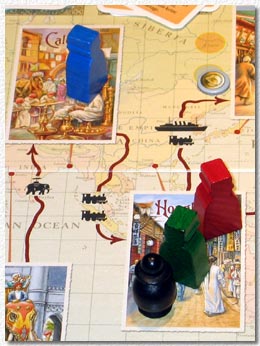
It might happen that player A advances “quickly” in space, meaning he always
hops from city to city and arrives in London… within 90 days… Player B might arrive
two turns later, but he used lower cards and wins in the end. Imagine: Both started the
same day in London, the first one experienced 90 days while the other only lived through,
say, 72. Did you ever hear of Einstein’s twin paradox?
Back to the game. My description so far may have sounded complicated, but “80
Tage” is a really, really straightforward game. It’s luck-driven, but it can be
explained and played with four players in less than one hour (which we did). Players
might complain that they don’t have too many choices during their turns, but in fact,
they do have some: At the beginning of a turn, you pick up one of the open transportation
cards. Every card is linked to some other advantage (free event card, start player next
round, …) so you must ponder the cards and their values against those other advantages.
Then, when you have two completely identical cards (e.g., two trains with value 6) and
you have to use exactly this kind of transportation (e.g., two trains), you advance only
half of the amount of days (i.e., 6 instead of 12). This means that card care is somewhat
less primitive than it might seem at first glance. Then, the very first and the very last
player to arrive at a city get another advantage (free event card, plus 1 day for all
others…). So you can follow the tactic of always being last (but beware, as soon as the
first player arrives in London, you lose 1 day per turn).
I haven’t mentioned all rules, but most. Winning the game is largely due to
getting the right cards, but it is still fun. “In 80 Tagen um die Welt” is the
kind of game you could play with non-players or children instead of stomaching Monopoly
or Risk. It is luck-driven, it is true, but there you’ll still find enough classic
German game mechanisms.
Westpark Gamers rating: 7.0