The
Hell Game
 |
||||||||||
|
This game might have been spotted in its early incarnation by avid Essen-visitors –
now this game has been “officially” published by using the increasingly popular
method of assuring a certain number of buyers through preorders before venturing into the
dangerous business of publishing a game (“Globopolis” take note!).
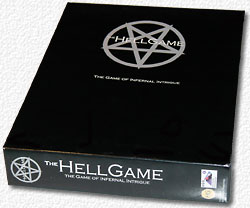
Open the box and you’ll discover loads of good stuff. The game is pretty unique in
its theme: players are evil demons from hell who try to take over…well, hell, what
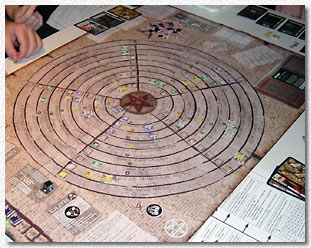
else! The board depicts the 9 circles of hell (the rulebook even explains in detail WHY
there are nine circles, as well as many sometimes surprising details of hellish
mythology). Several beautifully designed cards and counters depict the various forces of
hell, magic, the works. Most of the important tables are printed on the board in various
inclinations, there are spaces for all counters and most cards as well.
This is a very good looking game. Although the board is not mounted everything about
the game shows a lot of detail to attention – the only criticism could be that the board
is too overdesigned, making it a bit difficult to make out some details in a hurry.
Although there has been some activity in the small genre of “hellish” games
lately (“Hellrail” and “Dante’s Inferno” come to mind) , this must be the bad mother
of all hell-games. The designer certainly went to great lengths to research the game well
– apart from some dodgy Latin most of the information in the rulebook and on the cards is
outstanding in detail – I guess Satanists could even buy the game as a valuable
information tool, that’s how well researched it is (but: Satanists take heed: see
below)! The rules even have a long appendix which describes all the major demons from
hell… But the author never makes the mistake to treat his subject matter too
seriously (which might have been seen as a bit inappropriate). I cannot share Greg Schloesser’s
worry about the approach and the theme – the game is a satire, but not a silly
satire, which I think is very good. In fact it is very close to “Junta” in this respect, which also has a dodgy theme, but treats
it in a way which doesn’t take itself seriously.
The rules are written in a comfortably verbose but clear style, are well laid out and
use many examples. Although the game is not exactly easy everything becomes pretty clear
from the text.
And, I’m sorry to say, this is where the good stuff ends…because the rest
is…rather hellish, my friends.
Of course a game like this needs some kind of randomness – you don’t really expect
a game about hell to be a slick abstract strategy game, do you?
 But this game takes randomness to a new (fiery?) dimension.
This already begins with the starting position, which can be devilishly different for all
players. Each player controls 3 demons, who are initially randomly dealt out (they
usually stay with the player all of the game). The rank of these demons determines
playing order, the lesser ranking coming after the higher ranking (sometimes it is
preferable to come late in the turn order, which can be done by playing special
“Arcana” cards, which also double as spell cards). All these demons have
different strengths and special abilities – some of them are extremely powerful, others
not. Although you can randomly exchange one of the cards your are dealt out initially,
this costs you souls (the currency of the game), and the new card might even be worse
than the one you gave away. That this also costs souls is a double punishment for someone
who simply got dealt a bad card!
Also the starting positions on the board vary immensely – the 9 circles of hell are
divided into 5 “quarters” (they always have an extra quarter to spare in hell,
I guess) – controlling a full circle means winning the game (actually there is also
another victory condition: owning three “Arcana” cards with the number 6, a
winning condition which is both very improbable and also very unsatisfying if it happens,
except for Satanists). Some of these quarters are controlled by the players – again cards
are randomly dealt out (one representing each quarter), resulting in the possibility that
one player can win through the initial card deal! Also here some players might have a
very good deal, some very bad deals, as connected quarters produce more souls than
unconnected ones. In our game two players practically had double the initial income of
all other players – as income is used to buy armies, cards etc. this makes the game very
unattractive for the others from the start.
On your turn each demon has an action – you can roam earth to produce additional
souls, you can send armies out to conquer other quarters, you can wield mighty spells,
you can try to gain or lose favour with Satan himself or you can simply pass (sometimes
this is even a good option!) and so on. If you thought that the initial deal was
frustrating, talk about the game itself….Everything in this game is worked out
very detailed, very often using dice rolls (have I already said that players who roll 6
1’s in succession get extra favour with Satan himself for “having such bad
luck”? A silly rule, especially when you think about the fact that in combat low
rolls are usually good – why are they bad luck then?).
Combat is a total design disaster – it works pretty much like Axis&Allies, armies need to roll below a certain number to have a hit.
But different to A&A (which is already famous for long, drawn out battles) each unit
gets a SAVING THROW after a hit is assigned (and only one hit can be assigned to each
unit, another silly rule). This saving throw can easily give the armies a 4 in 6 chance
to survive, if the army-leading demon is strong enough (or even more!). This leads to
totally ridiculous battles which take forever. To give you an example: one battle between
only two units (!) took us 16 rounds, as the units kept surviving and surviving. Although
the rulebook offers a quick resolution method for small battles, this rarely makes sense,
as it is even more random. The rulebook also suggests that after a certain number of
rounds Satan himself randomly draws the winner of the battle – an even worse solution,
especially when large battles can easily take more than the above 16 rounds).
But combat itself is not the worst aspect – it is AVOIDING combat. Fleeing is not
done, like in other wargames, by retreating orderly into an area, you ROLL THE DICE where
you can go. Which again means that you can land in an enemy space, resulting in ANOTHER
possible combat. Which again can be avoided by the new enemy through fleeing, again
randomly landing in another space, AGAIN creating another combat, and so on ad
nauseam…These chain reactions can go on forever! Even worse are the hellhounds
(“wild armies” that you can recruit, randomly of course, in Antehell) – they
tend to go berserk and randomly move around hell, creating either myriads of battles, or
myriads of flights from battles, which again result in more battles, and so on and so
on….Have I already mentioned Uriel, the avenging angel, or Lilith, Adam’s
lesser known wife? These two move randomly around the board and create havoc wherever
they go, as if there wasn’t already enough chaos in the game. Of course there are
also the other usual design disasters like ultra-powerful spell cards and ultra-meek
ones, events which can turn the game around completely without any player input, dice
rolls for everything…the list goes on….
What is the point in playing this game, when EVERYTHING you do brings you neither gain
nor loss -actually doing nothing at all can also result in furthering your position,
there is a rule that makes an eliminated player take over the space with the most armies
(so what’s the point in amassing armies in the first place?). Perhaps this is some
kind of philosophical comment, but its sense eludes me.
The question one has to ask is how hellish and random a game has to be that depicts
hell and the senseless battles that take place there. In fact one might even argue that
this is the true meaning of the game – budding Satanists might learn about the futility
of their ways and give up their profession even! So I can recommend this game only to
horror fans and Christian gaming circles – the former might enjoy the research and love
to detail that went into the game, the latter can use the game in their crusade against
evil. Sadly there is not much here for real gamers, which is a shame, as the game could
have been very good with a major rules rewrite.