
San
Juan
Same author (Andreas Seyfarth), same publisher (Alea) and same location
(San Juan is the capitol of Puerto Rico) – yes, San Juan is the little brother of
Puerto Rico.
Opening the box delivers the first surprise: San Juan is a card game; no board,
no colonists, no money. Yet, we find a similar set of “role” cards and
buildings as in Puerto Rico. The basic principles are very similar to Puerto
Rico: the players’ task is to produce goods which can be sold for money and to
erect buildings which can in to flavours: production buildings for goods and general
purpose buildings which provide special abilities.
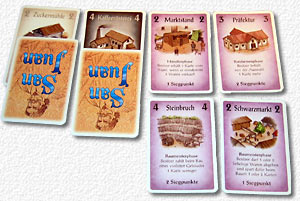
I am not going into much detail here about the rules of San Juan, but rather
take a look at the difference to Puerto Rico. As in Puerto Rico players
select a role and perform the action associated with it. But different to Puerto
Rico the same cards act as buildings, goods and money, depending on the action
performed. Erecting a building means playing the card of that build from one’s hand
as well as paying the building costs with other (building) cards from the player’s
hand. Producing goods means placing (building) cards from the draw pile face down next to
the corresponding production building; and selling goods means placing produced goods
(building cards) on the discard pile and drawing the corresponding amount of hand cards
(now reflecting money) from the draw pile. For those familiar with Puerto Rico
this is simple enough and easily understood. Those not familiar with Puerto Rico
rest assured: the rules are very well written and the game can be played after only a
brief introduction round.
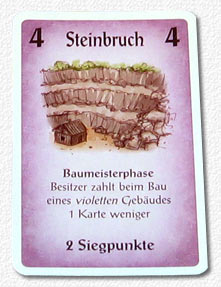
While Puerto Rico has a lot of depth and is rich in different strategies (see
our tips here), San Juan is a much lighter game. It has, however, a number of
advantages over Puerto Rico, which make it a game for a wider range of players. First and
foremost, San Juan is a lot shorter a game – playing time is around 45 minutes. We
didn’t see the high frustration level we discovered in Puerto Rico, which
occurs when other players play suboptimal or start ganging up. In San Juan players
are much more independent from other players’ actions than in Puerto Rico but
more dependent of card drawing luck, which is nicely balanced by the shorter playing,
providing a chance for “revenge”. Puerto Rico hardly leaves time for a
replay the same evening. Last but not least different to Puerto Rico, San
Juan can be played with two to four players equally well.
San Juan is definitely not a strategy game like Puerto Rico (you can
find our strategy hints here) and in my opinion leaves
little room for different tactics. Players are however always faced with tough decisions:
is it worthwhile to keep an expensive building card until one has collected sufficient
cards to be able to pay for it? Or is it better to use that card as money for a
“quick win” cheap building? Is it better to go for more production buildings or
for general purpose buildings? The former generate income, the latter save money due to
cost savings. A good (German) description of the San Juan cards and the associated
possible tactics can be found here.
Overall, San Juan is one of the best new releases in 2004 and a worthy
successor of Puerto Rico. It should not come as a surprise that it has been
selected as our “Game of the Month” in March 2004.