|
||||||||||||
|
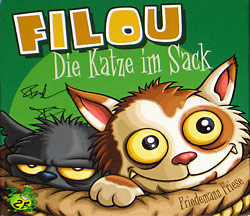


Felix: The Cat
in the Sack
reviewed by Aaron Haag
Unless we are playing a very long “whole evening” type of game almost none of our game
sessions is ending without playing an “Absacker” (nightcap or filler) game. These are short, light, easily taught games
which nevertheless provide sufficient replay value to have them on the table again and again. If
you have had a look at our session reports you will have noticed that our most favourite
“Absacker” is “Liar’s Dice” or
“Bluff” as the German edition is called. Other favourites are “Take 6” (6 nimmt) or “Bottle
Imp” (Flaschenteufel). What all of these games have in common is their short playing time,
which let’s you easily play at least one “revenge” game during the remaining 30
minutes or so. Also, all of these games provide very good player interaction and challenges
although being based primarily on elements of luck, thus they are not too serious or dry games
overall.
“Felix – The Cat in the Sack”, this year released on the “Spiel 2007” by
Friedemann Friese is a bidding game where sets of cards are auctioned. The catch is that players
are bidding on the virtual cat in the sack, i.e. a number of cards the value of which they cannot
determine right away. Without wanting to go too much into the details of the rules (they can be read
here) the principle is as follows:
- Beginning with the start player of a round each player places one of his hand cards face down
on the table. The card of the start player is then turned over. - In sequence, beginning with the start player, each player either bids on the whole set of
cards, increasing any previous bid, or passes. - A passing player is immediately out of that round and receives “mice” money; early
passers get less than late passers. In addition, the next card is turned over and revealed to the
players. - The last remaining player receives the set of cards and pays the amount bid to the bank.
- The game ends after nine rounds when all hand cards have been played.
- The goal of the game is to have the highest total of mice money and cat cards.
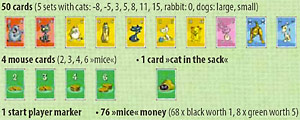 |
An important design element of “Felix” is the fact that two of the cat cards have a
negative value, making it possible to bid money on a stack of cards with a negative total. In
addition, three special cards (a “0” valued rabbit and two dogs voiding the highest or
lowest valued cat in the stack, respectively) and the fact that before the game commences every
player has randomly removed one of his hand cards make the evaluation of the probable total sum of
the stack even more difficult.
Let’s look at some typical scenarios in the game:
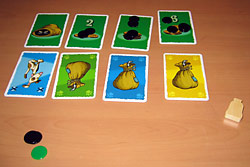
As a start player your first problem is which card to place on the table. As this is the only
card that is revealed before the bidding starts you are actually able to exert some control over
what will happen in the first bidding round. If you play a negative card you may create an
avalanche of passes by the other players if they played cards of low values, too. The effect is
that all players except yourself receive some “passing” money while you are left with
paying the bid and taking a possible low valued (or even negative) set. Something you surely want
to avoid.
 |
On the other hand, if the next player does not pass he most probably has played a high valued
card. In this situation you are “safe” as you are not the last bidder if everybody else
should pass and you have a choice of either taking the highest “pass” money or continue
the bidding if the now open cards suggest so.
So there is a bit of “Liar’s Dice” feeling in “Felix” as well, where you
want to create a situation where the player to your right is continuing the bidding if the overall
situation is still unclear due to the many face down cards. Seating order plays an important role
here because bluffing the player on your left on his own card obviously is a lot harder than
bluffing him on someone else’s card. Therefore “passing avalanches” most of the time
happen, when a player’s own card is the first one face down.
Another very nice game element is what I would call the “cash flow dilemma”. Whenever
you raise your bid you not only have to consider the potential value of the set of cards you bid on
against the amount of “passing” money you get when you drop out. It is equally important
to consider that high bids will render you short of cash in the next round. Paying 15 mice money
for a set of value 25 may sound better than taking 6 “passing” money but if you are left
with only a couple of mice after that you have just kicked yourself out of the bidding in the next
(or even more) round. A situation we have seen several times and learnt that it hard to recover
from.
 |
This may sound very abstract but when you play the game you will immediately feel the tension
created by the seating order, the current cash situation of yourself and the other players and the
cards already revealed.
Although the game mechanics are completely different, playing “Felix” also reminds me
a little of “Take 6” as it creates the feeling that one has some control over the game
only to determine at the end of a round that one should have played it differently. And while it is
so obvious to determine afterwards what went wrong it doesn’t really help to win the next
game.
Coming back to my initial words about filler games I can strongly recommend “Felix” as
just that: an easily explained, short game with lots of player interaction, or should I say player
chaos? If you like games which create the sense of being in control but demonstrate to you again
and again that you are not “Felix” can be equally addictive as “Liar’s
Dice”, “Bottle Imp” or “Take 6”.