Session Report 08.01.2003
Author: Moritz
at the table: Hans, Walter, Aaron, Peter, Moritz
on the table: La Città, Bluff
- La Città
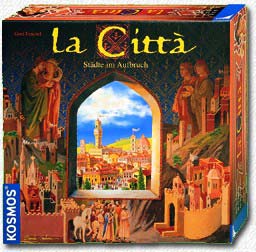
For some reason we hadn’t had a games evening for quite a while – this is
why the general mood was especially friendly. In fact, we never had a games evening with
so little bickering and quarreling in a long time. Might it have been the bottles of wine
that Walter and Aaron freely distributed (it was a belated celebration of Aaron’s
xxth birthday – I’m not allowed to say, which…[Did I say
that? Looking at Marcus Barnick’s “Who’s Who” website my age appears to be public knowledge!
Aaron])?We decided to play “La Città” – Walter had been given this game as a
present, and had apparently completely forgotten that we had already played this game
ages ago, when it was newly published. Back then the game hadn’t impressed us
greatly, but this time we really had to admit that this is a great game (which shows,
that the good game reviewer “always has to play twice”).Kosmos published this game as a planned successor to “Siedler”
– it is a lush edition, with absolutely fabulous game material, even for German
standards. It probably wasn’t the big commercial success they hoped for, but this
is a “gamer’s game”, like “Puerto
Rico”, a treat for addicts like us.The huge map depicts an empty Tuscany landscape, that players hope to fill with
prosperous cities. Certain landmarks are placed on the map before play (the setup
described in the rules gives each player about the same starting position, and is highly
recommended for the first games). There are “farming” (adjacent cities and
farms get food markers, they range from “1” food to “3” food
– a city/farm can touch a maximum of two of these tiles and earn the sum of the
tiles they touch), “water” (give the possibility to build the all-important
“fountain” tiles that hugely increase population capacity) and
“mountain” tiles (each mine touching them gives money, it is very important
that you build them early, like in “Puerto Rico”).Players start with two cities each, hoping to expand them and to achieve a huge
population.For this it is important to know the “will of the people” – people are
interested in 3 traits: “culture”, “education” and
“hygiene”, each symbolized through a colour. Each round 4 “will of the
people” cards are drawn: one open, the other three are secret. At the end of the
round the dominating colour will be found out by looking at the hidden cards (in case of
a draw, both traits are “prominent” and the players can choose which one to
activate with each of their cities). Now all cities within a certain distance (2 hexes)
of each other will compete for the extremely fickle and easily bored population. If the
neighbouring has city more cultural buildings than you, and culture is “in”
at the moment, it will draw away one population figure (which look suspiciously like
hobbits, by the way). You usually want as many people in your city as people –
first they bring points at the end of the game, second city expansion tiles need people
to work- if they have no people on them, they are “torn down” – the
city shrinks!But there is also a drawback: people need to be fed, and if you have more people than
food markers (described above) the game system will punish you heavily with having you
miss out a turn next round, and also reducing your victory score in the final round
severely. Peter, who has played this game more often than us, had warned as about this
fact, and we all played very carefully in this respect, but still people starved, as the
board and the expanding neighbours limit your access to food tiles severely.A round consists of 5 actions – you have 3 cards that you can always play, they
allow you to build basic buildings, get gold or start new cities. If you want to build
the larger coloured buildings (that give you more of an edge in the populace competition)
you need money and the abundant “open” row of action cards, that is
constantly renewed from the deck. This means you can have a maximum of 3
“self-decided actions” , the other actions come from the deck – with a
selection. Some of these cards have other functions – they give you free extra food
for the round, or strengthen your “traits” for the competition. The most
important card is certainly the one that allows you to predict to or more of the hidden
cards “will of the people” – played early this will give you an edge in
planning your turn!Cities are limited to 5 citizens and therefore tiles. A “market place” gives
you one “gift” citizen and the possibility to reach the populace of 8, a
“fountain” removes even this limit (this is why the water spaces are
extremely important – the winner needs two large cities, possibly more, no doubt
about that). Each round ends with the mutual removal of citizens from the cities, then
you check if you can actually nourish them.The game rewards good planning – If you pump up the traits of the cities (the
symbols for these traits look suspiciously like “McDonalds”-M’s, by the
way :-), you might get a larger population than you hoped for – starving is bad
news, as you lose an action next turn.You also want diverse cities – cities with all traits present get bonus points. It
is also a good idea to build last ditch cities in the final round (although there is very
little room on the board for additional cities) – each citizen gives you one
victory point – and new cities come with 3 “free” citizens!Turns are quick as the decisions are limited but important, very similar to Puerto Rico.
Watching the board and planning your expansion is strategically very demanding –
when will you cross the safe border of 2 hexes to other cities by building new buildings?
Can you be sure to beat them in traits this round? If not you might lose more than you
get.Cities can actually be completely destroyed by draining them of all cities, so beware!
If you have farming land close by you should build as many farms as possible, they come
in very handy for the end game, when you suddenly build new cities to garner VP’s.
The same is to be said for mines – the good buildings can be very expensive, and
money is very rare. A tactic that usually works is to have a “money city” and
a “farming” city, both with different goals.All in all this is a very nice game – not too complicated, but with lots of
nail-biting decisions to make. Although it is – like “Princes of Florence” and “Puerto
Rico” essentially a solitaire game played by a group, the competition between
the cities is THE all-important element of the game. The board is small, and the
competition is not sleeping. The game time is longer than the usual German game, I would
say around 3 hours for newbies.Thumbs up to “La città”!
- Bluff
After a “perfect” victory in “La Città” my strange lucky streak
didn’t stop – the two “Bluff” games we played were won with
almost no problem, the dice rolled where they should, and twice I beat Walter with
extremely lucky rolls that he just couldn’t believe.That this was a lucky streak was proven 2 days later at the “Spuiratzn”
– I lost every game, and always came last!