Session Report 15.01.2003
Author: Aaron
at the table: Walter, Peter, Moritz, Andrea, Aaron
on the table: T-Rex, Linie 1, Bluff
- T-Rex
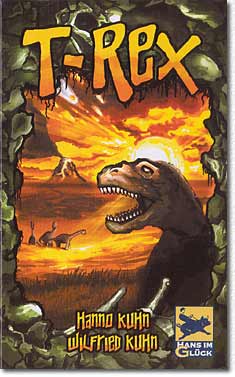
After some debate about the first game of the evening Peter finally succeeded in
convincing us to agree to T-Rex. Peter had played the game several time before and
enjoyed it a lot whereas especially Moritz didn’t like it too much on his first try.T-Rex is a card game where all players use an identical set of 17 cards and try to win
dinosaur eggs. These eggs come in 4 different colors and each egg is worth the total
number of eggs a player owns of that color at the end of the game, resulting in a
possible exponential growth of victory points.The player cards come in five colors with 3 cards of each color numbered from 1 to 15
plus 2 special cards. Before the first (of a total of 12) round of the game commences
each player shuffles his/her deck and draws 7 hand cards to start with. Additionally, 2
dino eggs are revealed from the dino egg draw pile and two color cards are placed on the
table to indicate the highest and lowest ranking card color for this round.Players in sequence play one of their hand cards placing it in front of them – there is
no need to follow suit. Each card carries a symbol (cards or a comet) which either
enables the player to draw additional cards from the draw pile or it signals the
beginning of the “end sequence” of that round. When the first comet card has
been played the round immediately ends once that player has played another turn and no
other player has played a higher ranking comet card. Card ranking goes by the card’s
color followed by the number on the card.Whoever has the highest ranking card in front of him/her selects one of the two dino
eggs; the second egg goes to the player with the second highest card. As a small, but
important, bonus the player having the lowest ranking card may replace one of the two
color cards that indicate the color rank for the next round. Then each player permanently
discards either the top card from his/her draw pile or the card last played in this
round. Then the remainder of the cards played this round are placed under the draw pile.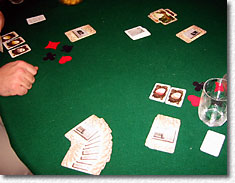 The first two or three rounds of T-Rex are usually heavily luck based as it
is completely unknown which cards are held by the other players. After a while most
players have gone through their draw pile at least once and usually have collected a set
of cards that suits their tactics. Especially players with a good memory now have an
advantage if they remember which cards are permanently out of the game and which cards or
at the bottom of the draw piles.Once a comet card is played in a round this type of information can be vital for winning
a dino egg because at that point it is important to be able to judge which player is able
to play higher ranking comet cards thereby extending the round. Exact timing is what make
winners here as it is important to play the highest ranking card in the last turn of a
round and in fact it can be very annoying if a round is extended by another comet card
and one has to play another card, which more often than not is a lower ranking card,
destroying any hope for winning an egg.For my liking T-Rex rewards good memory too much (old age, I guess). This combined with
the usual uncertainties of what tactic another player will apply provides me with too
many unpredictability. Interestingly, Moritz, who said he didn’t like the game
because of the strong memory effect won the game by far and Walter, our Bridge playing
card game wizard came in last. - Linie 1
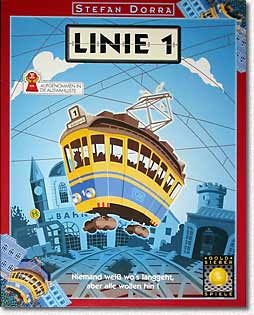
Linie 1 – or Streetcars as the English version published by Mayfair is called – was our
second game of the evening. We played this already once a couple of years ago with not
too enthusiastic memories and we wanted to give it another try.The task of the (up to five) players is to connect the terminal stops of their streetcar
line which are located at opposite borders of the game board by building tracks between
them, a principle which was employed already by Twixt may years ago. To make things not
too easy players get their streetcar line dealt secretly out of the six available lines
and additionally they have to include two (or three in games with less than 4 players) of
the many intermediate stops that are placed throughout the board. Also these stops are
dealt secretly.The game is played in two phases. During the track building phase a player places two
new track tiles anywhere on the board or upgrades already existing tiles. Tiles may only
be placed if they legally connect to tiles already placed and can only be upgraded if
existing track is maintained. As soon as a track tile is placed next to a stop location a
stop sign is placed on that tile. No additional stops are possible at this location.Players therefore are faced with the difficult task of making sure that the stops they
must pass are located in such a way that they caneasily be integrated into their own
network and on the other hand they must try and avoid revealing their intentions and line
identity too early. Line 1 allows all sorts of nasty track laying making it possible to
create long detours for other players once one knows their intentions. Even endless loops
are possible (see the left terminal of line 4 on the photo) making it impossible to use a
piece of track in both directions.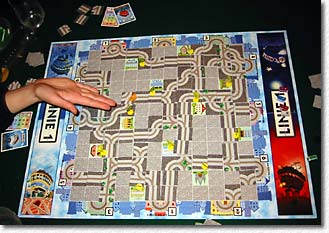 The second phase of the game begins once a player has completed the
required route. The player announces this to the other players and indicates the route on
the board. The rules state that this must be done so that all players are able to verify
that a valid route exists. And in fact, it happened twice during our game that a player
announced a valid route which in fact did not exist! Once the route has been verified the
player starts travelling with a streetcar starting at one terminal, along the two (three)
intermediate stops to the terminal at the opposite side of the board. The
“motor” of the streetcar is a die with numbers 1 to 4 and two “H”
signs. The player rolls the die once per turn and moves the streetcar the number of track
tiles indicated on the die or to the next stop if an “H” has been rolled. Here
it becomes obvious why a short route is so important.While some players have already started their streetcar other players may still be
building their route. The point in time when to start the streetcar needs to be carefully
judged because sometimes it can pay to optimize a route further rather than starting the
car on a hopelessly long route.Moritz came in first closely followed by Walter, who in fact had the shortest route of
all players. My chances of winning came to an abrupt end when Andrea
(“unintentionally”, as she said, believe it or not) blocked my intended
starting location by a loop construction.Line 1 in my opinion is a strange mixture of a game: on the one hand there is the rather
complex track building race amongst the players followed by a dice rolling war in the
second phase. My feeling is that the players who like the track building will not be too
happy with the second phase and vice versa. - Bluff
This evening we had sufficient time left to try some experiments with our usual final
game of the evening: Bluff. After Moritz had won the first game of Bluff (making this a
very good evening for him) we decided to change player position at the table to find out
if that has any influence on the game results. Doing so we managed to achieve a clear win
for each player – a result we never had before. Which leaves us with the question: does
the seating order really have in influence on the Bluff results? If so, what exactly is
the cause of this influence?