Session Report & Review 11.09.2003
Author: Aaron
at the table: Loredana, Hans, Peter, Aaron
on the table: Titan – The Arena, Maestro, Ra, Traumfabrik
This has been one of our few 4 player evenings and with the exception of Maestro we
made it a “Knizia only” game session. Interestingly, because unplanned, and
besides the fact that three games had Knizia as the author we found that this was an
evening where all games played had some commonality either in theme or game
mechanics.
- Titan – The Arena
We have already publish a review of this unfortunately
out-of-print game some time ago. - Maestro
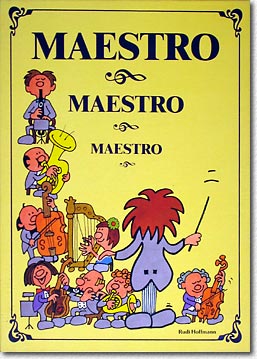
Just a few short word about Maestro, a Rudi Hoffmann attempt that has been one of the
nominees of “Spiel des Jahres” in the year 1989. Each player owns an agency of
musicians. A maximum of 10 artist tiles can be placed in the agency (up to 3 per turn
drawn randomly from a sack). Each musician plays a instrument and its the players’
task to place their musicians on one of the 10 pieces (from Darius Milhaud’s duo
Scaramouche to Rudolf Kummerer’s septet Alpenjägermarsch) that require these
musicians.Once the hiring of musicians for a piece has been started by placing a Maestro on one of
the available musician slots a player may place any number of musician on that piece per
turn as long as he plays the required instrument and the tiles are placed in sequence
next to the Maestro. Each such played artist yields 5 victory points. If a player is able
to place all artists including the Maestro in one single turn, thereby completing the
piece, each artist placed yields 10 VPs. A player completing a piece receives the
“critic” which yields 10 VPs to that player each turn, forcing the other
players to start and finish pieces themself quickly. The game ends when a total of 14
“applause” tiles have been drawn from the musician tile sack.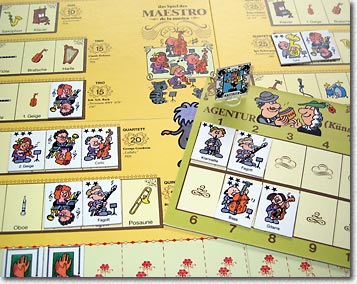 Sounds simple enough and not very challenging in terms of tactics
but there are a few things which make the game more demanding than one first thinks.
First of all, the agencies are split into a public and a private section, allowing
players to hire artists from the public parts of all other players’ agencies. This
makes filling the slots a little tactical (and risky) as players want to place important
(i.e. rare) musicians in the private slot of their agency. On the other hand these slots
yield a lot more negative VPs when still filled with artists at the end of the game.The second thing to watch is the placement of the Maestro himself. Since the Maestro tile
covers a musician slot in a piece players like to cover exactly those musicians that are
placed in the private area of the other players’ agencies, rendering them more or
less useless and a likely candidate for providing negative VPs at the end of the game.view/add comments 
Maestro is a family game, not too demanding, with a good amount of luck and it can be
played quickly. Interestingly, we only realized at the end of the evening that due to its
mechanisms it fits very well into the game selection of our session. - Ra
This game, too has been reviewed by us before: review.
- Traumfabik
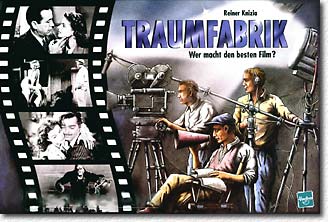
This Essen 2000 release of Reiner Knizia has been published by Hasbro, nowadays not
necessarily a recommendation for serious gamers. But since it’s a Knizia game and
Peter even stated it to be one of the best Knizia games he’s ever played it was on
the table as the final game of the evening (after convincing Loredana to play it again
when she mentioned that she’d played it too often in the last few weeks).Traumfabrik, or “Fabrik der Träume” as it was renamed some time ago, is a
bidding game about movie making. Players try to get artists (director, camera, actors,
special effects, guest stars) for the free slots of their movies and once a movie is
completed it yields a number of victory points based on the value of the artist (Knizia
appears as an actor with value -1, I guess he knows best why). Special prizes (victory
points) are allocated to the best movie of each of the four categories, the first movie
of a category and the worst movie of all (here’s where Knizia as an actor comes in
handy).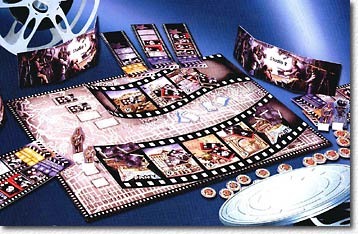 The game is played in four rounds and each
round has 6 auctions and 2 parties. The two to three artists available at each of
the six auctions of a round are randomly drawn and are revealed at the start of a
round so each player is able to decide on a suitable bidding strategy for the
complete round. The artists available at the two parties (one artist per player) are
not revealed in advance and they are not auctioned off but are selected by the
players in sequence based on the number of already hired actors of a player.At the start of the game each player receives money for bidding in an auction and after
each auction the money bid is paid by the highest bidder and distributed equally amongst
the other players (any modulo is saved for the next auction). As soon as a player has
filled all available slots and the VPs have been assigned they draw the next movie from
an open pile.The game ends after 4 rounds. Now the special prizes for best and worst movie are
allocated and the total number of VPs calculated. Any bidding money still in the players
possession counts as VPs.There is an element of luck in the game but it is acceptably low because all available
artists of the 6 auctions per round are visible when a round commences. The distribution
of movies at the start of the game is fair (each player has one movie of each category)
and the initial values of the movies appear to be identical. The key element of
Traumfabrik is clever bidding and if you like aution games Traumfabrik is definitely a
game for you. Or in other words, if you like “Modern Art” by Reiner Knizia, you
will also like Traumfabrik. Another nice touch is that, similar to Modern Art,
Traumfabrik is able to provide a flair which matches the game’s theme very well. All
movies in the game are classics and it’s fun to fill the artists positions with
famous people from the movie industry – the end result most of the time being rather
hilarious.view/add comments I disagree with Peter about Traumfabrik being one of the best Knizia games. Traumfabrik
is very good no doubt and I liked it a lot, but Modern Art in my opinion still is the
better of these two Knizia bidding games.