Hazienda
Preview of the new Kramer game by Moritz Eggert
Living in Munich means living in the most expensive city in Germany – the (usually)
nice weather, the closeness of the Alps and the many beergardens and other available
hedonistic pleasures make for extremely high rents and costs of living. I know many a
gamer here who can’t afford an apartment big enough to store his/her games!
But there are also benefits of living here, and one of them is living around the
corner of the headquarters of Hans-im-Glueck, undoubtedly one of Germany’s best
publishers for quality boardgames. As I’m a regular visitor of their monthly
boardgame evenings I sometimes have the honour of being able to test the new designs in
the pipeline. One of Hans-im-Glueck’s new games for this year’s Essen fair is
“Hazienda”, a new boardgame by master designer Wolfgang Kramer. But convincing
Bernd Brunnhofer, head of Hans-im-Glueck, to give a special preview of this game was not
as easy as I first thought:
‘We don’t usually like to do previews.‘ says Brunnhofer.
‘Even if they are positive they tend to create a too high expectation that nobody
can compete with, as was the case with “Euphrates & Tigris”. Now E&T is
considered a classic, but when it first came out there was a certain backlash to the
immense hype that didn’t make us happy‘.
But after promising to make this a descriptive preview instead of an evaluating review
(the latter would be morally dubious anyway, as I was slightly involved in the
playtesting of this game), Bernd was only too happy to indulge me in the secrets of this
new and certainly interesting Kramer game.
“Hazienda” takes place in Argentina, sometime between the 30’s and
50’s. The players (2-5) represent land owners who want to get rich quick by
establishing trade routes and accumulating acres of land. Earning and spending cash is an
important motor of the game, but of course it is victory points that count at the end of
the game, after all this is a game with the eponymous ‘Kramer Leiste’ (Kramer
track) to keep track of VP!
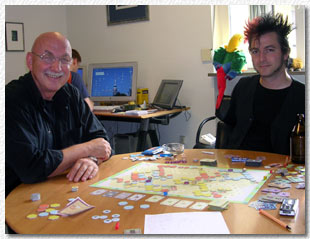
Each player starts with 20 bucks and a selection of animal and land cards. The board
consists of a ‘land track’ with 5 different types of land surrounding the open
‘Pampa’ spaces so typical for Argentina. Appearing throughout the Pampa spaces
are markets which players try to connect to their land spaces via ‘animal
routes’. Animals come in 4 different kinds, and have to be played as a match, so a
pig trade route can only be lengthened by playing more pig cards on it. There are also
water spaces (lakes) that accumulate victory points when the player owns adjacent animal
or land tiles. There are two VP calculations in the game, one after half of the animal
cards have been used up, one after all of them are in play, the latter situation ends the
game.
If all this sounds rather abstract it comes as no surprise. First of all this is a
Kramer game (what do you expect?), and even Brunnhofer makes it clear that ‘this is
certainly not an unconventional game’. But Kramer’s designs are widely known for
their durability and elegance, and so ‘Hazienda’ is certainly worth a closer
look. In fact the options for the players are impressive – there are 3 actions per player
turn, and they can be multiples of the same action and be done in any order.
First of all it is possible to buy cards. There are always open animal or land cards,
and these can be purchased for 3 bucks each. You can also try your luck and buy unknown
cards from the deck for 2 bucks. Playing a card also counts as an action. Land cards are
placed to own the corresponding land spaces (shown by placing a tile of your colour on
the board) and animal cards are played to create animal lines to reach the markets (also
played as tiles in your colour). The players usually try to create lines of at least 3
land spaces on the land track – the longer a continuous stretch of land is, the more VP
it will bring during the calculations (2 per space). Placing a hacienda on a land line is
expensive (12 bucks), but it brings an additional VP per space, so you better save up
actions for doing it before the game ends! It should be no surprise as the game is named
after them….
Haciendas can also be placed on animal lines, but this is done rarely.
Another possibility is ‘hugging’ lakes with your animal or land lines. You can
also cleverly create your own lakes (quasi godlike and slightly dubious from a realism
point of view, but essential to the game. One could think of them as artificial water
spaces created by dams). This also costs 12 bucks, and you should select a lake form that
hugs as many of your spaces as possible as other players will also benefit from a lake
placed next to their spaces, even if they didn’t do it themselves.
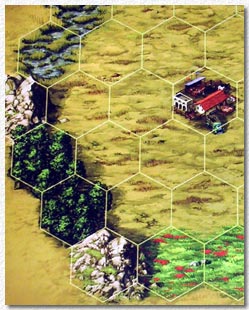
Connecting the markets is important in 2 ways: first of all each time an animal
connects to a market (even if done several times in a circle by playing more and more of
the same type of animal) you get the length of your land stretch plus the animal track in
money. Get rich quick schemes are usually quickly thwarted by your opponents who can
tactically place their tiles in your way to prevent a ‘circle run’ around a
market. The second and more important function of markets is that they are a VP cash cow:
the more different markets you connect yourself to the more VP you get, in an exponential
curve similar to the game Hare and Tortoise. Another way to make cash is to harvest a
stretch of land (this can only be done once per line) for 3 bucks per land space. Owning
money is not bad either, as 10 bucks convert to 1 VP – in both VP calculations!
These are, in a nutshell, the rules of the game, and they can be understood quickly by
any kind of gamers. As is usual for this type of games you want to do many things at once
but can only do so little in each turn. The road to victory is therefore to be as
efficient as possible with your actions, by maximising input and output. Balancing the
various VP requirements was therefore the most important task in the design work of this
game, says Brunnhofer, who is an expert at removing unnecessary details to make the
design as fluid as possible. Early versions of the game included, for example, many more
options for earning VP’s. One of them was the possibility to earn bonus VP’s for
the longest land line. ‘We dropped this to eliminate the boredom of watching players
constantly counting the length of their land lines, which bogged the game down
immensely’ says Brunnhofer. Another way of calculating VP’s by multiplying them
instead of adding them was also removed, because it ended in wildly differing sums which
made close and more exciting finishes impossible.
But there are also things which were added. ‘The original design of Kramer had
numbered spaces instead of different land types, because he wanted to avoid similarity to
other games of this type. Playing land cards was done very differently, with the use of
jokers and the possibility to look for certain numbers in the other player’s hands.
In the end we introduced the lands again because they added more flair’. Good idea,
because otherwise “Hazienda” might have been confused as an Acquire variant,
which it certainly isn’t! Another later change (this time by Kramer himself) was to
interrupt the otherwise continuous land track with Pampa spaces, which forces the players
to buy Pampa cards and also makes Pampa cards more valuable when they appear.
The prototype I played was the finished version ruleswise, but the game itself had not
yet gone to the printer. This is usually done very shortly before the Essen fair, to give
the possibility to change small details. Hans-im-Glueck is known to work hard on their
rules to avoid any opaqueness or confusion, and even as we played our 3-player game Bernd
Brunnhofer and Georg Wild made little notes for additional fine tuning.
As the game is very dependent on an interesting map this comes in two versions, one
‘symmetrical’ and one ‘asymmetrical’, with the first one being
recommended for beginners. As an additional service our own Guenther Rosenbaum from
www.westpark-gamers.de has finished a special program that enables players to create any
map they want from the original symbols and then print it out. Look for it now on our website or on the official Hans-im-Glueck website.
“Hazienda” plays in 1-2 hours, and can be equally played aggressively
(hindering other players from building good ’empires’), strategically (go for the
markets to get a surprise VP rush) or tactically (just consider what is best for you each
turn). Each of these options will tax your head without bursting it, as the game play is
rather swift (which was not the case with the earlier versions, where too many options
slowed the game down). It plays equally well with 3 or 2 players, with only slight
modifications in the distribution of cards. I predict that “Hazienda” will be a
welcome new addition to the already impressive line of Kramer games.
But don’t believe my hype – join Hans-im-Glueck in Essen to see the finished game
or play the game when it’s available. Although none of us would probably mind another
Euphrates & Tigris – hype or no hype.