Taking Control Of Time Control
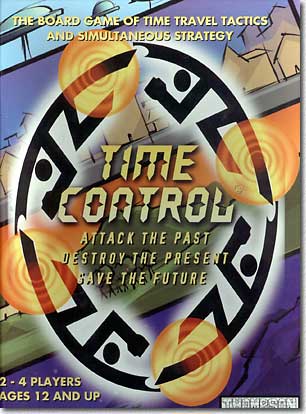
A review and a possible „fix“
“Time
Control” has been one of the most dissed games in boardgamegeek history – this
has to do with the fact that the designer sent out many free games to possible reviewers,
a practice which is normally laudable but which backfired in this case. We as the
“Westpark Gamers” had also received a copy, but as it arrived relatively late
we already had word from the various boardgamegeek reviews (by usually reliable
reviewers) that this game was truly awful. Therefore we never really got around to play
it (or rather didn’t dare, to be honest).
This reviewer will not try to rectify the view that is dominant about “Time
Control” – the game suffers from many flaws and has certainly not been
playtested enough (or perhaps not at all). But while reading the rules (second, optimized
version, still with many unclarities) I found that some of the ideas in the game were
neat and interesting. I also felt sorry for the game designer, who had apparently gone to
great length to present and print his game professionally (you can certainly not say that
the game is ugly looking, although tastes differ). Also, I am a fan of the “time
machine” genre, of which there are only very few good games (and only one true
masterpiece, the totally underrated and out of print “Time Agent” by TimJim
games). So before we finally decided to test this game, I already changed some of the
rules that I was sure wouldn’t work (therefore sparing us the aggravation that the
other testers felt while trying “to make it work”). But more about that
later…
To give you some idea what the game is about, here is a short description:
Each player represents a time agency which tries to keep reality safe from “time
waves”, accumulated problems that wander “up” to the present from the
past, created by the other players agents. Each player therefore is master of his own
“alternate reality”.
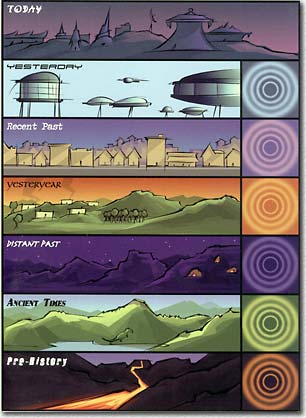
There are 7 time zones: today, yesterday, recent past, yesteryear, distant past,
ancient times and pre-history. Today is where your agents are safe, and from which you
send them to the past, to your own, and ultimately also to other players time zones.
There are 4 kinds of agents: normal ones, brawlers (good at beating the crap out of other
agents), scientists and historians (which are good in influencing and changing the time
waves).
First players deploy their agents on various time zones on their own board (movement
is linear, you can only move towards pre-history, from which you “snap back”
to the present). Now the most problematic phase of the game begins: the “free for
all”, which simply doesn’t work. In the original rules every player can do
whatever he wants whenever he wants, he just has to announce it, and see if somebody
opposes it. The latter happens when another player tries to take “time
control” , saying “before you do this I do that”, to which of course
another player can chime in say “and before you do that, I do
this”, etc. ad nauseam. At some point you try to get out of this mess by
resolving these “time duels”, which are akwardly done by the rules: you
either spend time chips (numbered 1-21) OR you play a “Fate” time chip which
enables you to blindly draw a card from -15 to +15 (or an automatic win card –
sic!). Confused already? Even more confusing is the fact that you can always re-duel (in
fact every player involved in the duel could do that), and that you lose only the
highest time chip spent, the others are kept.
Theoretically every player can be active until all his agents are “busy”,
moving/activating one at a time. Agents are moved to other boards to create
“create” tokens, which in turn create a time wave that after the first round
moves up to the present step-by-step to create more “create tokens” and
finally problem cards, which oust a player from the game if he accumulates enough of
them. Agents can also try to rectify these problems by flipping the create tokens to
their “solve” side (when in the same zone) – “solve” tokens who
reach the present can get rid of “problems”. Of course you can also attack
other agents, again using the clumsy duel rules.
And have I already said that time waves also attack agents, again using the
duel rules??? Although the duel faintly reminds one of the classic “Cosmic
Encounter”, it is absolutely overdone to use it for nearly every mechanism in the
game – in “Cosmic” playing the duel cards is always decisive and much
more rarely done.
And the biggest problem is: The first turn never ends! Agents keep on being active
(you start with 12), as some actions, even sometimes fights, don’t
“busy” them, therefore ending their activities. This means that we look at at
least 48 if not more actions by four players, most of which will be duelled about. And
most of which will involve yet another duel! And reduelled. And reduelled again.
For all eternity (perhaps fitting the theme, perversely).
All play reports said the same: They were playing the first round for what seemed like
ages, and then stopped because they simply were bored witless.
All this doesn’t sound like a lot of fun. This is why I tried to change it!
When we finally played I already used the optional rules that I created, and lo and
behold, suddenly the game wasn’t half bad! Players even admitted having
“fun”! :-)
After experimenting a bit more this is my attempt at an easy rules fix that makes
“Time Control” a much better, perhaps even interesting game. I am actually
sure that the designer, who I applaud for being calm about all the bad reviews, would
have changed the rules to this had he tried out the game a bit more with neutral
playtesters. Everybody at our playing agreed that this game “deserved another
chance” – I leave it to you if you are willing to give it a try!
Main problems with the game:
- The “free for all” rule creates endless confusing duels which are
repetitive and take forever. - Victory conditions involve kicking out every other player of the game – not a
good idea if turns take that long! - Game is much too long for its relatively light content.
And here is my attempt at a fix:
SETUP
- Remove the 4 problem cards “Bureaucratic” (2x) and
“Narcissism” (2x) they are not needed at all. - Remove the “fate” tokens from the time control tokens. They are not
needed. Remove the “Fate” card from the “Fate” deck. The
“Fate” deck will not be used, only for checking the results of individual
battles. - Get a few 6-sided dice – they are needed.
- Get 4 markers to show “1st”, “2nd”, “3rd” and
“4th” player, as the turn order will constantly change.
GAME PLAY
One major change: At the beginning of the game there is a time duel, using the time
control tokens. If there is a tie between two players, these two duel again, but they
cannot use the tokens they already played. The highest bidding player becomes
“player 1”, the second highest “player 2” etc.. Tokens that
are played are lost, even if several were played.
Now the playing order for the game has been established, which is adhered to strictly,
until somebody opposes it (see below).
Playing “interrupts”: Every player does one action at a time, as per the
original rules. But before he actually puts the action into effect every player can
“interrupt” his action, and try to duel for “time control”. The
first player to announce this challenge plays a duel with the challenged player, using
the “time control” tokens. The higher value wins, ties are repeated like
above. If the challenging player wins, he now takes over the former position of the
challenged player. He now does one action of his choice, which cannot be
interrupted again by other players! If the challenged player wins, he proceeds to do
his original action (which cannot again be interrupted by other players).
Example: Player 1 announces and does an action. Then player 2 announces another
action. Player 1 wants to interrupt and is the first to do so. Both players play a time
duel. Player 1 wins and now becomes in effect player 2, giving him two actions in a row,
while player 1 misses a turn. When it is player 3’s turn, either player 1 or player
2 (or player 4) could interrupt again, therefore changing the turn order again.
All Time Control tokens used for duels are lost and can only be regained through the
“Cash in” rules of the original rules, which remain as written!
The will never be any “reduels” – the first duel counts!
FIGHTS BETWEEN AGENTS
Agent’s duels are simplified as thus: Every player simply rolls a 6-sided die,
trying to beat the other player’s roll, ties are won by the attacker. The
losing player draws a fate card to see the combat result (as in the original rules),
which also refers to the attacker (again, as in the original rules).
All other agents by one of the fighting player’s which are in the exact same
time zone, add +1 per active agent, even if already busied. These “helping”
agents will NOT be busied after the combat!
This modifier is optional, the player can choose to involve only a few, even
none of his other agents (he has to specify which). But all agents who were involved in a
combat suffer the same negative result when losing (not when winning – so
already busied agents won’t suddenly become active again!).
“Sabotage” and “Aid”:
- “Sabotage” is trashed, there is only “Aid”.
- “Aid” is given when agents of other players announce to help with their
agents, if they are present in the same time zone as the combat. This means they give
their “+1” bonus/ses to one of the involved players. This is asked for in the
momentary turn order (after the attacking player): Players can give aid if present, or
refuse. If they give aid and the combat is successful for their side, they can
resurrect one “time control” token (regardless of how many agents
participated) that has already been used. There are no negative side effects when their
side is losing. - The player who receives aid can refuse to receive it, but once he uses the modifier
(deciding before rolling) he also has to accept the fact that aiding players regain time
control tokens, if he wins.
TIME WAVE ATTACKS
These attacks are handled as combats above, but there is no “aid” this
time. Time waves roll 1 die, adding 1 for each token present above one, regardless of
it’s kind (for example: the time wave consists of 3 “create”’s
and 1 “solve” – it rolls 1 die, adding 3 to the result.
Defending agents roll a die at a time for each of their agents present, adding
2 if the agent is still active, and nothing if the agent is busied.
Results of successful time wave attacks are handled by drawing a fate card, as in the
original rules.
WINNING CONDITIONS
Players are never kicked out of the game. Instead they accumulate
“problem” points for problem cards drawn. These problem points are kept,
even if the problem card is later “solved” (use poker chips or write them
down).
You get:
- 1 problem point for each problem card drawn
- 1 additional problem point if you draw a problem type that you already have as a card
(meaning you still own the unsolved problem). This is cumulative: if for example you draw
a technological problem and already have 2 technological problems, you would get
three problem points in one go.
The first player to accumulate 10 problem points ends the game immediately. Now
the player with the fewest problem points wins the game. If there is a tie, add
all remaining time control tokens of the players involved, checking who has more. If
there is still a tie, count the agents of the players involved, checking who has the most
left. If there is still a tie, both (or more) players win!
All other rules are as in the original game.
Note: These rules are still a work in progress. I would be interested in how
you liked them, and if you have other suggestions. In our opinion they made for a
quicker, more interesting game, that brings out the qualities of the original design idea
much more than the original rules.
ATTACK THE PAST
DESTROY THE PRESENT
SAVE THE FUTURE!
©Westpark Gamers, 2003, Moritz Eggert