Game Session Report 27.11.2002
Author: Hans
at the table: Peter, Moritz, Günther, Walter, Aaron, Hans
on the table: Age of Steam
- Age Of Steam
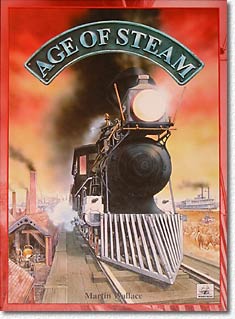
After considering and dismissing the option to play a new title, there was widespread
acclaim in this evening’s round of six (Aaron, Günther, Hans, Moritz, Peter, Walter)
to have another go at “Age of Steam”. Five of us had participated in WPGs first
playing of this title on November 5. Aaron was the only one new to the game and, sadly,
finished last. His income did not cover the costs until well into the game session, and
victory never was in his grasp. Of the other five, all did well with differing
strategies, and the outcome was not decided until the last two turns. Newbies beware!This time, we all had the impression that there was a fierce competition from the first
game turn to the last, and we put a lot of thought in choosing actions, bidding for turn
order, running trains, …With six players, the game covered the evening’s session, and we all very much needed
the short, relaxed round of “Bluff” afterwards. Truly, “Age of Steam”
is a rewarding experience, but you need to take it seriously – it is serious fun!At the beginning, all players except Hans (me) decided not to raise fresh money by
distributing shares, not wanting to be burdened with dividends. This first decision of
the game is already critical: A share is worth five money, and costs one money in
dividends, per turn. Obviously, they are a net loss in the long run. On the other hand,
if you want to build three tiles and also bid some amount for turn order, it is pretty
much inevitable to do some deficit spending at some point.Peter followed a very “cheap” strategy from the beginning to the end, with
only five shares distributed (two is the starting amount), and did surprisingly (to me)
well. At the final count, he had only four track sections to his color, but finished
runner-up. Hans did the opposite, building many tracks, transporting many goods, but
facing a lot of costs and, decisively, the final VP reduction for distributed shares. The
expansive (expensive) strategy was, however, only defeated in the last two rounds, when
the goods became scarce and Hans’ tracks sections were no longer in demand.Bidding for turn order was cautious, Peter did well by using the
“urbanization” option as a means to build free track (a minor city tile costs
money, a major city tile placed during urbanization is for free). Hans grabbed important
ground in the south center portion of the map with “first build”. Most track
was built there, in the first turns.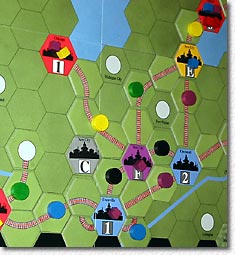 We played with six players, so there were only six game
turns, and I have the impression that the game was developing in three distinct phases:
opening, mid- and endgame.During the opening game, in the first two turns, money is very much a problem. It seems
necessary to increase your income by 2 per turn at least. To this end, you should try to
cooperate with others on a 1-1 basis (as soon as there are “2” trains). Build
opportunistic tracks and stay near the center. Watch closely where goods are about to
appear that can be easily transported. Upgrade your train soon. Use the
“Locomotive” option in order not to lose a transportation round while
upgrading. This option becomes increasingly important with an expansive strategy. Use the
“Turn Order” option if you want to run a “cheap” enterprise. Moritz,
Hans and Günther made good progress in this phase. Aaron fell behind and did not recover
until it was too late.In the mid-game, it is important to have a good train in order to break even with your
enterprise and cash in on longer transport routes. “Urbanization” and
“First Move” (of goods) become very important options. During this phase, the
goods are depleted at a very high rate, and the game becomes somewhat unpredictable. With
fewer than six players, it may be different, but we haven’t played with a smaller
round, yet. It is necessary to rely more and more on transporting goods yourself, over
your own tracks, to gain profit, as more and more competing routes are becoming
available. It is now a good decision to issue shares and build always the full amount of
tracks regardless of the terrain. Everyone did so, and even the most reluctant players
gave out shares and competed for turn order with higher bids. At this point, Hans’
expensive strategy netted the largest profit for the first time, with an impressive
income which outweighed the high costs for his “4” train and eight shares.
Moritz was handicapped by a slow “2” train, but still had the second best
profit, due to small costs and due to the income base he had built up in the starting
rounds. Günther was doing okay, participating with a track section in several often-run
routes and in a 1-1 cooperation with Aaron who had very limited feasible transportation
routes. Walter was exploring the western map and did not have the best returns on his
investment so far, however had not lost money in turn order bids, thus keeping a sound
financial basis. Peter kept a very low profile, giving out only one share above the
starting two and concentrated on train upgrade and on building a few crucial tracks, thus
creating a highly profitable transport route from the as yet unexplored east coast
“city 3” to the board center. This was the decisive move for his outstanding
endgame performance. Moritz was building for the endgame as well (in the west), but his
slow train remained a problem.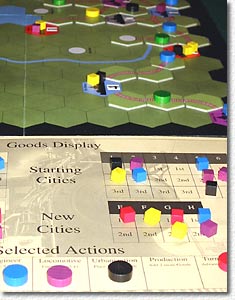 The endgame saw impressive upheavals of player
performances. Goods remained in good supply only in the east coast cities and in the far
west. This handicapped Hans very much who had not prepared for this foreseeable event and
was building tracks here, there, and everywhere (giving out shares to cover building
costs) which did not return the investment. In addition, Hans’ large income incurred
the highest reduction penalties, a balancing mechanism of the game system. Peter was now
cashing in in big chunks, running goods exclusively on his own few track sections.
Günther wanted to do the same by linking the east cost to his track sections in the
northern center, but he had to upgrade his train during a transportation round of the
last game turn, which cost him second place, and he finished fourth, together with Hans.
Walter finally linked the northwest to the center, and also had a track section which was
often used by Peter, but it was too late in order to make more than third place. Moritz
could maintain a continuous, if moderate, flow of goods, and got another win with a very
even-paced, unspectacular strategy. As it seems, it was a good decision to connect his
tracks with cities of many different colors, keeping open options for transportation
throughout the game.It was an exciting, close game, and we put no little effort in playing it well. There
remains, however, an amount of uncertainty as to whether the random availability of
additional goods (which come in each game turn by rolling dice) doesn’t give luck a
too big influence on the outcome (considering the amount of planning one has to do). I
had this impression in the first game, three weeks ago, but this time I didn’t think
so. Next time we’ll see! I look forward to it.